- K/12
- Higher Education




School Wellbeing, Safety & Inclusion
Wellbeing, safety and two days to respond
Australia’s bullying deadline is welcome, but lands on a workforce already past its limit
A parent emails the school office at 4 pm on a Thursday to say their daughter is being bullied. They want something done and they want to know who’s handling it.
Who reads that email first? Who decides what happens next? And can the school demonstrate, six months on, that someone acted inside two school days?
By Term 1 2027, every Australian school will need to answer all three questions, on the record.
That deadline arrives alongside Let’s Stop Bullying, the $10 million national awareness campaign Education Minister Jason Clare launched on 9 August 2026. Every school in the country, whatever its sector, must publish anti-bullying policies aligned with the National Framework for Addressing Bullying in Australian Schools and respond to any bullying complaint within two school days.
The framework follows the 2025 Anti-Bullying Rapid Review, co-chaired by Dr Charlotte Keating and Professor Jo Robinson, AM, which found one in four students in Years 4 to 9 are bullied regularly and that reports of cyberbullying to the eSafety Commissioner climbed more than 455% between 2019 and 2024.
“This is just the start and the hard work is ahead of us,” Clare said in a public statement about the plan. And that is already proving to be the case.
What two school days asks of a school
The deadline’s premise – that the clock starts as soon as a student makes a report – rests on the assumption that they are reporting at all. Plenty never do. The Educator has explored how schools can encourage children to report bullying and why school safety depends on visible leadership rather than paperwork, but research consistently shows students stay silent for three main reasons: they don’t know who to tell, they don’t believe anything will change, or they fear retaliation. The two-day framework addresses none of those barriers directly.
Adam Inder, head of education at Pivot Professional Learning, works with schools across Australia and says the pattern is consistent: “School leaders are constantly code-switching as part of their complex roles. If a student is struggling, leaders rely on that student telling someone, whether it be a school staff member or a parent.” Pivot’s data, much of which comes from its Wellbeing for Learning tool, says otherwise.
“When we look at bullying longitudinally, it tends to show up in the data before it shows up as a formal report,” Inder says. “Often, by the time a student’s ready to speak up, they may have already been through it more than once. Asking the right questions, in the right way, and keeping that up over time, is likely to give schools a better chance of picking things up earlier rather than later. And a safer way to raise a concern, one that doesn’t rely on a formal report, may help reduce how much a student has to go through before someone steps in.”
Inder points to an example of a school dealing with bullying on its buses. Pivot designed some additional questions into the existing survey, focused specifically on what was happening with bullying. That information allowed the school to track and curtail the behaviour effectively.
“That’s the value of continuous, granular data: it surfaces what students experience but don’t necessarily say out loud,” Inder adds.
Across schools using Wellbeing for Learning, measures of resilience, belonging and safety have improved over time. The strongest gain has been in help-seeking, with more students reporting that they ask for support when they need it. Inder traces much of that progress back to relationships. What matters most is whether a student has a trusted adult they can turn to, and whether they believe that person will respond when they do.
That’s also, not coincidentally, what the two-day framework is trying to protect. A student who trusts the system enough to self-refer during a survey is more likely to report a bullying incident before it escalates. The infrastructure and the culture are the same problem.


Where the reporting chain breaks down
Then there’s the question of what happens after a report does land. At a typical secondary school, concerns arrive through many different channels. Year advisers. The wellbeing team. A general inbox. A teacher’s direct message on the learning platform. A conversation in a corridor on the way to period four that never gets written down.
Jonathan Joffe, managing director of Tes Australia, says that fragmentation only compounds when a two-day deadline arrives. Joffe says the failure points are almost universal. For example, the reporting chain often breaks down at the handover.
“The information gets captured – that’s rarely the problem – but it doesn’t travel. A concern raised with a yard duty teacher on a Friday afternoon might not reach the wellbeing lead until Tuesday, and by then you’ve spent most of your window.”
A second failure point is the threshold decision. Staff quietly assess whether something is serious enough to formally report, and if they decide it’s not, the clock never starts at all. A third is aggregation: three small reports about the same student sitting in three different places doesn’t read as a pattern to anyone.
The gap is costly. Staff spend the response window reconstructing what happened and who knew what, instead of supporting the student in front of them. Schools are expected to keep records of steps taken against their own policy, and a fractured intake makes a defensible record very difficult to assemble after the fact.
“Fragmentation doesn't just slow a school down; it can leave the school unable to prove it did the right thing, even when it did,” Joffe says.
It also drains trust with families. “It was reported to someone else” is rarely an acceptable answer to a parent asking what happened to their child. And it costs staff in ways that don’t always show up immediately.
“The burnout risk here isn’t the volume of concerns. It’s the anxiety of not knowing whether the thing you passed on was actually picked up and is being actioned. That sits with people, and it accumulates,” Joffe explains.
“”The way to resolve this is through a single intake point,” he suggests. Every concern, from every channel and every staff member, should land in the same place with a timestamp. That change is what makes everything else in the framework achievable.
And it needs to happen now rather than in Term 4, because a new process needs a full term of ordinary use before it can be relied on under pressure. Queensland's rapid support squads represent one model of what early action can look like at a system level.

Jonathan JoffeTes Australia
The staff being asked to build it
There’s one complication in the policy discussion that’s not getting the attention it should: the workforce being asked to construct the infrastructure to support the new framework when it’s already past its limit.
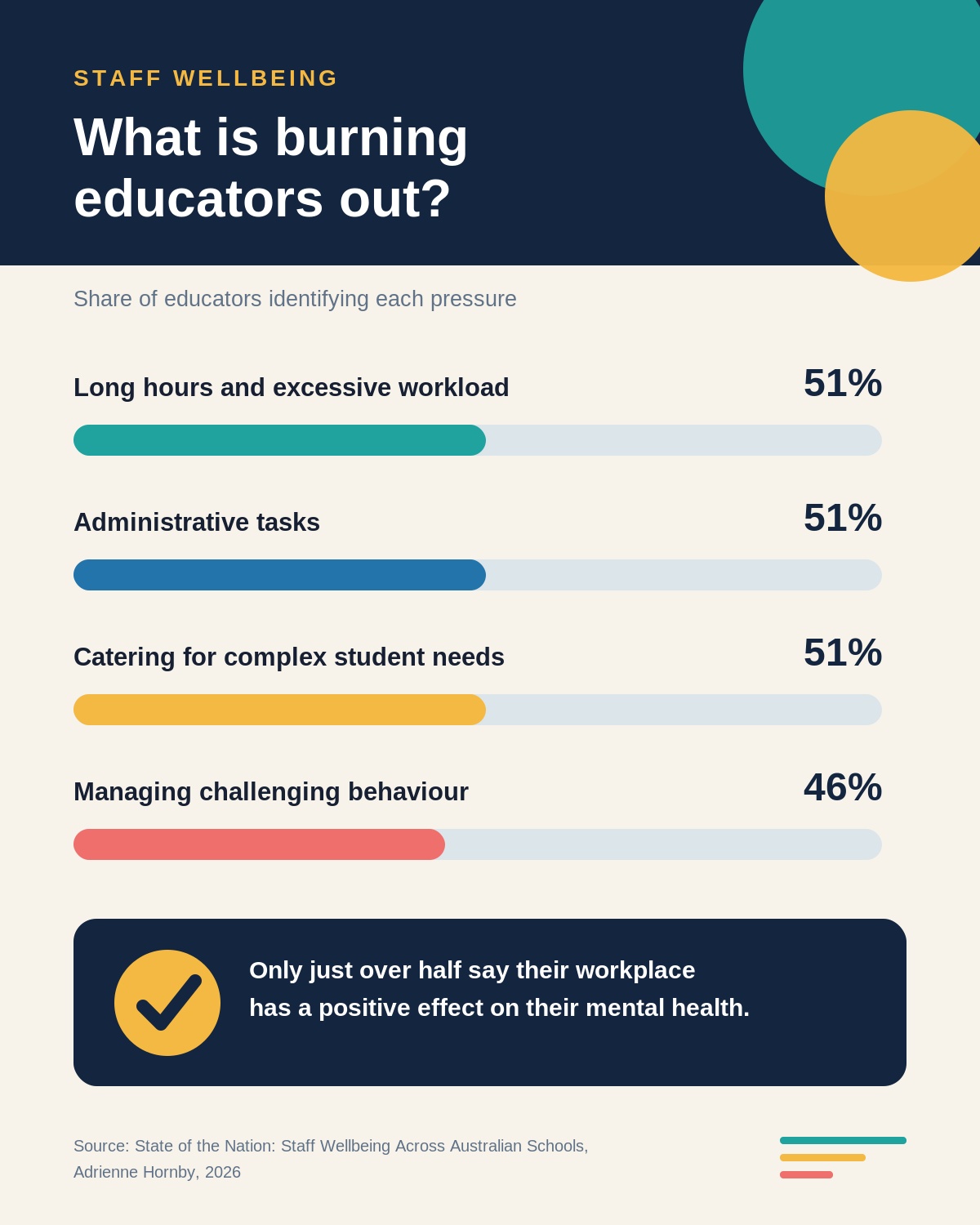
The State of the Nation: Staff Wellbeing Across Australian Schools report, by education consultant Adrienne Hornby, drew on 4,536 staff across 58 government, Catholic and independent schools surveyed between 2023 and 2026. It found almost one in two educators – 49% – are burnt out. Only just over half said their workplace has a positive effect on their mental health.
The causes point in a clear direction. Half of respondents cited workload, long hours and administrative burden. Almost as many – 51% and 46%, respectively – named catering for complex student needs and managing challenging behaviour.
Of those top drivers, the latter two are the inclusion agenda showing up in classrooms without the resourcing to match, and Inder says that’s not a coincidence. They’re areas that, too often, aren’t visible to a school until they’ve already reached crisis level. At that point, “staff are managing the fallout rather than the early signs,” Hornby notes.
“When schools measure continuously, that changes. Behaviour and complex needs get picked up earlier and with more precision, which means staff are supported to respond before pressure builds to breaking point, not just after. Continuous measurement doesn’t add to a teacher’s workload. It gives leaders the evidence to direct support where and when it’s needed.”
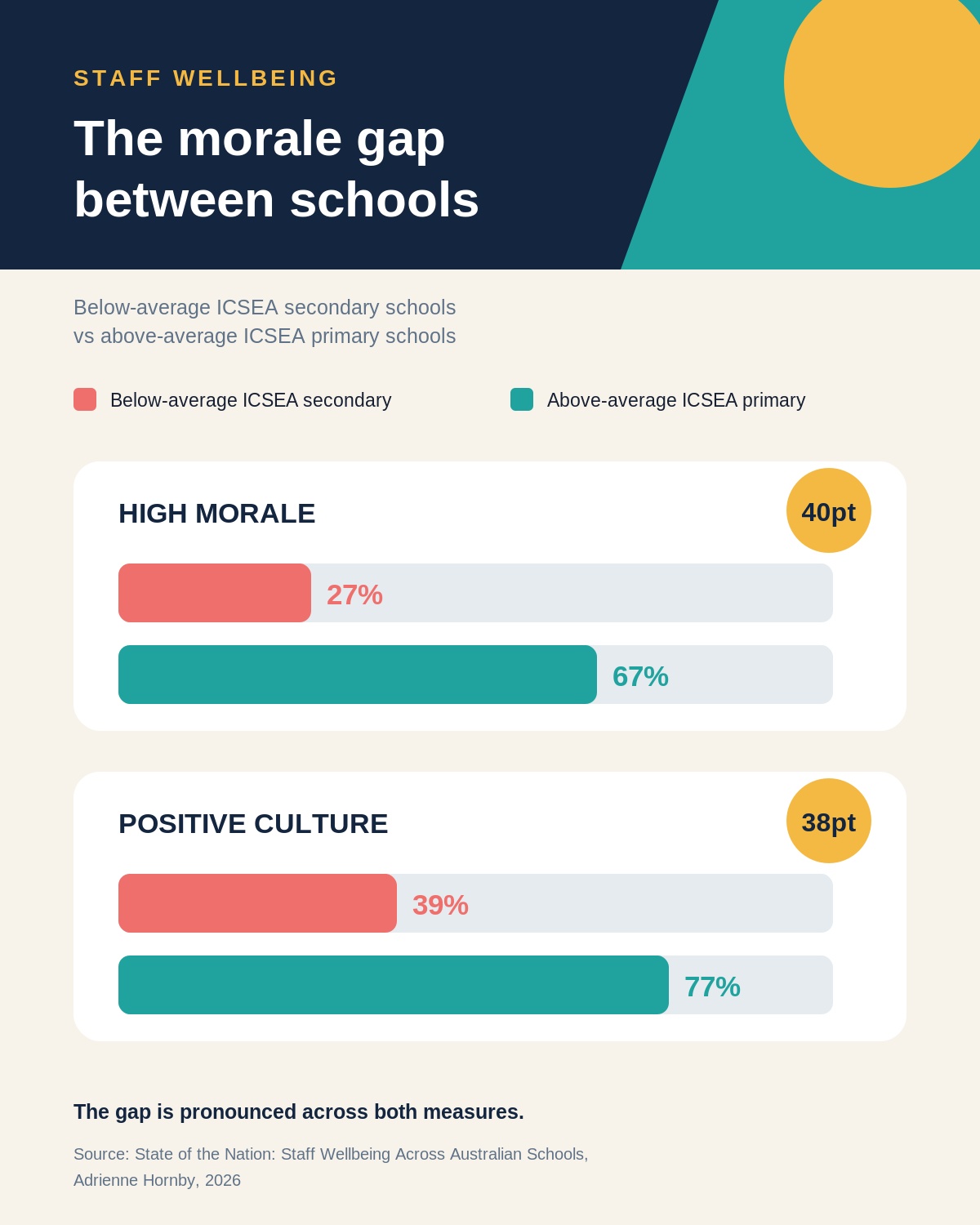
The data also shows significant differences between schools when broken apart by ICSEA band. Staff in below-average ICSEA secondary schools reported morale of just 27%, against a national average figure of 50%. Positive culture, 39% against 63%. In specialist schools, 34% of staff named occupational violence as a stressor – more than three times the national rate. Stress attributed to staff shortages hit 62%.
Above-average ICSEA primary schools, by contrast, reported 67% high morale and 77% positive culture. The disparity shows that the schools furthest from meeting the deadline are the schools with the least capacity to build anything new.
The road to Term 1 2027
The National Framework is sound. The two-day requirement is reasonable. What neither can supply is the infrastructure to meet it – the single intake point, the reporting culture, the connected data – in schools where staff are managing more than they can carry.
Come Term 1 2027, schools will fall into one of two groups. Either they will do the hard work of building that infrastructure, or they will publish a policy and hope nobody tests it. What hangs in the balance are students who need someone to act, and whose wellbeing depends on whether they do.
The difference between the two groups, Joffe says, doesn’t come down to care or commitment. It comes down to whether the system makes the right behaviour easy to capture and act on – or keeps asking already stretched people to be heroic every single day.