



Jump to winners | Jump to methodology
The best schools for teachers in Australia have earned their staff’s trust, their loyalty and their 5-star rating. What they’re doing differently is what the profession in crisis needs to hear
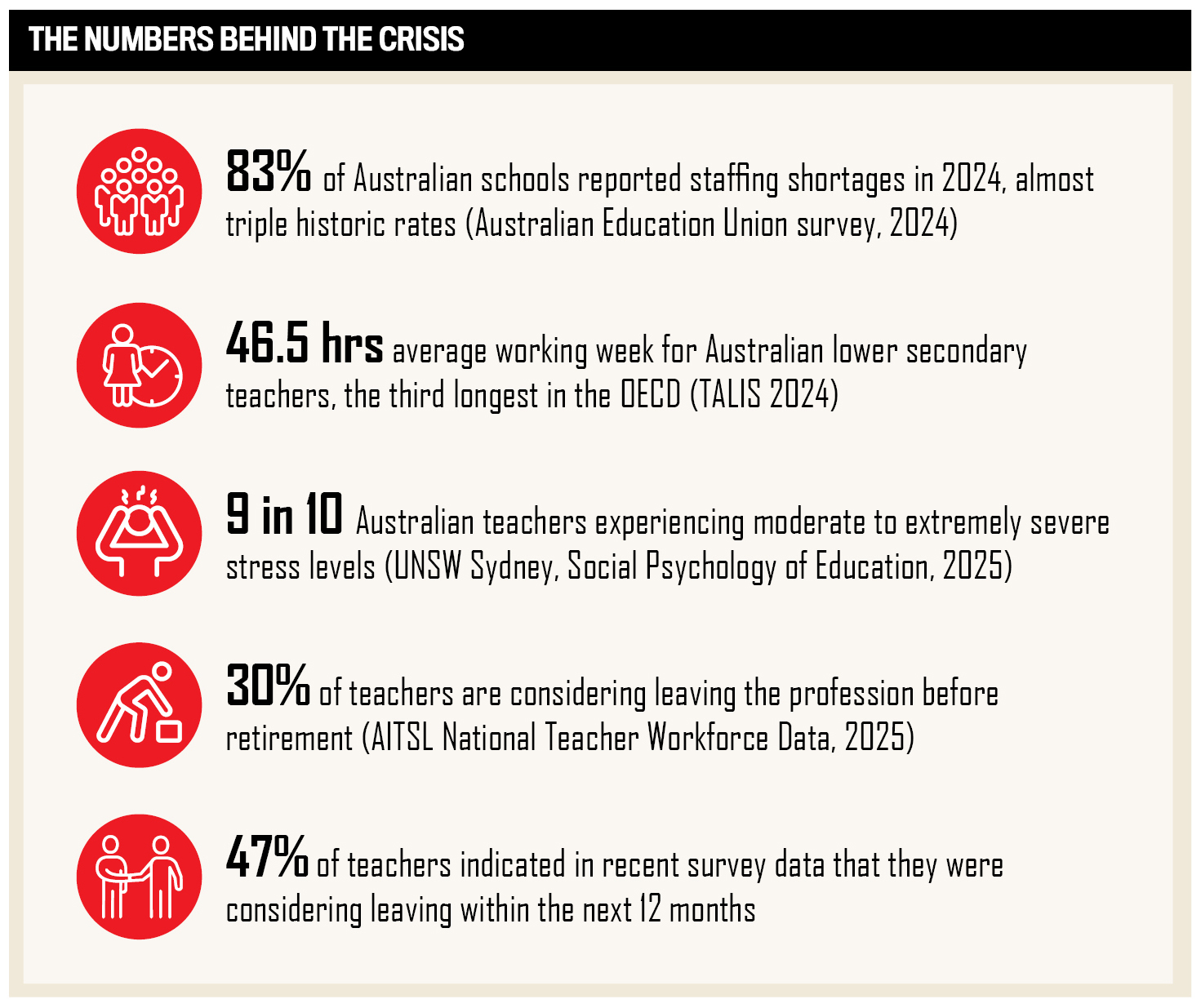
Excessive workloads, administrative burdens, inadequate recognition and a culture in too many schools that has mistaken compliance for care has resulted in headline figures that are not easy reading for anyone in education. Research from UNSW Sydney found that nine in 10 Australian teachers are experiencing moderate to extremely severe stress, with rates of depression and anxiety running at three times the national norm.
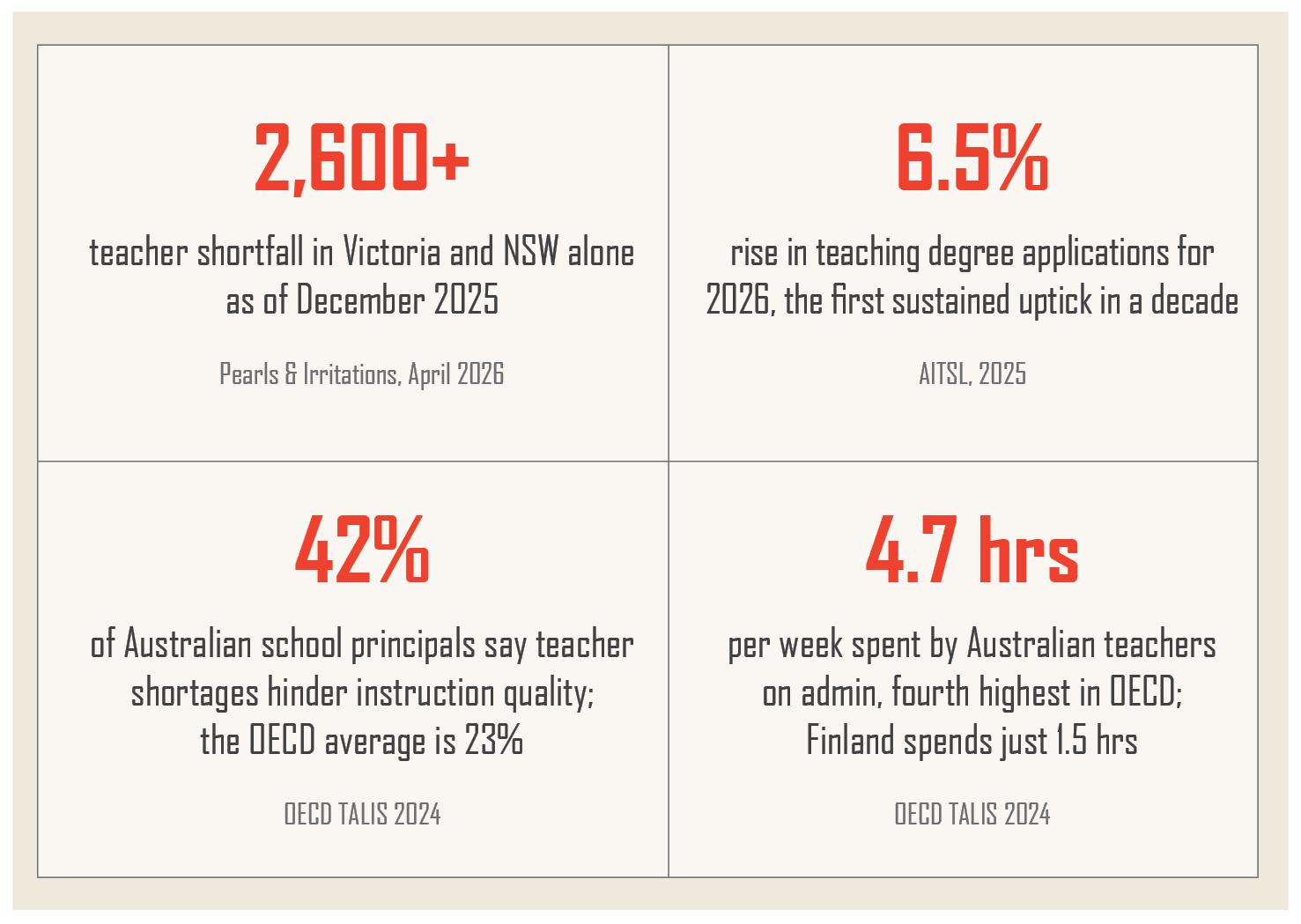
In 2024, 83% of Australian schools were experiencing teacher shortages. Australia has the second highest teacher shortage in public schools in the OECD — 58% of lower secondary teachers work in schools reporting shortages, behind only Belgium — and shortages have tripled since 2018. At the same time, research from UNSW Sydney found that nine in 10 Australian teachers are experiencing moderate to extremely severe stress, with rates of depression and anxiety running at three times the national norm.
Australian lower secondary teachers now work an average of 46.5 hours per week – the third-longest working week in the OECD, behind only Japan and New Zealand, and well above the OECD average of 40.8 hours.
And yet, a cohort of schools in Australia is doing something different. Their staff, surveyed anonymously, gave them satisfaction ratings of 75% or above across five key dimensions of workplace experience. They are the best schools for teachers in Australia in 2026 — and The Educator’s 5-Star Employers of Choice this year.
This report tells their story and examines the data behind it.
It is in this context that the 5-Star Employers of Choice list carries particular weight. These are not schools that have responded to a crisis with a press release. They are schools that have built, year by year, the conditions under which their people choose to stay.


Randstad’s 2026 Workmonitor research found work-life balance (56%) and job security (51%) now eclipse pay (47%) as the top priorities for Australian education professionals — a seismic shift from just a decade ago when base salary was the dominant lever for talent attraction and retention.
The finding aligns with what Jeannou Stijns, director of education at Randstad, has been observing across the sector. “If we look back five to 10 years, base salary and traditional, linear career progression were the ultimate levers for talent attraction and retention,” she says. “Today, educators are seeking the whole package.”
Globally, Randstad’s 2026 Workmonitor – drawing on insights from more than 27,000 workers across 35 markets – found that while pay remains an important attractor, work-life balance is now what keeps people in their roles. Almost half (46%) of respondents cited work-life balance as their key retention factor; only a quarter (23%) cited pay. The message for school leaders is unambiguous: flexibility, culture and genuine wellbeing support are no longer differentiators. They are minimum expectations.

Schools were first invited to nominate themselves by completing a detailed employer questionnaire covering areas including compensation, benefits, culture, professional development, flexible working, sustainable business programs, employees feeling appreciated, and diversity and inclusion. The decisive element was an anonymous staff survey. Employees from each nominated school were asked to evaluate their workplace across the same criteria. To prevent self-selecting groups from inflating the data, each school was required to reach a minimum response threshold proportionate to its size.
Only schools achieving a 75% or greater average satisfaction rating were awarded 5-Star status. Five schools cleared that bar in 2026.
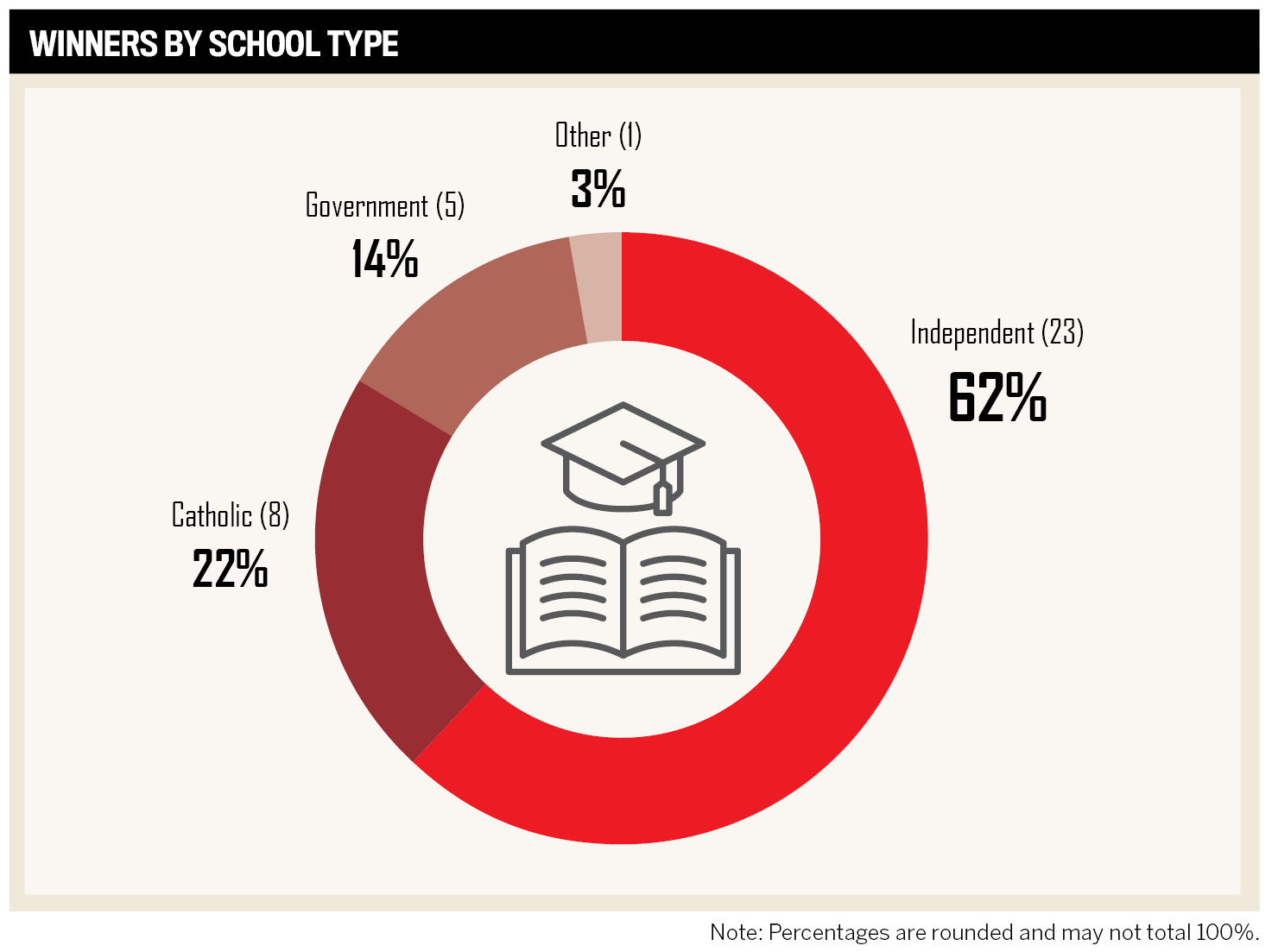
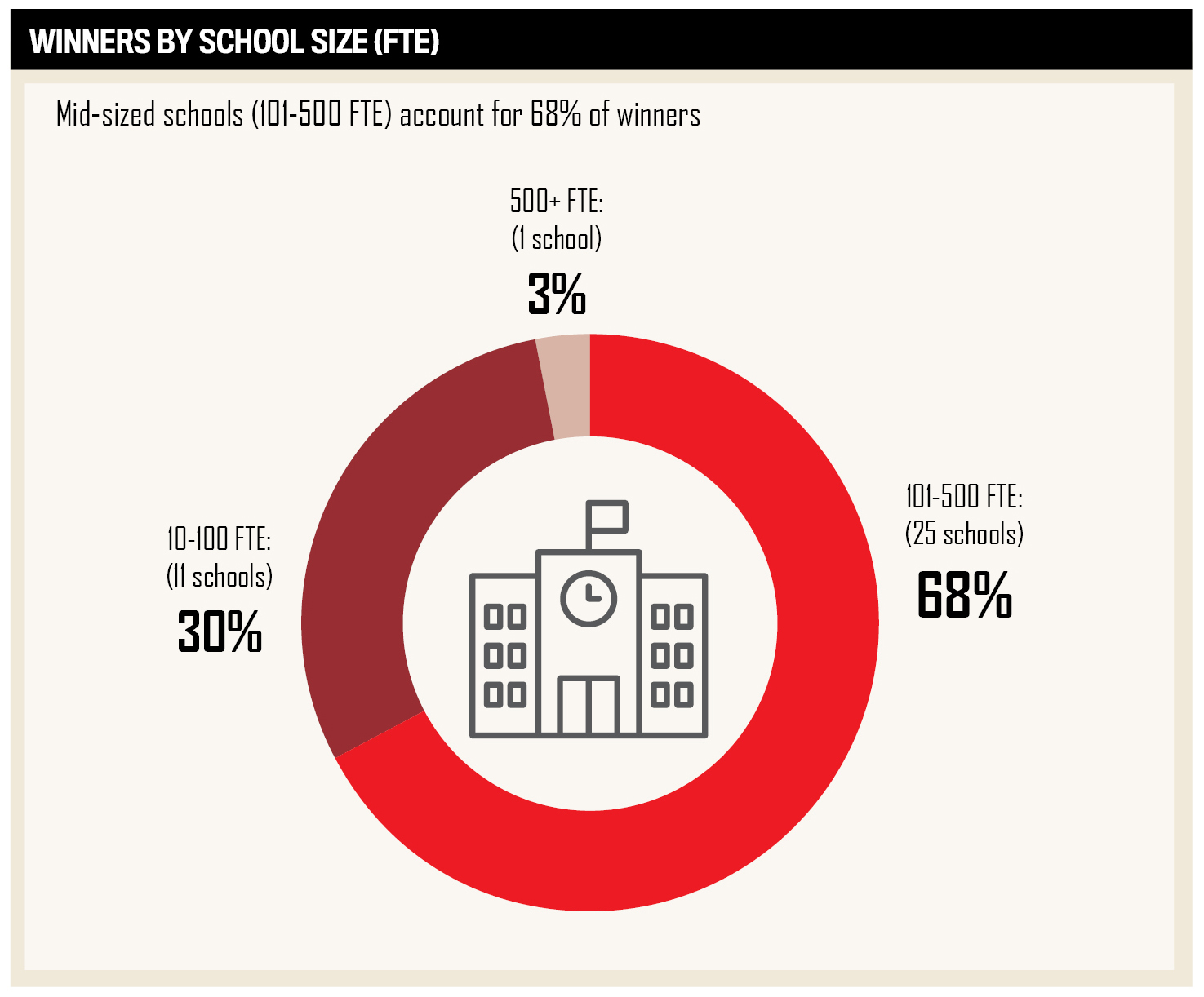
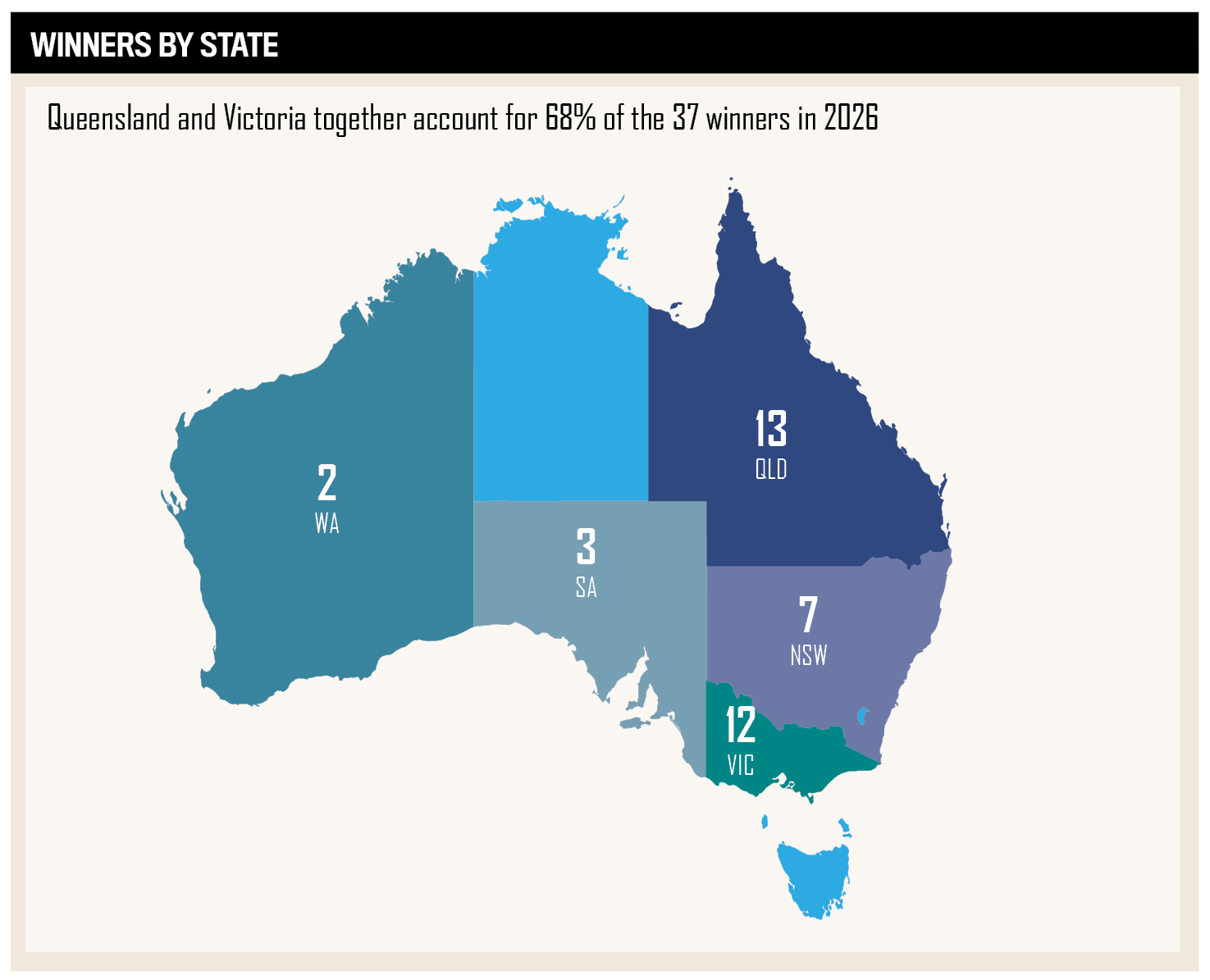
Across 37 schools in five states, the 2026 cohort reveals clear patterns in school type, size and geography.


For three consecutive years between 2021 and 2023, John Paul College appeared on this list. Earning a place again – in a year when staff expectations have risen sharply – is not a coincidence.
The co-educational school in Daisy Hill, QLD, has built its employer reputation on a foundational premise: that transparency around pay is not a luxury but a minimum standard. Salaries are benchmarked annually against Education Queensland rates using the Argent Independent Schools Benchmark Reports and maintained at a 4% premium above them. A senior teacher earns $129,799 plus superannuation. A head of year or head of faculty earns $153,805, with a 0.4 FTE time release to actually do the job well.
In 2025, co-curricular pay rates were increased by 25%. Parental leave was extended to all staff regardless of gender. Employment conditions were harmonised so every employee – not just teachers – can access enhanced long service leave, maternity leave and superannuation at 12.75%.
Perhaps the most telling initiative is also one of the smallest. Each teacher’s weekly timetable includes a ‘sacrosanct’ block: a protected spare period that cannot be used for cover duties or additional assignments. In a profession where nearly 70% of teachers describe their workload as ‘largely or completely unmanageable’ (UNSW Sydney, Social Psychology of Education, 2025), this single structural change is a meaningful institutional commitment.
A recognition program marks loyalty milestones from 10 to 35 years, announced at Foundation Day assemblies. Annual Staff Awards are peer-nominated. The Employee Assistance Program extends to family members. Staff turnover stands at 15.42%.
Culture has become the defining differentiator. Today’s educators will leave a well-paying role if the environment doesn’t match their values – whether that means poor management, unrealistic expectations or simply not feeling seen.

When Matthew Flinders Anglican College hosted a conference on the science of learning in 2025, it did not send a delegation of senior leaders. It sent every teacher. More than 500 people gathered to hear internationally recognised neuroscientists and educational psychologists. The message was implicit but unmistakable: professional development here is not a reward for high performers. It is everyone’s entitlement.
That philosophy runs through the entire employment experience at the 22-hectare Sunshine Coast campus. Staff turnover sits at just 6.4%, a figure that speaks volumes in a sector where Queensland has seen up to 50% of graduate teachers leave within five years.
The college’s bespoke teaching framework, ‘The Flinders Way’, is not a policy document. It is a guide to practice that every teacher helped shape, and that every teacher receives coaching support to implement. Secondary teachers work with a dedicated instructional coach providing structured, non-evaluative feedback. In the Primary School, weekly professional learning is embedded into the calendar, not added on top of it.
Flexibility is treated as a ‘strategic enabler’ rather than a concession. In 2025, nearly 10% of staff operated under formal flexible work arrangements. Non-teaching full-time staff can work a nine-day fortnight. Teaching staff receive a scheduled fortnightly work-from-home period built into their hours of duty.
The wellness offering goes well beyond the standard EAP. A ‘Flinders CARE Club’ organises care packages for staff going through illness or bereavement. A ‘Flinders Foodbank’ coordinates home-cooked meals for staff facing hardship. Annual skin cancer checks, flu vaccinations and gender-specific health screening days are available to all. These are community initiatives, not corporate programs.
A Staff Fellowship scheme provides $5,000 toward postgraduate study. Ergonomic refurbishments across multiple department staff rooms were completed in 2025. Every staff member has a large desktop monitor.
Professional development has become a retention tool, not just a training function. Randstad’s data shows 29% of educators have left a role because it didn’t offer adequate development opportunities – a figure that has been rising sharply year on year.

St Aidan’s Anglican Girls’ School has been educating young women in Brisbane’s western suburbs since 1929. In that time, it has developed a particular understanding of what institutional care looks like. The school’s wellbeing framework for staff – organised around Lead, Amplify, Include and Connect — reflects a view that support must be visible, authentic, inclusive and relational.
The framework is not decorative. During reporting and examination periods, when workload peaks are most acute, the school provides practical relief: lunches are organised, morning teas are laid on, invigilators are deployed so teachers are not stretched across competing demands simultaneously. This is the kind of targeted support that the UNSW research identified as critical – administrative and compliance burdens are a primary driver of burnout, and the schools that interrupt those burdens structurally, rather than offering yoga sessions in response, are the ones whose staff stay.
The school’s articulation of its wellbeing philosophy is telling: wellbeing, it maintains, is not simply happiness. It is about having meaning in working life – developing as a person and feeling that the work is worthwhile. This is a more demanding definition, and it implies a more demanding set of obligations on the institution.
Staff salaries are benchmarked not only against the independent and state education sectors, but against comparable roles across other industries entirely, an acknowledgement that schools compete for talent beyond their own sector. The Leadership Shadowing Program gives staff genuine exposure to senior decision-making. Financial support and study leave are available for master’s and PhD candidates. Many of the school’s teachers already hold doctorates.

There are schools that speak about culture, and there are schools that have built one. Salesian College Chadstone, a Catholic boys’ school in Melbourne, falls clearly into the second category. Its employer practices cannot be fully understood without reference to the Salesian charism – the philosophy of St John Bosco, organised around the principles of reason, religion and loving kindness.
Loving kindness, in this context, is not a soft concept. It manifests in the way the College approaches professional development: as accompaniment, not evaluation. The Professional Growth Program runs every term, driven by an instructional coaching model that is explicitly developmental rather than judgmental. Victoria faces a projected deficit of over 2,000 teachers by 2030, making the College’s 9% staff turnover rate all the more significant.
The faith formation programs are unusual in the sector. Staff is supported to undertake immersive programs retracing the sites significant to Don Bosco’s life and mission, travelling through Italy and across the Pacific region. These reinforce a shared sense of purpose that many schools struggle to cultivate through conventional means.
More than 60% of staff hold formal religious education accreditation. Forty staff have completed Youth Mental Health First Aid training. The 2025 People at Work Survey was followed by a formal Psychosocial Risk Assessment – a response to new obligations under the amended Occupational Health and Safety Act (2024) – producing a concrete Wellbeing Action Plan running through 2027.
The College became a member of the Council of International Schools in 2025. Its governance framework includes a Board-approved Diversity and Inclusion Policy, and staff forums and surveys are built into the strategic planning cycle as mechanisms of genuine consultation, not performance.
The most effective DEI initiatives move beyond compliance to cultivate transparency, mutual respect and authentic belonging. Randstad’s data shows 81% of education workers say they can be their authentic selves at work, but only in organisations where values and culture are actively lived.

Y Schools Queensland was founded in 2010, making it the newest school on this year’s list by some margin. Its relative youth has not prevented it from developing one of the more innovative employment models in the sector, partly because it has not had decades of entrenched practice to unpick.
The organisation operates on a premise that researchers have been making for years: that structural working conditions shape teacher wellbeing more directly than any supplementary wellness program. Small class sizes. Non-contact time capped at 16 one-hour sessions per week. No parent-teacher interviews outside school hours. Non-term-time leave available to all staff, not just teachers. Long service leave accessible after seven years rather than the standard 10.
The Employee Assistance Program goes well beyond the sector standard: not three sessions per incident but unlimited professional supervision for all staff – a commitment that reflects the emotional demands of working in a school environment that serves vulnerable young people. Salary packaging allows staff to increase take-home pay by packaging up to $15,900 in living expenses.
Incentive programs are unusual in the not-for-profit education sector: a $2,000 sign-on payment for hard-to-fill roles, rising to $3,000 at six months, plus referral bonuses for existing staff. Monthly recognition programs, annual excellence awards, and campus-specific recognition initiatives layer a culture of acknowledgement onto the structural foundations.
The full-time attrition rate of 23.9% reflects the broader structural pressures the organisation works within – it serves students with complex needs in a demanding environment. But Y Schools’ inclusion on this list speaks to the experience of the people who are there: they feel supported, seen and valued in ways that the sector, at its worst, has rarely managed.
The data from this year’s survey sits within a larger picture that the sector cannot ignore. Applications to study teaching rose 6.5% for 2026 – the third consecutive year of growth, following a 9% jump in 2025 and 10% in 2024, reversing years of decline. Domestic undergraduate offers rose a further 6.3%. These are encouraging signs but they do not solve the retention problem.
Speaking to Stijns about what distinguishes the schools that earn genuine employee loyalty from those that merely perform it, she returns to what Randstad calls the ‘great workforce adaptation’. She says, “Employers who fail to adapt will struggle to retain their best educators. The balance of power has shifted.”
The five best schools for teachers in Australia named here have adapted in different ways. John Paul College has focused on structural financial commitments. Matthew Flinders has built its offer around professional identity and learning. Salesian Chadstone has grounded everything in mission. Y Schools Queensland has redesigned the working conditions themselves. St Aidan’s has built a culture of visibility and care during the moments that matter most.
What unites them is a recognition that Stijns articulates clearly: “Talent are increasingly willing to make trade-offs. They will compromise on top-tier salaries if it means they can protect their mental health, have stability and work within a supportive environment.”
The schools that understand this – and act on it, year after year, in the daily texture of working life rather than in policy documents – are the ones whose staff, when asked anonymously, say: it is good here.
Earning 5-Star Employer of Choice status is not the result of a single initiative, a generous salary scale or a well-written wellbeing policy. The schools on The Educator’s 2026 list have each arrived here through a sustained, structural commitment to the people who work for them – one that shows up not in documents but in daily practice.
Based on the data and the stories behind it, five qualities distinguish the best schools for teachers in Australia from the rest.
1. They protect time.
In a profession where nearly 70% of teachers describe their workload as unmanageable (UNSW Sydney, 2025), the schools that earn staff loyalty are those that actively defend non-contact time, limit administrative burden, and treat the working week as something to be designed, not simply endured. Protected planning periods, capped contact hours and no after-hours obligations are not perks. They are signals of institutional respect.
2. They invest in professional growth.
Nearly a third of Australian educators have left a role because it offered insufficient learning support. The schools on this list treat professional development not as a budget line but as a strategic commitment through embedded coaching, postgraduate study support, leadership pathways and development frameworks that belong to staff rather than being imposed on them.
3.They build genuine cultures of care.
With 53% of Australian educators having quit a role specifically because of poor workplace culture, culture is not a soft differentiator – it is the central one. The best schools make care visible and consistent: in how peak workload periods are managed, in how recognition is given, in how staff are supported through difficulty. These are not programs. They are habits.
4. They pay fairly and transparently.
Compensation may have dropped to third place in priority rankings, but it remains a baseline condition of trust. The schools that consistently earn high satisfaction ratings benchmark salaries against multiple sectors, explain their pay structures openly and review them regularly. Fairness and transparency matter as much as the number itself.
5. They make inclusion real, not aspirational.
With 87% of education staff wanting their workplace to feel like a community, diversity and inclusion cannot live only in policy documents. The best employers build consultation into their planning cycles, act on what they hear and create conditions where all staff – regardless of background, career stage or identity – feel genuinely welcome and authentically themselves.
Which are the best schools for teachers in Australia, and how is the list determined?
The best schools for teachers in Australia are identified each year through The Educator’s 5-Star Employers of Choice program, an annual benchmarking process that ranks schools based primarily on anonymous employee feedback, not institutional self-reporting. Schools are evaluated across five dimensions – benefits, compensation, culture, employee development, and commitment to diversity and inclusion – and only those achieving a 75% or greater average satisfaction rating are awarded 5-Star status. The result is a list that reflects the genuine, day-to-day experience of the people who work in these schools.
How were the schools selected?
The process moved in two stages. First, schools were invited to participate by completing a detailed employer nomination form, which asked them to explain their offerings and practices across the five evaluation dimensions. Second, employees from nominated schools were invited to complete an anonymous survey assessing their workplace. To ensure statistical validity, each school was required to meet a minimum number of employee responses calibrated to its size, preventing a handful of enthusiastic respondents from inflating the results. Schools that cleared both the response threshold and the 75% satisfaction benchmark were named 5-Star Employers of Choice for 2026. The program is proudly supported by the Australian Boarding Schools Association.
What do the results tell us about the state of the teaching profession in Australia?
The report reveals a profession at a critical juncture. On the one hand, the sector faces significant structural challenges: 83% of schools reported staffing shortages in 2024, Australian teachers work the third-longest hours in the OECD (46.5 hours per week on average, per TALIS 2024), and UNSW research found that nine in 10 teachers are experiencing moderate to extremely severe stress. On the other hand, the schools featured in this report demonstrate that these conditions are not inevitable. Where leadership invests genuinely in staff – through protected time, career development, flexible arrangements and authentic cultures of care – people choose to stay. The report is ultimately a proof of concept: that being a great employer in education is possible, and that the consequences of achieving it are measurable.
Is salary still the most important factor for teachers choosing where to work?
No, and the shift is significant. Randstad’s 2026 Workmonitor research found that among Australian education professionals, compensation now ranks third in importance, behind work-life balance (cited as ‘very important’ by 56% of respondents) and job security (51%). Only 47% rated pay as very important. This does not mean salary is irrelevant – it remains a baseline expectation and a signal of institutional respect. But it does mean that schools competing purely on remuneration, without addressing culture, workload and development, will continue to struggle with retention. As Randstad’s Jeannou Stijns puts it: “Talent are increasingly willing to make trade-offs. They will compromise on top-tier salaries if it means they can protect their mental health and work within a supportive environment.”
What do the best schools for teachers in Australia have in common?
Despite their different locations, sectors, founding philosophies and student demographics, the five schools share a common orientation: they treat the employment experience of their staff as a strategic priority rather than an afterthought. Each has made specific, structural commitments – whether that is John Paul College’s benchmarked pay premium and protected timetable blocks, Matthew Flinders’ embedded coaching model and community wellbeing clubs, St Aidan’s practical support during high-workload periods, Salesian Chadstone’s psychosocial risk planning and faith formation programs, or Y Schools Queensland’s redesigned working conditions and unlimited employee assistance. These are not wellness perks layered onto a demanding environment. They are changes to the environment itself.
How does teacher wellbeing affect student outcomes?
The research is unambiguous. The UNSW Sydney study of nearly 5,000 teachers found that poor teacher mental health is directly linked to lower student achievement, reduced classroom quality and diminished student wellbeing. The OECD’s TALIS survey states explicitly that “teachers are more likely to exhibit effective practices, experience high wellbeing and job satisfaction and remain in the profession when they have sufficient support to face the challenges at hand.” In other words, investing in staff experience is not a soft, HR-driven aspiration. It is one of the most direct levers a school has for improving outcomes for students. A teacher who is burnt out, overloaded and undervalued cannot give their best. A teacher who feels genuinely supported can.
Can any school participate in the program?
Yes. The program is open to Australian schools of all types and sizes – government, Catholic and independent; primary, secondary and combined. Schools are invited to participate at the start of the annual cycle by completing the employer nomination form. The key requirement is not size or sector, but genuine willingness to be assessed by the people who work there. The anonymous nature of the employee survey is fundamental to the integrity of the process: schools cannot coach or curate the responses their staff submit. The rating reflects the actual experience of the workforce, not the institution’s preferred self-image.
How can my school become one of the best schools for teachers in Australia?
The best schools for teachers in Australia share three characteristics that any school can work towards. First, the conditions that drive teacher retention are largely within a school’s control: workload management, genuine flexibility, professional development investment and a culture of recognition are all leadership decisions, not resource constraints. Second, the cost of inaction is high – high turnover, recruitment difficulty and the damage to student outcomes that follows from an unstable, overstretched workforce. Third, the schools featured here show that improvement does not require a single large gesture. It requires consistent, structural commitment over time – the kind that shows up in a timetable, a salary benchmark, a coaching conversation or a lunch provided during exam week. Small signals, made reliably, accumulate into the kind of culture that keeps people in a school for a decade or more. That is what 5-Star looks like in practice.

















To find the educational establishments that have offered the best employee experience in the past year, The Educator first invited schools to participate by filling out an employer form, which asked schools to explain their various offerings and practices.
Next, employees from nominated schools were asked to fill out an anonymous survey evaluating their workplace on a number of metrics, including benefits, compensation, culture, employee development, and commitment to diversity and inclusion.
To be considered, each school had to reach a minimum number of employee responses based on its overall size. Schools that achieved a 75% or greater average satisfaction rating from employees were named 5-Star Employers of Choice for 2026.