



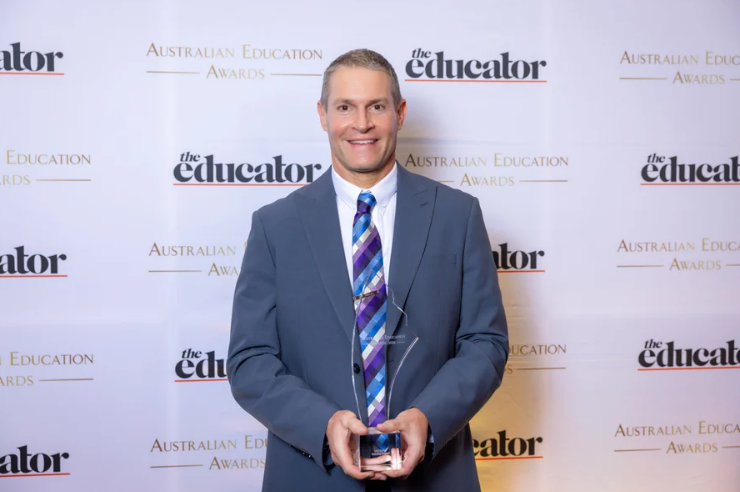
When Bellbird Park State Secondary College's name was read out for Best Student Wellbeing Program at the Australian Education Awards 2026, it capped a journey that started with a simple question.
What does it take for a teenager to feel safe enough to learn?
For one of Queensland's newest secondary colleges, now home to more than 1,800 students, that question has shaped everything from mentoring rosters to classroom routines. The College’s Executive Principal, Michael West, says the answer lies less in what is delivered to students than in what is built with them, and the results speak for themselves.
“At its heart, a great student wellbeing program creates the conditions in which every young person feels safe, known, connected and ready to learn.”
According to West, it rests on five important pillars.
“First, strong relationships and belonging: every student needs trusted adults and positive peer connections,” he said. “Second, authentic student voice: programs should be designed with students, not simply delivered to them.”
Third, says West, is prevention and early intervention, supported by timely data so concerns are identified before they become crises.
“Fourth, a coherent multi-tiered model that aligns universal supports, targeted interventions and intensive case management rather than relying on disconnected initiatives,” he said. “Finally, wellbeing must be embedded in curriculum, classroom practice, behaviour, attendance and inclusion - not treated as an occasional event.”
West said that at Bellbird Park SSC, these pillars are strengthened by family and community partnerships, culturally responsive practice and clear accountability.
“The ultimate measure is whether students experience greater belonging and resilience, remain engaged in learning, and achieve outcomes that may once have seemed beyond their reach.”
Doing wellbeing differently
A 2026 study by Edith Cowan University found nearly half of students surveyed rated their school's wellbeing program as “ineffective”, with kids often sceptical of teacher-delivered content.
The researchers found that students disengage when material repeats what they already know. Beyond that, effective programs feature relatable presenters, smart timing away from exam stress, genuine teacher buy-in, visible follow-through on feedback, and authentic student voice in design.
West said the study is a reminder that students quickly distinguish between authentic support and content simply being delivered to them.
“At Bellbird Park SSC, we begin with student experience, not a pre-packaged activity,” he said. “Students shape priorities through surveys, voice forums, leadership groups and feedback, and they see their input lead to action.”
Bellbird Park State Secondary College frames its curriculum around the motto “Many Pathways. No Limits,” offering specialised academic pathways and vocational options rather than a single standardised “weekly Pathways curriculum.”
“Our weekly Pathways curriculum is sequenced across Years 7–12 and adapted for age, context and emerging need,” West explained. “It is reinforced through classroom relationships, mentoring, regulation strategies and personalised learning adjustments, rather than existing only in a wellbeing lesson.”
Nor does the College expect teachers to carry this work alone.
“Our multidisciplinary Visible Support Team brings together leaders, guidance officers, youth workers, cultural staff and external partners to identify risk early and coordinate support,” he said. “The difference is authenticity and follow-through: relevant content, credible people, the right support at the right time, and visible evidence that the school listens and responds.”
The story behind the numbers
West said the most meaningful outcome in the College’s most recent complete data is that more students stayed connected to learning. Last year, the College saw a jump in its student attendance rate while average and daily behavioural incidents fell.
“Our student surveys also showed stronger peer relationships, belonging, motivation and confidence in achieving future goals,” he said. “Behind those numbers are young people whose trajectories have changed.”
West said one student began the year attending less than 60% of the time and was significantly disengaged.
“Through high-frequency Check & Connect mentoring, family communication, predictable morning routines and reduced support as progress stabilised, the student moved to above 80% attendance.”
Academic results have also improved across the College.
“More important than academic grades, we have seen the growth in confidence, connection and personal responsibility of our students.”
The wellbeing win was not the only recognition to come Bellbird Park State Secondary College's way that night. The college also took out Best Co-Curricular Program and the OneSchool Global Innovation in Curriculum Design award, while one of its own claimed Secondary School Teacher of the Year (Government), a haul West puts down to a culture of excellence that extends well beyond wellbeing alone
The one change every principal should make
West said that if he could ask every principal to change one thing about how they approach student wellbeing, it would be to stop treating wellbeing as a separate program and treat it as a whole-school condition for learning.
“A guest speaker, themed week or isolated lesson can be valuable, but it cannot compensate for a student who does not feel known, safe or connected each day,” he said.
“Wellbeing should be visible in how leaders allocate resources, teachers build relationships, schools respond to behaviour, teams use attendance and engagement data, and families are engaged. It must also be shaped by students.”
West said the Principal’s role is to build a coherent system in which every adult understands that wellbeing and academic achievement reinforce each other.
“When students are emotionally safe, culturally respected, supported early and surrounded by adults who combine high expectations with high support, they are better able to attend, participate, persist and succeed,” he said.
“The question should not be, ‘What wellbeing program do we run?’ but, ‘How does every part of our school enable students to thrive?’”.