



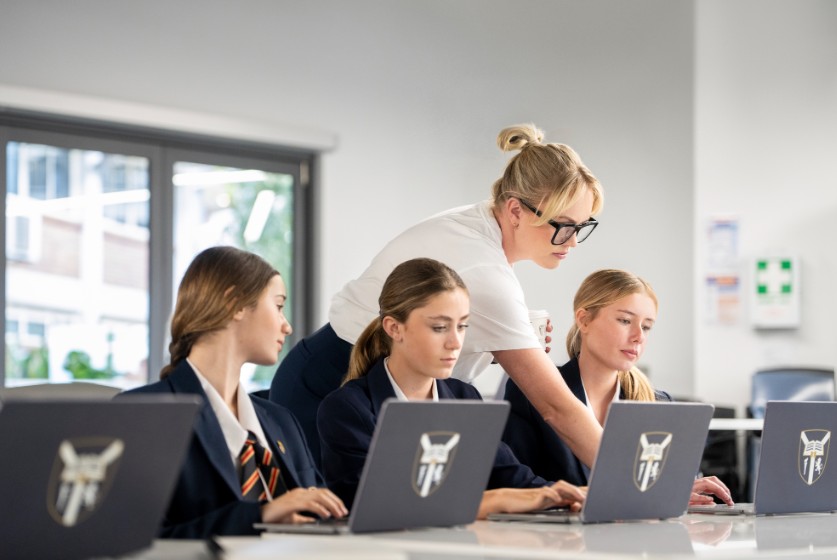
Onboarding new technology in the classroom can often be daunting to educators, but Lindisfarne Anglican Grammar School has never shied away from an opportunity to innovate.
Indeed, the school’s proactive approach to tech integration has garnered significant recognition, most recently seen with the school winning 'Best Use of Technology' at the 2023 Australian Education Awards and an Excellence Award in the same category in 2025.
Kane Bradford, Head of Professional Practice, Innovation and Partnerships and the lead for AI-related initiatives at Lindisfarne, said these accolades reflect the school’s consistent efforts to stay ahead of the curve.
Not content to rest on its laurels, the school is now redefining modern learning with Mac-powered classrooms.
After noticing inconsistencies with BYOD, the school’s staff turned to students for input with the majority saying they preferred the Mac operating system. From productivity and creativity to AI, the shift is now being described as a “game-changer” for the school.
Purposeful tech at every stage
“At Lindisfarne, our approach to technology is grounded in our ConnectEd philosophy and shaped by a deliberate ‘Digital Transitions’ strategy, meeting students where they are developmentally and ensuring technology enhances learning in purposeful, age-appropriate ways,” Principal Stuart Marquardt told The Educator.
“Over the past year, we have intentionally refined how students engage with devices across different stages of schooling. Our Year 7 students leave their MacBooks at school to support balance, organisation and healthy digital habits as they transition into secondary learning.”
The school’s Year 8 students continue this staged approach by leaving devices on campus during holiday periods, reinforcing mindful and structured technology use.
“Our Kindergarten to Year 6 students all have an iPad in their classroom for use where appropriate, while at the senior level, students are supported through a sophisticated multi-device learning environment,” Marquardt explained.
“Year 12 students have embraced using iPads alongside their M4 MacBooks, particularly in subjects requiring digital notation, collaboration and flexible workflows.”
Marquardt said this approach reflects the evolving nature of learning and prepares students for the realities of modern tertiary study and professional environments.
“Lindisfarne intentionally explores how technology supports wellbeing, engagement, creativity and deeper learning outcomes for every student.”
Rethinking the BYOD model
Dr Kane Bradford: Head-Professional Practice, Innovation & Partnerships, said that with a BYOD approach, the learning experience can be disparate.
“When moving to a 1:1 solution, learning time is not lost, particularly with products available across the Apple suite,” Bradford told The Educator. “We found that the initial decision was simple: move to 1:1 over BYOD to reduce the inconsistency and issues associated with a disparate tech experience for students and staff at school.”
Bradford said that when the school investigated the best possible learning solution, the iPad or the MacBook was “superior on every measure.”
“Importantly, we cycle devices every two years and undertake due diligence each time we roll over. Apple has been chosen repeatedly over about a 10-year period.”
Adapting to the next wave of learning
Recognising that change management in schools can be bumpy at the best of times, Principal Stuart Marquardt took the view that simplicity and usability mattered most.
“It's cliché, but ultimately, the intuitive nature of the Apple range made the case for us,” Marquardt said. “Instant improvements were evident in the classroom due to the consistent experience in a 1:1 environment.”
Moreover, said Marquardt, Apple tech accepts and is actually designed to work with and integrate other systems.
“We found that with competitor products, it is increasingly difficult to gain access to the wide range of learning and productivity tools available,” he said. “With Apple, you can access all of them.”
Marquardt said this is particularly important as schools move toward multi-device contexts.
“We know we will soon be in a world where learning involves 2:1, 3:1 or even 4:1 device-to-student ratios,” he said. “In fact, in 2026 our Year 12 students have been preparing for HSC Exams in a 2:1 device environment across their iPads for notetaking and record keeping, and MacBook for everything else.”
A school-wide approach to modern learning
Dr Kane Bradford: Head-Professional Practice, Innovation & Partnerships, said giving students consistent access to reliable technology has strengthened learning across the school.
“The MacBook is industry-leading technology. Putting these devices in students' hands empowers them to create in ways they just haven't before,” he said. “With the MacBook, and a program ensuring continuous access to the latest technology on a two-year rotation, our students consistently have the best tools for learning.”
Bradford said consistent experiences across the K-12 setting “enhance learning and simplify operations.”
“We know what the students have in front of them; it's reliable, secure, and consistently the best-in-market technology for learning.”