



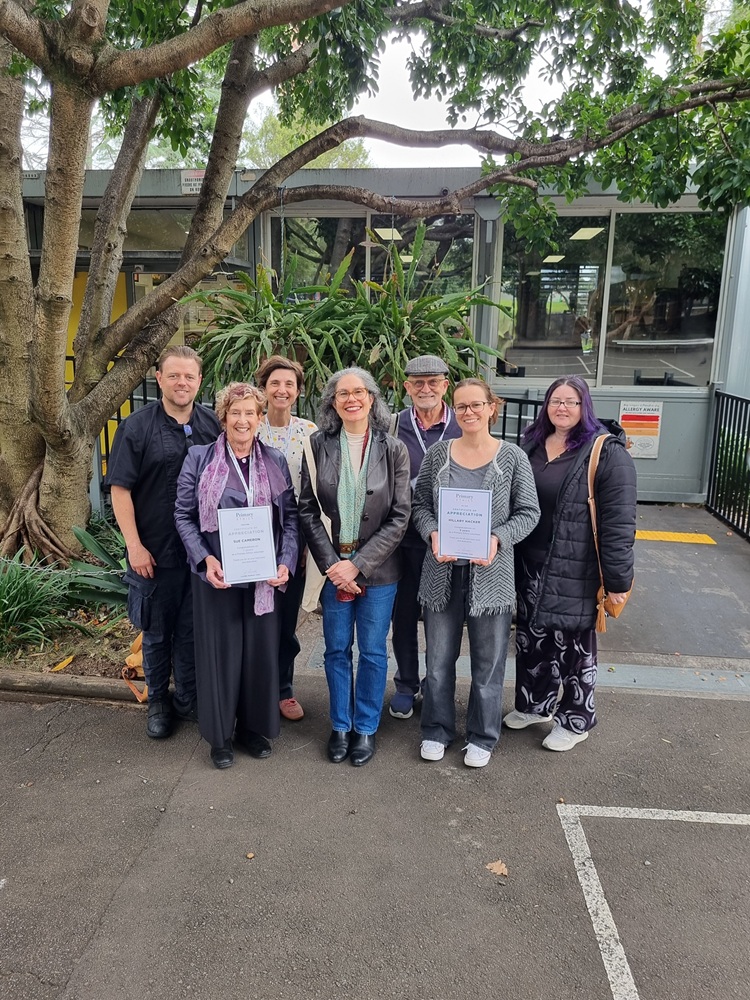
Petersham Public School's volunteer ethics team (From L-R): Nathan Grange, Sue Cameron, Olivia Rosenman, Laura Ramos, Barry Richardson, Hilary Hacker, and Ellie Rule
Imagine a circle of eight-year-old children wrestling with a question most adults would prefer to dodge.
Is it ever okay to break a promise?
There's no answer sheet. No lecture. Just young people listening, disagreeing and building on each other's reasoning.
That’s the groundbreaking model behind Primary Ethics – the volunteer-run program now teaching more than 500 NSW primary schools every week.
New research from the Australian Catholic University, the largest study of its kind, found that programs that promote discussions of ethical challenges can help students recognise ethical issues and think more carefully about what to do.
"The Primary Ethics curriculum was designed to help students consider everyday ethical dilemmas using carefully developed lesson plans and pedagogy that equips volunteer teachers with practical skills to facilitate constructive discussion in the classroom," Laura Ramos, Chief Operating Officer at Primary Ethics, told The Educator.
"The clearest sign that ethics lessons are making a difference comes straight from Primary Ethics volunteer ethics teachers – in what they share about how students are responding in the classroom and how this shows up in the playground."
'Students are feeing off each other's ideas'
Petersham Public School, located in Sydney's inner-west, is seeing the benefits of ethics education from Kindergarten right through to Year 6.
“We have wonderful volunteers who make Primary Ethics possible at Petersham Public School," the school's Principal, Lisa Sands, told The Educator.
“As Principal, I work thoughtfully to manage organisation and supervision arrangements to ensure that all students can access the SRE/SEE offering of their choosing.”
Kindy teacher Nathan Grange, part of the volunteer ethics team at Petersham Public School, said he has noticed how his students are learning by speaking freely and asking questions within the structure of the ethics lesson.
“Students care about what is happening in the stories, they are listening and feeding off each other's ideas," Grange told The Educator.
Amy Butler, the school's Year 3-4 Ethics Teacher, is an educator who has also seen the benefits of these lessons first hand.
“In the final reflective class last year one of the students said, ‘ethics class has made me more confident to share my ideas outside of ethics class.’”
Year 5-6 Ethics Teacher, Sue Cameron, the classes are having cut-through, even if some students are using what they've learned in a joking way.
“I have heard some kids just after the Ethics Class saying, ‘I respectfully disagree with you, because…’ They were making a joke of the phrase, but they have definitely taken it on board!”
Built on parent choice, not public funding
Ramos said Primary Ethics has been successful because it collaborates with the education system to support parents’ choices.
"We operate within the NSW Department of Education’s policy on Special Religious Education and Special Education in Ethics; that’s the mechanism that enables our presence in public schools today," she said.
"We recognise that school leaders juggle multiple priorities to strengthen student learning and wellbeing. So, we maintain our focus on bringing high-quality ethics education for students whose families have chosen the SEE option."
Ramos said keeping that focus has never come with a government cheque attached.
"We’ve been running without any government funding throughout our entire 16-year history – relying on donations to cover the costs of volunteer teacher training and support, as well as ongoing curriculum development."
A critical skill in a polarised world
Roger Reidy, Chair of the Primary Ethics Board, said the findings deserve a hearing at the top of the system.
"We encourage decision-makers in the education sector to reflect on the recent ACU research and the growing social need to equip young people with practical skills to make sense of and participate in our rapidly changing world," he said.
"This need is becoming increasingly urgent as digital platforms seem to reward polarising views and erode connection."
Reidy said none of that progress has come at the expense of the program's original purpose.
"We’ve been continually improving our program to help students think critically, engage constructively with others who may have significantly different perspectives, and understand what is motivating their individual choices," he said.
"We want to keep collaborating with public schools in NSW to meet community demand for high-quality ethics education that strengthens these vitally important skills."