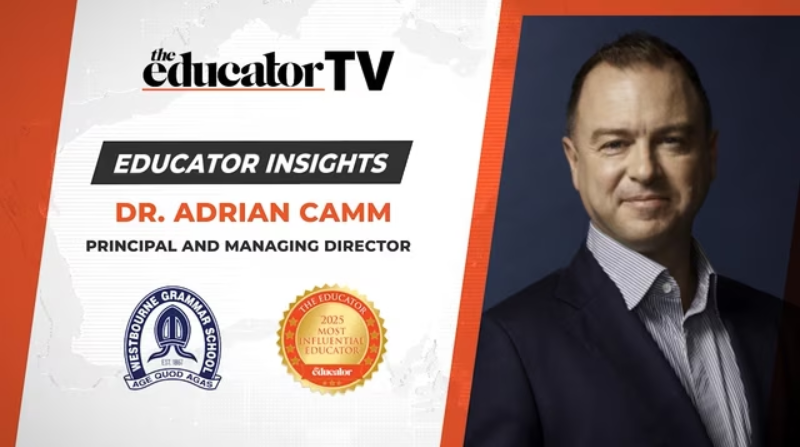



How this principal's inspiring vision set a path for education excellence
Discussing his ambitious leadership strategy, Dr Camm reveals key initiatives driving the school forward: a comprehensive master plan, cutting-edge technology, and programs prioritising people, place, and learning. His focus on innovation and talent development aims to establish the school as a leader in education.
To view full transcript, please click here
Kylie Speer 00:00:09
Hello and welcome to The Educator TV. I'm Kylie Speer and joining me today is Dr. Adrian Camm, Principal at Westbourne Grammar School. Adrian has been named as an excellence awardee for School Principal of the Year Non Government in the 2024 Australian Education Awards. Welcome to you, Adrian, lovely to see you again, and huge congratulations on such a well deserved accolade.
Adrian Camm 00:00:36
Thanks, Kylie, great to be here and really looking forward to the chat.
Kylie Speer 00:00:41
Well, firstly, Adrian ranking among Australia's best principles is quite a feat. What are the characteristics that make a great principle?
Adrian Camm 00:00:51
Oh, firstly, it's just an honor to be recognized in this way and alongside some fantastic leaders from across the country. But I think the characteristics of what makes a great principal. Where do you start? I think they have to have a vision for what could be, not just what is. I think that's really important. I think they're really good at interacting with a diverse range of people, students, staff, parents, those external to the school. They need to understand, I think, the classical and contemporary elements of a modern education, I think they need to promote a culture of growth and development within their organization. They need to be comfortable being uncomfortable. And I know that's a bit of a cliche, but they really have to have this ability to constantly grapple with uncertainty, because as a principal, you're always making decisions based on incomplete information. I think great principles need to be politically astute. Have the ability to zoom out see what's happening in the wider world, in society, the political and cultural landscape, to be able to zoom in right down to the micro details within the school and to understand all aspects of school operations. But then also have this ability to be able to zoom within. And what I mean by that is to constantly engage in this critical self reflection, because we need to be engaged in this process of constantly trying to improve our self awareness. Because I think self awareness is one of those key attributes that really make a great principle. And then I think Kylie, there's other things, you know, they should have strong business acumen, understand school finances, be versed in digital understand change management, high levels of er, you know, emotional intelligence. They need to be agile, adaptable. And I think, you know, humility, curiosity, those sorts of things go a long way, but probably one of the most important things that makes a great principle is just being true to yourself and really doubling down on who you are, being authentic, and then understanding that every moment, every day, every second, every minute, every hour, your leadership and management style needs to change depending upon what the context that you find yourself in. And I think there's a bit in that response that we could unpack further, but I think one, it highlights the complexity of the role, but also, I think it's the you know, I think I've provided a snapshot there of the characteristics and the attributes that make a great principle.
Kylie Speer 00:03:18
You have led many innovations at Westbourne in recent years, how do you cultivate an idea and then make it real?
Adrian Camm 00:03:27
Thanks. Kylie, at Westbourne, we fundamentally believe that people come first, and by empowering our people, we will see continuous innovation. So what we've actually done is adopted what we call accelerator networks across the school and these accelerator networks, they they operate in synergy with the traditional hierarchy. And what it does is it allows us to capitalize on rapid fire strategic decisions, to be able to be agile, to go in new directions. Because what actually happens is the hierarchy and the accelerator networks work in synergy, and they coexist to drive efficiency and innovation. So essentially, distributed leadership model. We give people a seat at the table, we give them a voice, and the two systems work as one, and there's a constant flow of information and ideas exchanged between them. And so what that looks like in practice is that everyone at the school, irrespective of their position, whether they hold a leadership position or not, they are encouraged to innovate, to submit proposals, to come up with ideas, to put them forward. And collectively, at different points across the school. We analyze those ideas, we we debate them, we resource them, we pilot them, we test them, and we evaluate them, and then if they work, we scale them so that a whole school approach is adopted, whatever the innovation or idea is. And I think that's how we've been. Able to catalyze change at the pace that we've been able to see change over the past two, two and a half, three years. And that pace is incredible, but it's also sustainable, because we have innovation coming from the bottom up as well as the top down.
Kylie Speer 00:05:17
What are some of the staff outcomes that epitomize your leadership style and demonstrate the impact of your philosophy?
Adrian Camm 00:05:26
There's been so many, I think one of the one of the things that we talk about at the moment here at Westbourne is that we've become, and increasingly are becoming, a talent incubator environment where we're attracting the best people, but the people that are here, we're putting some world class or best in class programs in place to support their growth and professional learning. And so these things include career trajectory, individualized, personalized, career trajectory, pathway, plans, career advancement opportunities. And we're essentially becoming a place where people want to work. So some of the staff outcomes that we've seen through different policies and practices that we've introduced are things like, we have 18 staff now doing post graduate study at a master's level. We have two staff doing PhDs, supported by the school, international travel fellowships, some of the most generous professional learning provisions, I think, in the country. And one of the things we've just rolled out at the school, which is not common in many other schools, is allied health services here at the school. And so that means that our staff, whether you're a teacher or a administrator or a professional staff member, you can access massage, Cairo, Myo, physio, during the day, when you have freeze within your schedule. And so I think all of that combines, really, to create this culture where everyone's moving in the same direction, and that everyone is buying in and seeing themselves as a leader, irrespective of the position they hold at the school.
Kylie Speer 00:07:06
What does engagement with students look like, and how do you stay connected with what's important to them?
Adrian Camm 00:07:13
Engaging with students is the best part of my day. I think that looks very different from the from day to day. I think every morning, I hand write and hand deliver birthday cards to every student across the school, and that gives me an opportunity to get out and to know students on a personal level, right from prep all the way through to year 12. We provide opportunities for students to sit on committees, decision making committees. We provide opportunities for students to sit on interview panels, to recruit teachers or to even recruit senior leaders in the school, and the feedback from that from the students has been incredible, but also the feedback from potential candidates looking to join the school has also been really, really positive. We give kids and young people here at the school an opportunity to make decisions, to make real decisions, to engage in debate, to engage in the same professional learning that teachers engage in. And we actively encourage students to submit proposals to senior leaders at the school, and we consider them carefully, and sometimes they're great proposals and we can action them. Sometimes they're proposals that we are great proposals, but we can't action them. But we make sure that we have a feedback loop in place so that students are brought into the discussion, so that they can understand why we can't do something that they've asked us to do at that point in time, and that way, they feel seen, they feel valued, they feel heard, and they feel as though their ideas matter. And so for me, it's, it's walking around the school, it's having lunch with our prefect team. It's, it's trying to be as approachable and relational, relational and as visible as possible, and really encouraging this two way dialog. Because my firm belief is we're not just preparing students for a world of work beyond Westbourne. We're actually preparing them to be active contributors today, and so we need to treat them as such, and I think that goes a long way in creating a really enviable culture here at the school.
Kylie Speer 00:09:18
The school has won multiple awards over recent years. What are you most proud of?
Adrian Camm 00:09:25
Where to start? I think we have, we as a school, we've been acknowledged and recognized with with numerous awards. I've been recognized with some individual awards. I think there's been a whole range of staff here at the school who have also been acknowledged with individual awards at a national level, at a state level, at an association based level, depending upon their subject area, I think probably what I'm most proud of is having a small part to play. In students, our young people, or our staff, setting really audacious goals and then exceeding their own expectation expectations, and having a small part to play in that, and then being their big, biggest cheerleader. I think that's what fills me with most pride, and that's what really makes me happy here at the school, gives me energy and just make making it really explicit that we are actually making a difference every single day here at the school in different ways. And I think, you know, it's not, it's not just the accolades and the acknowledgements and the awards, they're great, but it's the tangible outcomes that you see on the ground for each individual that that's that's where it really is for me.
Kylie Speer 00:10:43
Adrian, it's no secret that you're a driver of innovation. And do you position Westbourne as a leader in this area? Can you share some of the cutting edge projects?
Adrian Camm 00:10:54
Yeah, sure. Kylie, there's, there's so much great work happening here. I think one of the innovations that I'm really excited by is our work in artificial intelligence or AI. A couple of years ago, we launched an AI Academy for students, and we now have students from years five to 12 creating their own artificially intelligent applications utilizing machine learning. And so what they're doing is they're learning about artificial intelligence by creating their own. And so this not only aligns with our vision here at the School of shaping learners who inspire the world, but also our philosophical position of creating opportunities and ensuring that the young people today are actually the creators of tomorrow's technology, not just the consumers. And that extends to the work that we're doing in AI with staff. I think one of the, one of the, one of the things we've just recently released is I've created an AI avatar, or a digital twin, or a deep fake, if you like, of myself, and this AI version of myself is able to recognize, understand and appropriately respond to human text or human speech, and it responds in a human like manner. So it looks like me, it sounds like me, it acts like me, but it can respond in one of 50 different languages. And what this is really doing is it's creating new ways of us connecting with people. So we're connecting with our parents, and we're using this technology to educate them about the opportunities and the challenges of a future world that's going to be driven by AI. We're using it in different ways to connect with our international markets and making sure that we're speaking to them in their natural language. And we're also automating different systems and workflow processes here at the school. So for instance, if a new staff member signs their contract here at the school and they're going to be joining us, that initiates or triggers a workflow and an automated video message from me pops into their inbox to say, hi, Kylie, I just saw that you signed your contract. Welcome to the team, you know, and and so just using AI in in novel ways, right across the business, from teaching and learning to to business operations to our system structures and processes, and really just leaning in to an area that, you know, to be honest, some schools are still struggling with or grappling with that idea, but we're 100% invested, because we know it's the future. There's so many others that I can talk about. You know, our professional learning model called learning to lead here at the school. I know, I know other schools are launching their own learning to lead initiatives within their own school. So, you know, imitation is the biggest form of flattery, but we're very happy to share that. You know, it's not a it's not a wildly new innovation, but I think what we have done, and the learning that we've had from that has not only created something really special here at the school, but we're happy to share that with others, because we believe that that's making a systems wide contribution, and we're giving back in a way, by sharing the work that we're doing so others can take that and then elevate it to even greater heights. And I think that's fantastic. So I might stop there, because there's so many different innovations I could share. And as you can see, I'm really passionate about it.
Kylie Speer 00:14:25
How do you make sure that what you aspire to for the school reflects what the community expects?
Adrian Camm 00:14:31
Really important. I think we have a really diverse community here. We have over 50 different nationalities at the school, and so it's actually imperative that you are listening deeply to your community's needs and wants. Of course, as educators, those who make a career in education, we have expertise and experience that we can bring to the table, but we need to make sure that we're doing things in a way that's respectful and meeting the needs of our community. So what that looks like for. US is and particularly, I like to take a leading approach with this work. We are constantly engaging with our parent community and our students and our staff in consultation and collaboration. We do stakeholder engagement workshops anytime that we're looking to launch a new initiative, develop a new strategy, or what have you I instituted monthly amas or ask me anythings where we invite parents into the school to have morning tea or lunch with me, and they can ask anything that's on their mind. And those have been really successful opportunities for parents to engage directly with me, for me to be able to perhaps correct misconceptions sometimes that might come from from the dialog or the narrative that's happening at different parts of the school. But then also, you know, town hall meetings, I send out weekly videos and written communications so that there's direct line of sight with me in terms of school operations or the celebration of events or anything that people need to know. But like most schools parents here at Westbourne, they want the very best for their young person, and that's totally normal. So what we try and do is we try to exceed their expectations by delivering excellent academic outcomes, providing really contemporary and cutting edge curriculum offerings, providing a strong, proactive and reactive well being program, and just equipping our young people with the skills, the tools, the attitudes, the attributes and the dispositions, so that they can succeed in whatever it is that they set their mind to and whatever challenges the future has in store for them.
Kylie Speer 00:16:51
And finally, Adrian, you talked about self awareness earlier. How do you maintain your drive and seek your own inspiration? What have you done for self development?
Adrian Camm 00:17:03
Thanks. Kylie, I recently completed a doctor of philosophy or a PhD, so that kept me busy for the last seven years. Was very fortunate to spend a month residential program recently at the say business school at Oxford University, rubbing shoulders with some fabulous leaders from around the world in different industries. That inspires me. Learning inspires me. I read. I read widely across many different areas, and then I like to share that with with anyone who will listen. But, but I think one of the things that really keeps me motivated is being able to give back in a way. I really get a lot of energy from taking on a coaching or a mentoring role with people who are aspiring to leadership positions, and not necessarily those just in at the school here at Westbourne, but those around the country, and you know that, that's what inspires me, supporting others on their journey. And I'm an active user or contributor on LinkedIn, and you know, if there are, if there's anyone that's listening, listening to this, who wants to reach out and and perhaps hasn't, you know, for whatever reason, I really encourage you to reach out to connect with me. And if there's anything that I can do to support people on their journey, I'm always happy to help.
Kylie Speer 00:18:34
Well, congratulations and thank you once again for your time today. Adrian, it's always so inspiring to check in with you and the team at West board.
Adrian Camm 00:18:43
Thanks so much Kylie, absolute joy talking with you. And you know, I can't wait to the next time we chat.
Kylie Speer 00:18:50
And thank you, of course, to our viewers for watching the latest episode of the educator TV. We look forward to seeing you again soon.