Jump to winners | Jump to methodology
Trust over tech
Discover the best educational service providers in Australia for 2026. Explore winning EdTech, AI and management tools vetted by expert educators
Why the best educational service providers in
Australia matter more in 2026
The best educational service providers in Australia are having to work harder than ever to earn a school’s trust. Teacher shortages, rising student mental health needs and a steady drumbeat of global instability are converging on classrooms in 2026, reshaping what schools expect from the providers who support them. The Australian Education Union, citing OECD TALIS 2024 data, found 42% of Australian lower secondary teachers are now in schools with a qualified-teacher shortage – nearly double the OECD average and up from just 14% in 2018. On student wellbeing, headspace National’s survey of more than 3,000 young Australians found nearly half (49%) are experiencing high or very high levels of psychological distress, rising from 31% at age 12–14 to 65% at age 18–25.
“There are lots of things happening within the world... [and] leaders of schools are looking for support resources that will actually help their teachers manage all of that,” says Phil Lambert, one of the 41 educators driving culture and reform across Australian schools named to The Educator’s Most Influential Educators 2026 list.
That backdrop sits behind The Educator’s Service Provider Awards 2026, which names the best educational service providers in Australia across 15 categories, from artificial intelligence in schools to student wellbeing and school management systems. Nominations were assessed for true innovation and proven success, according to TE’s own submissions data, before the judging panel narrowed the field to 22 standout organisations. The awards are proudly supported by the Australian Boarding Schools Association.
What sets Australia’s top education service providers apart in 2026
Trust has overtaken raw functionality as the deciding factor for Australian schools choosing a service provider in 2026. Three sector experts agree the strongest differentiators are data security, ethical AI use and genuine alignment with a school’s values and constraints.
For education service providers, 2026 has brought a harder question than “Does it work?”. “The bar has moved from ‘Does it work?’ to ‘Does it make us better?,’” says Chrissy Gamble, principal of Kingswood College. Providers, she argues, are no longer judged on features alone but on whether they genuinely understand a school’s context: “The best question a provider can ask is sometimes, ‘Are you sure you need this?’”
Gareth Leechman, a 2026 Most Influential Educator, frames the same shift in almost identical terms. An outstanding provider, he says, “not only listens but understands,” and then “delivers on the arrangement that has been made within the requirements of the school” – all within a school’s budget. Beyond cost, he identifies values alignment and visibly ethical conduct as the next-biggest differentiators.
Data security sits at the centre of that trust question for both experts, against a backdrop of the growing cyber risk facing Australian independent schools – Aon’s 2026 Independent Schools Risk Report found one in four schools experienced a cyber incident in 2026, up from one in five in 2024. Leechman points to recent breaches at Canva’s own account of its 2019 security incident, Telstra’s official statement on its 2024 data breach and Origin Energy’s own account of its July 2026 data breach as evidence that “even some of the traditional best providers can be hacked.” He urges schools to ask five core questions of any provider: where data is stored, who owns it, who can access it, what protections exist and how a breach would be handled.
Lambert sharpens this into a contractual obligation. Schools, he says, should require providers to disclose where data is held – including by any third parties – and to limit collection strictly to what is necessary: “The privacy of the individuals that are your employees or students is paramount. There’s no compromise there.”
Winners at a glance
Profile of a 2026 winner
What separates a winner from the field, based on judging scores and evidence
Innovation+1.9 vs non-medal nominees
Proven success+1.8 vs non-medal nominees
Quality+1.4 vs non-medal nominees
Value for money+0.6 vs non-medal nominees
01
Independent validation
Winners cite a named third-party study, audit or evaluation behind their results – not just their own word for it.
02
One sharp, quantified outcome
A single specific number leads the pitch: a multiplier, a percentage, a dollar figure – never a vague claim.
03
A named model behind the service
A specific coordinator, supervised clinical model or dedicated role sits behind the offering, not a generic team.
04
Multi-year relationships
Long-running partnerships that schools renew year after year, cited as evidence of trust rather than novelty.
05
Consolidation over addition
The strongest pitches replace several existing tools or processes with one – they simplify, rather than add another system.
On artificial intelligence, all three experts land on cautious optimism. Gamble’s test is blunt: “If removing the word ‘AI’ from the sales pitch makes the product less impressive, I probably need to ask more questions.” Leechman agrees AI can genuinely help with lesson preparation, programming and assessment creation, provided the expertise of the educator is still paramount. Lambert goes further, warning of “shadow AI” – unauthorised use by teachers and students alike – and a real risk of professional deskilling: “There are weaknesses in some of the materials, and really, if systems are going to use them, they need to really find the right ones that work for their context.” The concern echoes new research on AI integrity issues in Australian education, which found governance gaps widening even as adoption accelerates.
Feature: Catholic Education Network (CEnet)
Among this year’s 22 winners, one organisation claimed gold in three separate categories and bronze in a fourth: Catholic Education Network (CEnet), a member-owned, not-for-profit shared-services provider supporting Catholic dioceses and schools across Australia.
CEnet won gold in Student & School Management Systems, Security Software and Tech / Hardware, and bronze in Performance Tracking & Analytics – a spread that reflects its position as core infrastructure for more than 370,000 students nationally.
A year and a half of rapid change
“We provide – we’re a shared services provider in the technology space for a number of schools across Australia and dioceses across Australia,” says Paul Giusti, who became CEnet’s CEO in January 2025. Giusti describes the period since as “one of fast pace, lots of excitement, lots of change” – driven partly by rapid movement in AI, and partly by CEnet’s own growth: the organisation has added roughly 40,000 students and 40 schools to its membership base in that time.
Coming into the CEO role, Giusti says he found a mix of established initiatives and fresh priorities. “There were certainly some very good programs and initiatives already underway as I arrived, and then there were some other things that immediately sort of arose as a priority that we should be undertaking,” he says, describing “a good blend of the work that was already happening here within CEnet together with some new ideas that we were able to jump on and execute fairly quickly.”
Consolidated buying power, real savings
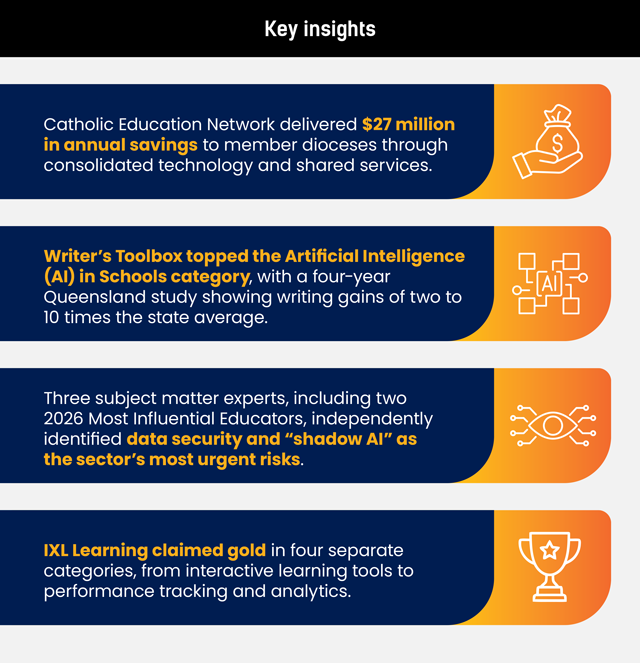
The organisation’s central value proposition is scale. CEnet was founded around 20 years ago on the principle of pooling the buying power of multiple dioceses, and Giusti says the model still delivers $27 million in annual savings to members today. Those savings are not simply banked – Giusti says dioceses redirect the money into “teaching staff... infrastructure within the schools or other areas within their diocese,” calling it “a real big value proposition that we hold near and dear to our hearts.”
CEChat: guardrails built for Catholic classrooms
That scale also underpins CEChat, a purpose-built generative AI tool developed specifically for Catholic classrooms. The tool was already in development when Giusti joined CEnet, built on a simple premise: an off-the-shelf AI product could be deployed in any classroom, but “we felt that there needed to be additional guardrails upon a tool and a service that we provided out to our schools.”
CEChat runs on two tiers of guardrails. At the top level sit universal protections – internet connectivity rules and the ethos of Catholic social teaching – that apply across every school using the tool. Beneath that, individual schools can tailor a second layer to their own curriculum. “If the school has a particular curriculum that they’re following, you’re able to embed that specifically for their school,” Giusti says.
Feature: Catholic Education Network
How CEChat keeps AI safe for Catholic classrooms
A two-tier guardrail system, built before CEChat was ever deployed to a school
Tier 1 — Universal guardrails
Internet connectivity rules and the ethos of Catholic social teaching, applied across every school using the tool.
Tier 2 — School-level guardrails
A second layer each school can tailor to its own curriculum — embedded specifically for that school’s needs.
“We felt that there needed to be additional guardrails upon a tool and a service that we provided out to our schools.” — Paul Giusti, Chief Executive Officer, Catholic Education Network
Onboarding, he adds, is deliberately straightforward. Once a school works through what CEnet calls a discernment process and confirms CEChat is the right fit, “we activate that deployment process, and they can be up and running very, very quickly.” Ongoing development is shaped directly by classroom feedback, gathered through what Giusti describes as “many, many touch points and various committees and working groups” spanning diocesan, customer and school level.
Security at national scale
Cybersecurity is another pillar of CEnet’s offering, and one of three distinct layers, Ian Gregory – who heads the organisation's architecture and cybersecurity function – points to when explaining what member schools gain that they could not otherwise access.
24-hour threat monitoring
CEnet runs round-the-clock surveillance “across the top of all of the catholic.edu.au domain names” and the national IP addresses used by Catholic schools, providing early warning of issues schools would have no way of detecting themselves.
Safe-by-default internet gateway
A protected gateway layer minimises the risk of staff or students “accidentally stumbling across things or infections that might be on school networks,” Gregory says.
“We have a very unique capability that is not always accessible to a lot of the schools or dioceses within their own context”
Ian GregoryCatholic Education Network (CEnet)
Crowdsourced technology assessment
The third layer, Gregory says, is more human than technical: a crowdsourced technology-assessment platform that pools due-diligence work across the sector. Rather than every school independently vetting the same vendors, CEnet has built “a process and a platform for undertaking those assessments in a crowdsourced type model where we have assessors from across the entire country, all belonging to different schools and different organisations... that come together under a common framework.” If one school’s assessment flags a vendor with a low alignment score, the finding is shared sector-wide so other schools can apply appropriate controls before they engage. “It’s really finding that unity in the diversity that is Catholic education,” Gregory says.
The financial savings are easy to point to; the time saved is harder to quantify but, Gregory argues, just as significant. “We’re talking about thousands and thousands of hours saved through that process,” he says of the assessment platform alone. “What it means is it’s freeing people up to be more effective and more efficient within their environments. And ultimately that’s putting more time back into the classroom.”
Community over transaction
The organisation also points to a less visible layer of CEnet’s work: a library of video-based professional learning content developed in partnership with subject-matter experts and key suppliers, made freely available to Catholic teachers regardless of membership status. They see it as creating the glue for their federation so that they are a community rather than simply consumers of a shared service.
For Gregory, that community model is itself a point of difference from other providers, and one he traces to a specific principle. “We see ourselves at the very bottom of the rung here,” he says. “We’re not an enterprise top-tier service provider. We are there to meet our members and schools where they’re at, and we will customise our capability to meet them where they’re at.” He ties the approach to subsidiarity, a principle of Catholic social teaching under which decisions are made at the level closest to those affected by them – “and that keeps us honest,” Gregory says. “It keeps our services aligned because they will only consume our services if they’re 100% aligned to where they’re at at that point in time.”
Giusti extends the point to equity of access. CEnet, he says, provides “the same level of access to technologies” whether a diocese has as few as 1,800 students or sits in a metropolitan area with 75,000 – “really, really, really important, and we’re really proud to be able to provide that equitable access to technology across a very, very broad landscape.”
Staying ahead of a generational shift
That forward focus extends to how CEnet sees its own workforce evolving. Gregory says the organisation has been developing an internal AI strategy and is noticing a generational change in how staff and students describe themselves. “I’m starting to feel like I’m an old hat IT,” he says. “To date, we’ve been known as IT practitioners. And what we’re starting to see is, through students that are coming through their schools and even new staff that are coming into CEnet, they’re coming and calling themselves AI practitioners... It’s a completely different world, and we’re doing our best to stay abreast of that and sort of ready our organisation as best we can and be AI-enabled and AI-native.”
Giusti also frames CEnet’s overall role in terms of what schools don’t see. “A lot of what has been described is perhaps invisible to teachers in the classroom because it just works for them,” he says.
Data spotlight: four standout Australian education providers
Another four of this year’s winners stand out for the strength of their self-reported data, spanning AI-driven writing outcomes, school swim programs, learning management systems and hardware supply, following on from last year’s edition of Australia’s top education service providers. None of the four below were interviewed; the figures come directly from their award submissions.
Writer’s Toolbox – gold, Artificial intelligence (AI) in schools
Writer’s Toolbox topped the AI in schools category with the highest weighted score of any winner in this year’s awards, at 9.7 out of 10. The company’s patented educational AI platform is the product of a decade of development and $16.5 million in research and development (R&D) investment and is built to evaluate the semantic quality of student writing rather than surface-level grammar – critically, the tool does not generate text on a student’s behalf. A four-year longitudinal study found gains of two to 10 times the National Assessment Program – Literacy and Numeracy (NAPLAN) state average among users, with Year 9 boys recording results 9.6 times the state average. The platform now serves more than 170,000 users across 700-plus Australian schools, with local licences growing 10.87% in 2025.
Aquastar Swim Schools – gold, Fitness and sports programs
Aquastar Swim Schools claimed gold in the Fitness and sports programs category on the strength of two decades running dedicated school swimming programs, reaching more than 4,500 children a year. Judges cited the organisation’s dedicated School Program Coordinator role, careful student-level assessment and grouping, and partnerships with individual schools running eight years or longer – including an eight-year testimonial from St Michael’s. The category drew fewer entries than most, but Aquastar’s depth of school-specific tailoring and safety culture set it apart from its single competitor.
Schoolbox – silver, Learning management systems
Schoolbox took silver in the Learning management systems category, standing out as an Australian-owned platform with more than 25 years in the market. The system brings K–12 learning management, pastoral care and school community communications into one platform and has recently added AI capabilities, including an AI Discussion Activity tool and Differentiation Profiles, alongside integration with Microsoft Education via Learning Tools Interoperability (LTI). Schoolbox’s footprint now extends beyond Australia to New Zealand, Asia, the Middle East and Europe.
Winc Education – silver, Tech/hardware
Winc Education placed second in the Tech/hardware category, drawing on more than 50 years as a single supplier for school hardware and technology needs. The company was named winner of CCW’s Best Customer Service Australia/NZ in 2025 and the Service Excellence category at the 2025 Australian Business Awards. Judges noted dedicated Education Account Managers and contracted school pricing as particular strengths.
If 2026 has been the year trust became part of the product, the next 12–24 months look set to formalise that shift. Expect schools and schooling systems to move from ad hoc AI adoption towards structured governance – deciding which tools are endorsed, which are banned, and how “shadow AI” use by staff and students is identified and managed, as Lambert describes.
Data contracts are likely to get more specific, too. Rather than general assurances, schools will increasingly ask providers to commit – in writing – to data-minimisation clauses, named storage locations, and defined breach-response protocols, echoing the near-identical checklists both Lambert and Leechman set out independently.
For providers like CEnet, that points towards deepening their AI strategy: Gregory says the organisation is actively working to become “AI-enabled and AI-native,” partly in response to a generational shift in which incoming staff increasingly identify as AI practitioners rather than IT practitioners. Whether other providers follow that lead, or lean instead on point-solution AI features, may become one of next year’s clearest lines of differentiation.
What defines a top education service provider in Australia
Across 15 categories and 22 winning organisations, this year’s Service Provider Awards point to a common thread: the providers Australian schools rate most highly are not necessarily the newest or the most heavily marketed, but the ones that can prove they understand a school’s context and constraints.
Whether that proof comes from a four-year academic study, a collective savings figure or a contractual guarantee on data handling, the message from this year’s judging panel – and from the sector’s own most influential voices – is consistent.
As Leechman puts it, there is no shortage of quality providers in the Australian market; the real work for school leaders is being “discerning to make sure you’ve got the right fit.”
Artificial intelligence in schools
- Jacaranda
- Seven Steps to Writing Success
- Writer’s Toolbox
EdTech platforms (apps, coding tools and STEM kits)
- Catholic Education Network (CEnet)
- IXL Learning
- Jacaranda
- Seven Steps to Writing Success
Exam preparation and assessment services
- FunFox Program
- IXL Learning
Fitness and sports programs
- Student Residence Southern Region
Interactive learning
- Financial Basics Foundation
- IXL Learning
- Kimberlin Education
- Study Work Grow
Learning management systems
- Financial Basics Foundation
- Kimberlin Education
Mental health and counselling services
- Education360
- STEER Global
- Student Residence Southern Region
- Toolbox Education
Nutrition and wellness providers
- Student Residence Southern Region
Performance tracking and analytics
- Australian Teacher Aide
- Catholic Education Network (CEnet)
- Education360
- IXL Learning
- STEER Global
Professional development
- Australian Teacher Aide
- Catholic Education Network (CEnet)
- Seven Steps to Writing Success
- Study Work Grow
Recruiters/staffing solutions
- Hutton Consulting Australia
Security software
- Catholic Education Network (CEnet)
Student and school management systems
- Catholic Education Network (CEnet)
- Upschool.co
Tech/hardware
- Catholic Education Network (CEnet)
Tutoring and learning support programs
- FunFox Program
- Safeguarding Services
- Study Work Grow
- Upschool.co
Insights
As part of our editorial process, The Educator’s researchers interviewed the subject matter experts below for their independent analysis of this report and its findings.
FAQs
What makes a provider one of the best educational service providers in Australia?
The best educational service providers in Australia combine proven outcomes, transparent data practices and genuine alignment with a school’s values and constraints. The Educator’s judging panel assesses innovation, proven success, value for money and quality across 15 categories to identify these providers each year.
How were the 2026 winners selected?
Education service providers catering to Australian schools were invited to submit entries across 15 categories in May 2026. TE’s team assessed each entry for genuine innovation and proven success, benchmarking nominees against each other before narrowing the field to 22 winning organisations.
What is “shadow AI,” and why does it matter for schools?
Shadow AI refers to teachers and students using AI tools without institutional authorisation or guidance, typically because the tools are quick and freely accessible. Education experts warn it can lead to professional deskilling if not actively managed by schools and schooling systems.
What should schools ask providers about data security?
Experts recommend five core questions: where data is stored, who owns it, who can access it, what protective measures exist, and how a breach would be handled – ideally set out in writing as part of any contractual agreement. Schools can also cross-check providers against Safer Technologies 4 Schools (ST4S), the national assessment framework for Australian and NZ schools.
Where is AI genuinely helping schools right now?
Subject matter experts point to time efficiencies in lesson preparation, programming and assessment creation as AI’s clearest current benefit, provided educator expertise remains central to how outputs are used – see how one AI mentor is helping upskill Australia’s teachers for a practical example.
What trends are expected to shape education service providers over the next two years?
Expect more formal AI governance policies in schools, more specific data-handling contracts with named storage locations and breach protocols, and growing differentiation between providers who build AI-native strategies and those offering point-solution AI features.
In May 2026, The Educator invited education service providers catering to schools across Australia to participate in the Service Provider Awards. Entries were accepted across 15 categories, including artificial intelligence in schools, EdTech platforms, mental health and counselling services, and student and school management systems. TE’s editorial team assessed each entry for genuine innovation and proven success, benchmarking nominees against one another. The judging process narrowed entries down to 22 of the sector’s most outstanding service providers.
The Service Provider Awards report is proudly supported by the Australian Boarding Schools Association.