



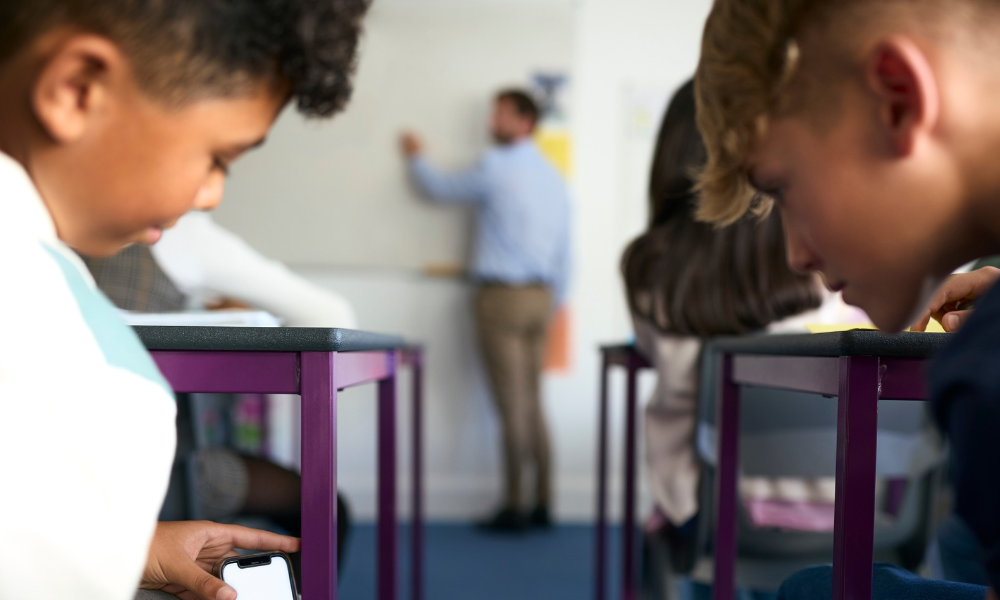
Years of reform, a phone ban and a Senate inquiry later, the disciplinary climate in Australia’s classrooms still trails much of the developed world.
The latest results from the Programme for International Student Assessment (PISA) show Australia ranked 69th of 80 countries on disciplinary climate, based on science students’ responses. Forty-one per cent reported noise and disorder against an OECD average of 31%, and one-third of the 15-year-old students reported that classmates don’t listen to what the teacher is saying.
In a recent representative national sample of 377 teachers by the Centre for Independent Studies, respondents estimated that, on average, nine minutes were lost to misbehaviour for every 30 minutes of teaching time — almost a third of a lesson.
More than half of teachers estimated losing at least a fifth of their teaching time, and four in 10 said misbehaviour disrupts most or every lesson.
The quiet toll of everyday disruption
In a recent piece, Blaise Joseph, Director of the Education Program at The Centre for Independent Studies, said the culprit is rarely extreme incidents but everyday disruption, such as talking out of turn, calling out, arriving late and ignoring instructions.
“Each interruption might consume only a little time. But add them together from many different students during a lesson, a week, or an entire school year, and the cumulative cost is enormous,” Joseph wrote. “The survey has attracted criticism, including the suggestion that conducting it towards the end of a school term inflated estimates of misbehaviour.”
However, England’s regular national teacher surveys show that the point in the term does not substantially change estimates of lost learning time, Joseph pointed out.
“Those surveys consistently found around six or seven minutes lost in every 30 minutes, compared with nine minutes in the Australian survey,” he wrote. “All surveys have limitations, and estimates can overstate or understate aspects of a problem.”
Joseph said Australia should follow England’s lead with regular national teacher surveys on classroom behaviour, backed by system and school-level surveys, to track trends over time and test whether behaviour policies are working.
“Further, our study does not even capture the full cost of misbehaviour,” he wrote. “Since the research was released, many teachers have recounted how much additional time they spend outside lessons dealing with misbehaviour: documenting incidents, contacting parents, following up with students and school leaders, and going through often arduous administrative processes to impose consequences.”
Joseph pointed out that a precise estimate of learning time lost to misbehaviour in Australia is difficult to pinpoint, suggesting the true loss per 30 minutes of teaching could be seven minutes or it could be eleven minutes.
“Losing anything close to this amount represents a serious problem that needs to be addressed.”
Recognising the implications of this in classrooms across the nation, the Australian Education Research Organisation (AERO) has just released its final suite of federally funded classroom management resources for schools.
The new resources update AERO’s 21 foundational guides, adding micro courses, guidance on disruptive behaviour and teacher wellbeing, and whole-school professional learning materials for leaders.
Busy teachers can now access an interactive tool offering short courses and learning sequences that focus on key practices. There are also concise guides on preventing problems before they arise, responding to escalated behaviour, managing students who are persistently disengaged or disruptive, and maintaining teacher wellbeing in the classroom.
For school leaders, there is support to build a consistent whole-school approach. This includes materials for running professional development sessions with staff, along with reflection tools that help teams identify what they are doing well, where they can improve and how to plan for that improvement.
“All students deserve to learn in safe and supportive classrooms, where expectations are clear and consistently reinforced,” AERO CEO Dr Jenny Donovan said. “These resources have been tested in Australian schools and refined with input from teachers and leaders, so they are practical and ready to use.”
Dr Donovan said the resources would also help school leaders build a shared understanding of effective classroom management across their staff.
“When a whole school is working together to ensure a consistent evidence-based approach to managing behaviour, students experience clear and predictable expectations from one classroom to the next, and teachers feel better supported,” she said.
“School systems and sectors can also draw on these resources to support professional learning and help embed effective practice at scale.”
‘Our systems need to afford school leaders that trust’
Data from AITSL's 2024 Australian Teacher Workforce report found that nearly halfd (47%) of Australian teachers planning to leave the profession cited student behaviour as a reason, up from just 25% in 2020.
Former Principal, educator and author Adam Voigt said sending a struggling teacher on a classroom management course isn't born of indifference – it's often the only sanctioned response available.
“The system offers workshops. The community expects visible action and the compliance machinery rewards things that can be documented,” Voigt told The Educator. “And so leaders often reach for the tool they've been given, even when they privately know it won't change the culture producing the problem.”
In his new book, The Truth About Student Behaviour, Voigt argues that school leaders “have more design freedom than the system has tricked them into believing they do.”
“The most powerful levers for changing student behaviour sit inside the school: in the culture leadership builds daily, in the consistency of adult interactions with students and in the degree to which students feel they genuinely belong.”
Voigt said no external workshop addresses these challenges, and no centrally mandated compliance framework does either.
“They grow from leadership that is trusted to design the conditions for authentic connection,” he said. “Our systems need to afford school leaders that trust. And our school leaders need to know they're already equipped to use it.”