



Ten years ago, 17 early learning students walked into Melbourne’s first vertical school. That campus has since grown into a 755-student model, and education leaders say it previews how Australian cities will need to build schools as land grows scarcer.
Haileybury City opened in April 2016 on King Street in the Melbourne CBD. The 10-storey former National Australia Bank building combines early learning through Year 12 in a single structure. A decade on, students travel from suburbs as far apart as Truganina, Toorak and Tullamarine.
The 2026 anniversary arrives as planners confront a familiar constraint: less land for the sprawling, single-storey campuses that have defined Australian schooling, even as inner-city populations grow.
Looking to the world
Multi-storey schools are already common in European capitals including Paris, Copenhagen and Oslo, and Asian cities such as Singapore, Hong Kong and Japan. Caroline Merrick, head of Haileybury City since 2019, expects Australia to follow.
“I think, in coming years, we will see more vertical schools in Australian cities, and that’s a positive step forward. Vertical campuses can offer students so many unique experiences, close connection to the diverse community around them, and an excellent education,” Merrick said.
“A lot of schools focus on their history and try to replicate what has been done in the past, but it may be time to do things differently,” she said.
For those exploring what 21st century school design looks like, vertical campuses offer a compelling answer. They are particularly relevant where traditional footprints are no longer viable.
Nathan Chisholm, inaugural principal of Melbourne’s second vertical school and now Haileybury’s deputy principal – student wellbeing, said density would push more schools upward.
“If we were living in New York or Hong Kong and talking about vertical schools, people wouldn’t think it was odd. But in Australia, families wonder how you can manage if there isn’t an oval or a swimming pool – there’s a misconception that it can’t be a ‘normal school,’” Chisholm said.
Vertical schools: designed for connection
Chisholm said vertical schools succeed by integrating with their surrounding city rather than copying a traditional campus footprint.
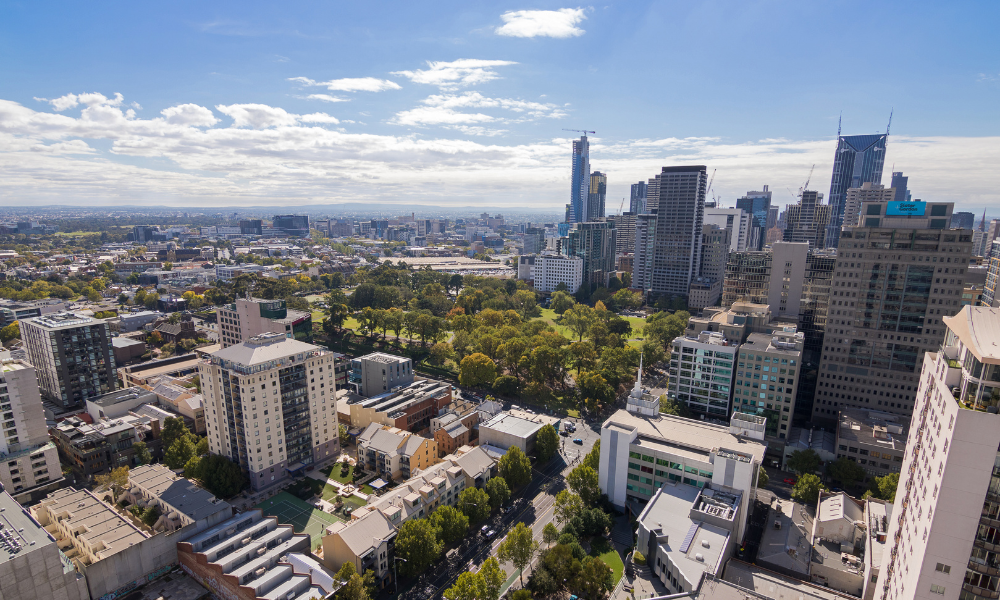
“The key to a successful vertical school is working with the community around you,” Chisholm said. “Students can also make the most of green spaces in the city, like Flagstaff Gardens in the case of Haileybury City.
“Successful vertical schools combine architecture, wellbeing and pedagogy that work together to create a genuine sense of connection and community,” Chisholm said.
At Haileybury City, the building’s 1,500 square metres of recreation space, alongside the adjoining 18-hectare Flagstaff Gardens, is engineered to shift function throughout the day.
“A single space at Haileybury City can have different uses throughout the day – it will be an assessment space for a SAC, an assembly space, later in the day it may host an English class and a visiting poet, and it may also accommodate a parent information night,” she said.
“However, it’s also important to remember that a successful vertical school isn’t solely defined by its architecture, but by its culture and people,” Merrick said.
The value of education-focused architecture has long been debated in Australia. Haileybury City’s decade of operation offers one of the clearest real-world examples.
Beyond one vertical campus
Victoria’s government system has followed a similar path. South Melbourne Primary School opened in Southbank in 2018 as the state’s first government vertical school. Docklands Primary followed in 2021, then North Melbourne Primary in 2023, according to CBD News.
The Grattan Institute has projected Australia needs roughly 650,000 additional school places by 2026. That is equivalent to seven new classrooms every day for a decade, per ArchitectureAU. A national inquiry into public school infrastructure funding and supply has since been launched, underscoring the scale of the challenge.
As Haileybury City’s first cohort approaches graduation, Merrick and Chisholm both expect more vertical campuses to follow.