



It started with two sheds, a handful of resources, and a dream.
In 2019, at the Garma Festival in Arnhem Land, a serendipitous meeting between Barker College Principal Phillip Heath and revered Yolŋu elder Dr G Yunupiŋu set something magical in motion.
“Old Man,” as he was known to his community, had long held a noble vision – that Yolŋu children could learn on their own country, in their own language, without ever having to choose between a strong education and a strong cultural identity.
Two years later, that dream became a school when Dhupuma Barker opened its doors in Gunyangara in April 2021.
The school was built on a simple but radical idea: that English and Yolŋu Matha could sit side by side in the same classroom, with equal honour given to both.
The results speak for themselves.
Attendance has soared past national benchmarks. Students have gone on to blitz world robotics championships, and a community that once had almost nothing to work with now has a school it is fiercely proud of.
A dream finally recognised
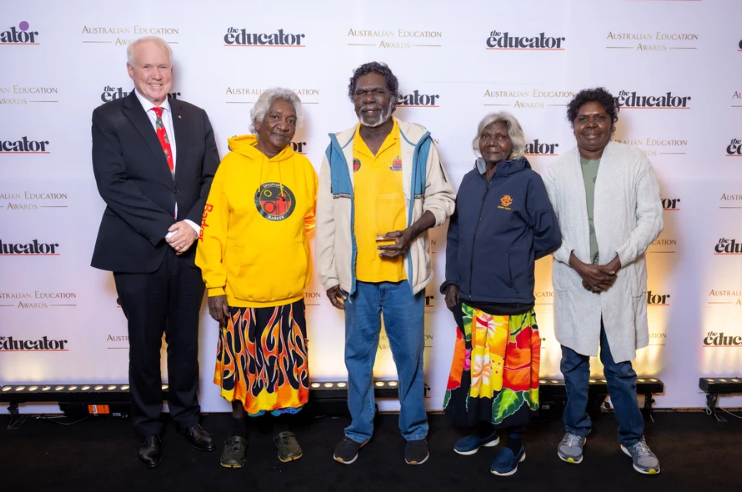
On Friday 7 August 2026, Dhupuma Barker’s success was recognised on the national stage when it was named the Best First Nations Education Program at the Australian Education Awards 2026.
“This award is a wonderful honour, but more importantly it is an acknowledgement of the vision and commitment of the First Nations communities in Hornsby, Darkinjung and Dhupuma,” Heath told The Educator. “At Barker College, we truly believe that young people should not have to choose between a strong education and a strong cultural identity.”
Heath said the award wouldn’t have been possible without Dhupuma Barker’s team of Indigenous co-teachers and “a wider team of gifted and caring teachers.”
“It is their dedication that allows students to stay connected to family, culture and country, to proudly and safely learn in two worlds,” he said. “We are also deeply grateful to our generous donors who believe in this vision and walk alongside us to ensure that we can bring this vision to reality.”
However, Heath said the award truly belongs to the “wonderful” students at Darkinjung Barker, Dhupuma Barker and Barker College at Hornsby.
“To see these students arrive at school each day, big smiles on their faces, eager to learn and grow, is the ultimate reward.”
Walking confidently in two worlds
When asked about the most meaningful outcomes of Dhupuma Barker's two-way bilingual learning program, Heath pointed to students flourishing academically while staying firmly grounded in their language, culture and identity.
“The most meaningful outcomes are seeing young people flourishing as they learn to walk confidently in two worlds and achieving one year of academic growth for every year of life,” Heath said. “Our students are developing strong literacy and numeracy skills while remaining deeply connected to their language, culture and identity.”
Heath said the results are clear evidence that culture and curriculum aren't at odds, but work best hand in hand.
“What we’re seeing year after year are students who are learning more effectively when their culture and language are valued and embedded within the learning experience,” he said. “School attendance is exceeding the national benchmarks, and every student with an attendance rate higher than 70% has demonstrated measurable literacy improvement.”
Heath said beyond academic outcomes, there is a strong sense of belonging among students, families and staff.
“Attendance levels, community engagement and the confidence of students to lead, participate and contribute all point to the power of an education model that honours both Indigenous knowledge and the Australian Curriculum.”
A richer school for everyone
Heath believes Dhupuma Barker's success offers a blueprint other schools could follow, starting with a lesson that goes to the very heart of how the program was built.
“The first lesson is that successful First Nations education must be done with community leadership at the centre of decision-making,” he said. “Our Indigenous co-teachers are educators, cultural authorities and leaders whose knowledge shapes teaching, curriculum, and student support.”
Heath said the school’s staff have learned that they need to listen deeply, share responsibility and recognise the expertise that already exists within local Indigenous communities.
“The second lesson is that culture should not sit on the margins of schooling,” he said. “Across our First Nations education programs, academic measures sit alongside Indigenous definitions of wellbeing, identity, and cultural continuity.”
The third lesson, said Heath, is that two-way learning benefits everyone in the school community, not just First Nations students.
“We are creating richer learning environments where different ways of knowing, being and doing are valued by the broader community,” he said. “We see this in practice at our Hornsby campus, which is immeasurably richer for having Darkinjung and Dhupuma students visit and share with us each year.”
The dream isn't finished yet
Asked what's next for the program, Heath said the focus is on building on what's already working, with each campus following its own path forward.
“We have a number of priorities to meet the learning needs of the different contexts of each School,” he said. “At Dhupuma Barker, this includes further developing bilingual curriculum resources, strengthening pathways for students as they move through their schooling, and continuing to build leadership opportunities for local educators.”
Heath said the vision extends well beyond the classroom, with plans already taking shape to grow the program's reach and impact.
“At Darkinjung Barker in NSW, we hope to reinvigorate language by working with local language experts, as well as seeking to accommodate growing demand for the program in larger premises,” he said. “Another dream for Darkinjung Barker is to create an Aboriginal secondary school so that students can continue their education on country.”
Heath said students at Barker College have flourished with the engagement of an Indigenous Youth mentor, to encourage students to be grounded culturally and supported academically in the Yarn Up program.
“We are also committed to growing the opportunities for collaboration across Barker's Indigenous campuses so that students can learn from one another's experiences and cultures,” he said. “Across all campuses, we are working to strengthen student and family engagement from the early years, and building clearer pathways into vocational training, tertiary education and community leadership for our students.”
Heath said one ambition stands out above the rest – building homegrown teaching talent for the long term.
“A key focus is to grow a pipeline of Indigenous educators by creating pathways for local co-teachers to gain formal teaching qualifications.”
What schools owe the future
Asked to reflect on the deeper purpose of schooling, Heath said the true measure has little to do with results on a page, and everything to do with the lives students go on to lead.
“At its heart, the purpose of schooling is to prepare young people to live meaningful lives, equipped to contribute positively to their communities both during and beyond their years at School,” he said. “At Barker College, we deliberately and intentionally focus on the whole person, allowing each student to thrive holistically and to look beyond the Mint Gates to a career and life of impact and purpose.”
Heath said schools should nurture character, curiosity, compassion, resilience and a sense of purpose.
“For teachers and leaders in 2026 and beyond, that means keeping people at the centre of our decision-making. It means preparing students not only for employment, but for citizenship, service and leadership,” he said. “The greatest measure of a school's success is not simply what its students achieve, but who they become and how they use their gifts in the service of others.”
Heath said offering an educational experience that is culturally safe, grounding student identity and value is intrinsic to the range of Indigenous Education pathways the school offers.
“That has always been Barker's aspiration, and it remains as important today as ever.”