



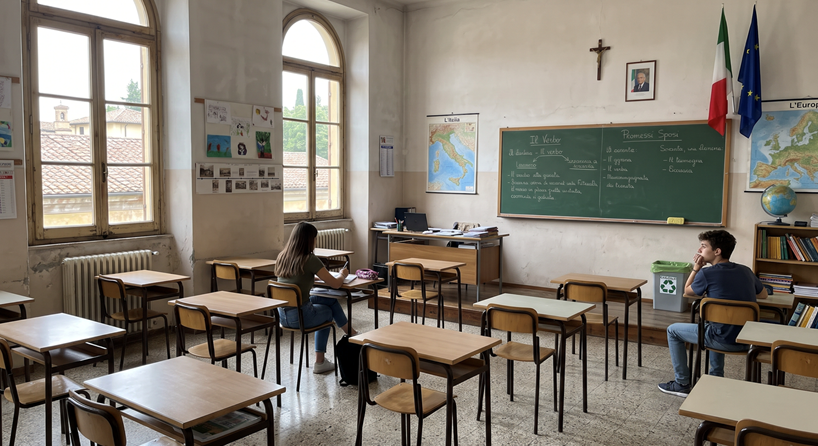
Italy’s government plans to cut almost 7,000 jobs from its state schools, arguing that a shrinking population of children means the country needs fewer staff.
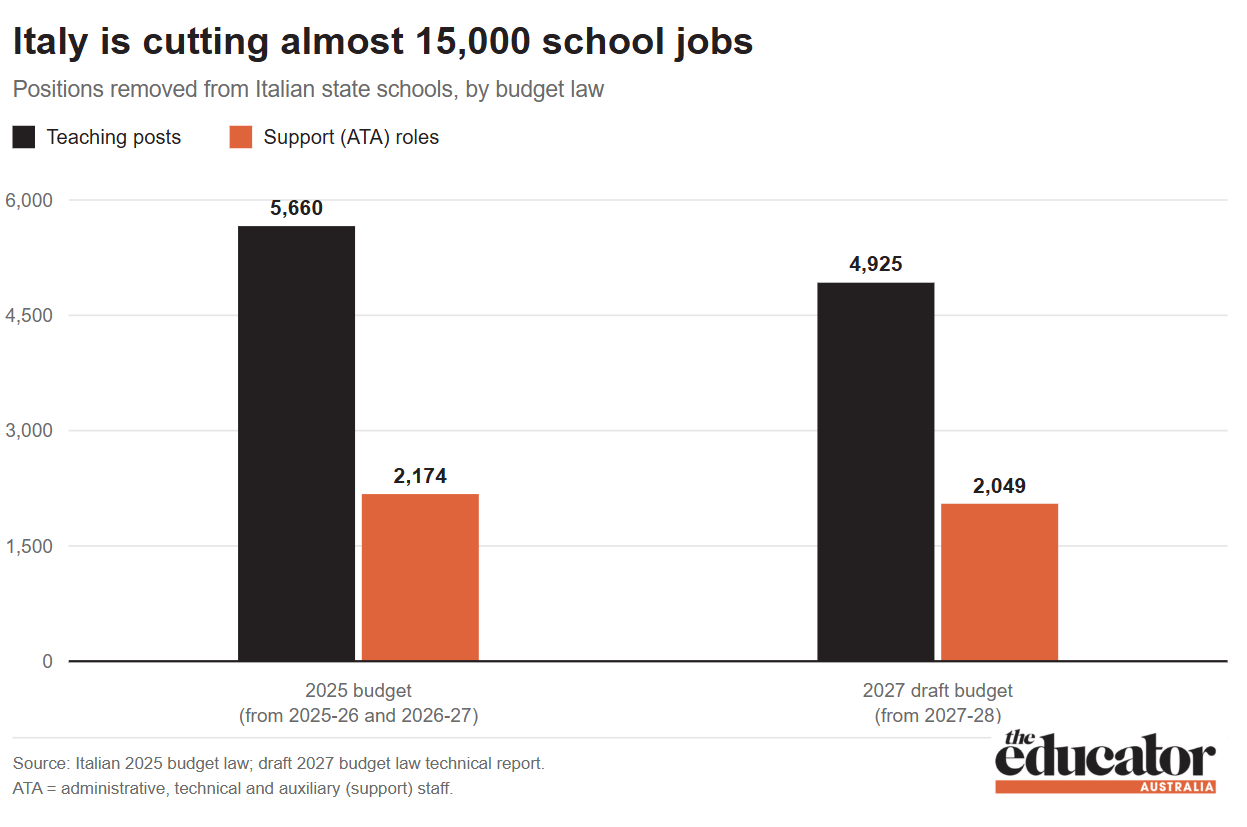
The draft 2027 budget, approved by cabinet in late October, removes 4,925 teaching positions and 2,049 administrative, technical and support roles from the start of the 2027-28 school year. The bill’s technical report estimates savings of €83.9 million (about A$135 million) in 2027, rising to €251.7 million (about A$405 million) a year from 2028.
The cuts come on top of reductions in the 2025 budget, which removed 5,660 teaching posts from 2025-26 and 2,174 support roles from 2026-27. If parliament passes the new bill unchanged, Italian schools will have lost 14,808 positions over three school years.
Read next: Australia faces decline in domestic STEM enrolments
The government’s case rests on enrolments. Italy had 8.4 million primary and secondary students in 2017-18 and 7.7 million in 2024-25, according to official figures reported by Reuters.
Principals push back
Mario Rusconi, of the national principals’ association ANP, told la Repubblica that the demographic decline was real and serious, but that it “cannot be used as an excuse to further weaken our public education system”. ANP president Antonello Giannelli has argued that falling enrolments should be used to improve schools rather than to shrink them.
The UIL union described the cuts as unacceptable and asked parliament to remove them. Unions have organised a sit-in for 11 November and a national strike for 20 November. Projections from the Agnelli Foundation, a Turin-based education research institute, suggest some regions face far steeper falls. Sardinia, for example, could need around 40 per cent fewer teachers by 2040.
Australia’s first-year classes are shrinking
Australia’s population is still growing, largely through migration, and total school enrolments reached a record 4,160,918 in 2025. The first year of school tells a different story.
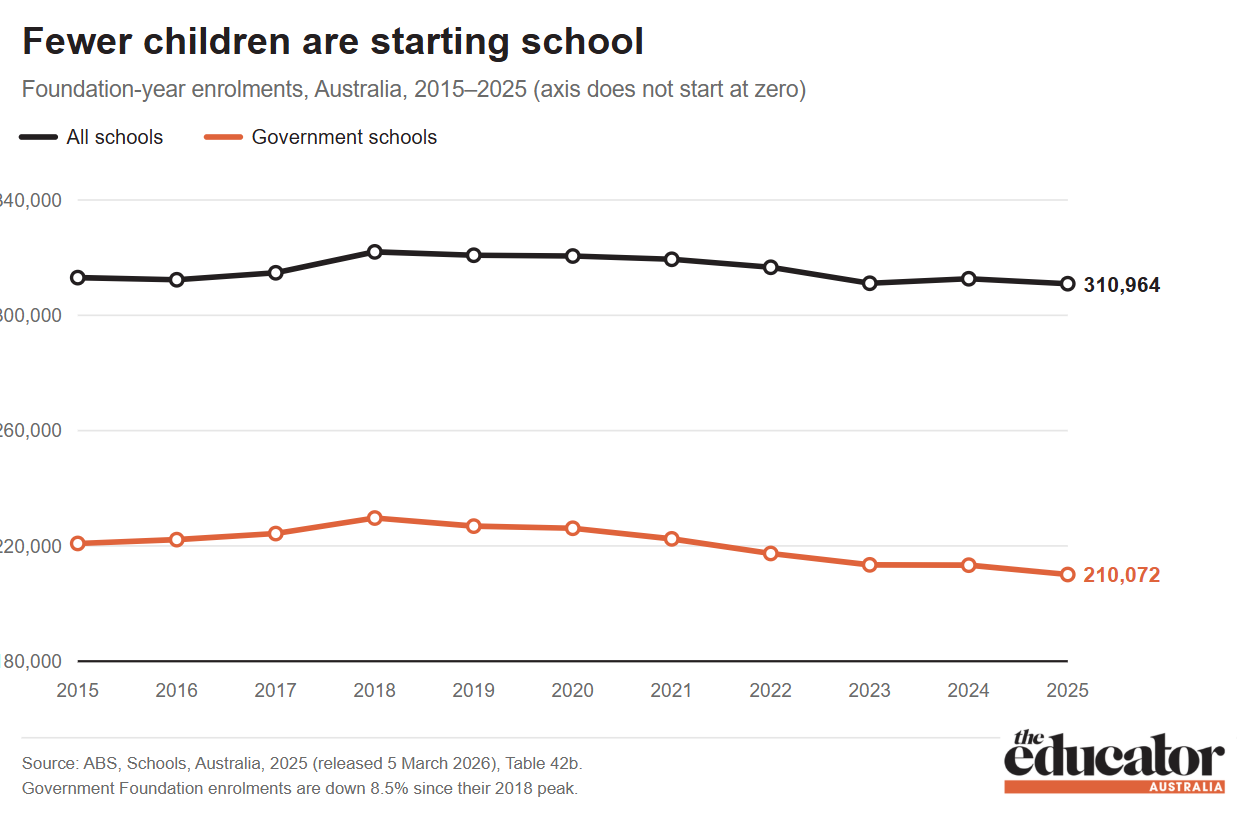
ABS Schools data shows Foundation-year enrolments in government schools peaked at 229,676 in 2018 and had fallen to 210,072 by 2025, a drop of 8.5 per cent. Across all sectors, Foundation enrolments have slipped from 322,017 to 310,964 over the same period.
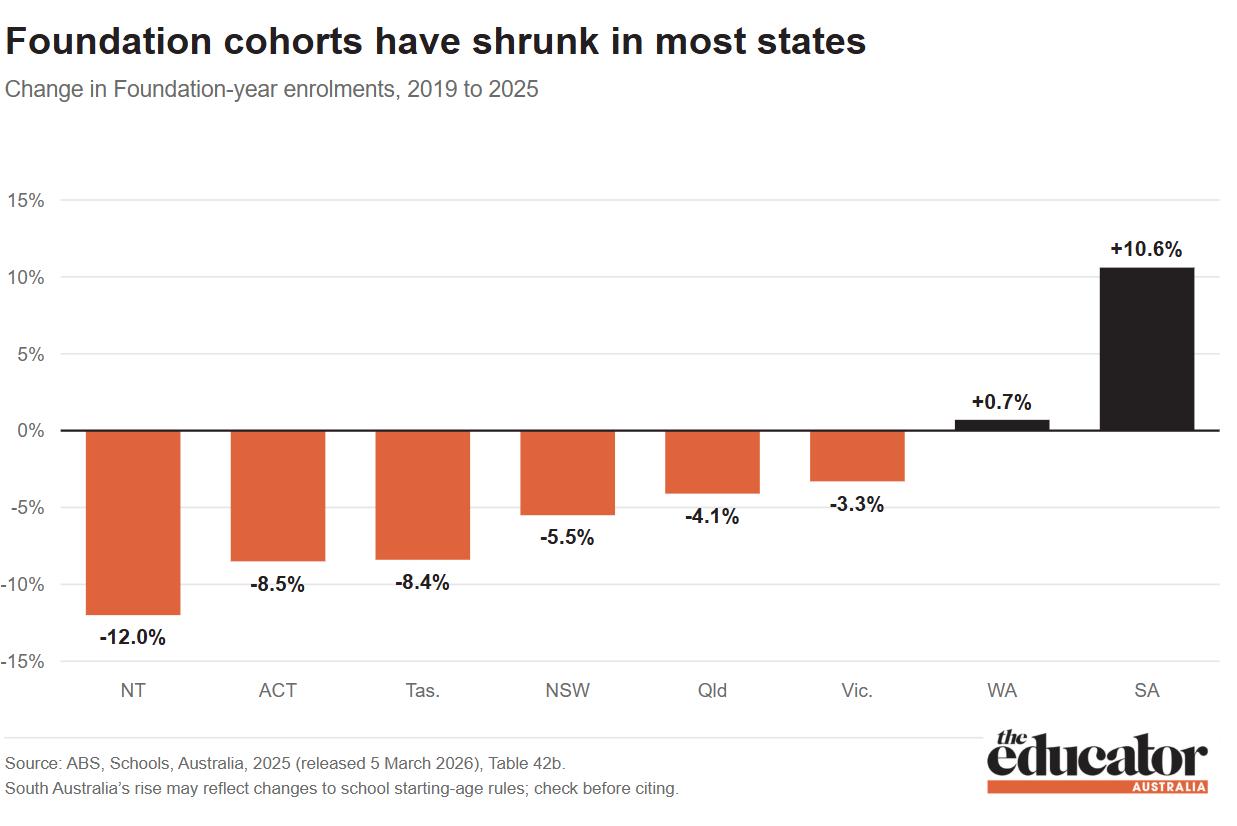
The decline is spread across most of the country. Compared with 2019, Foundation cohorts in 2025 were 12 per cent smaller in the Northern Territory, 8.5 per cent smaller in the ACT and 8.4 per cent smaller in Tasmania. NSW had around 5,500 fewer Foundation students than in 2019. Western Australia was roughly flat, and South Australia was the exception with a rise of 10.6 per cent.
Birth data suggests the trend has further to run. Figures released by the ABS on 6 November show 299,903 births registered in 2025 and a total fertility rate of 1.497 babies per woman. That is a slight rise on the record low of 1.481 in 2024, but the ABS says the rate remains historically low. Australia’s rate has been below the replacement level of about 2.1 since 1976.
Read next: The hidden legal risk sitting in your staffroom
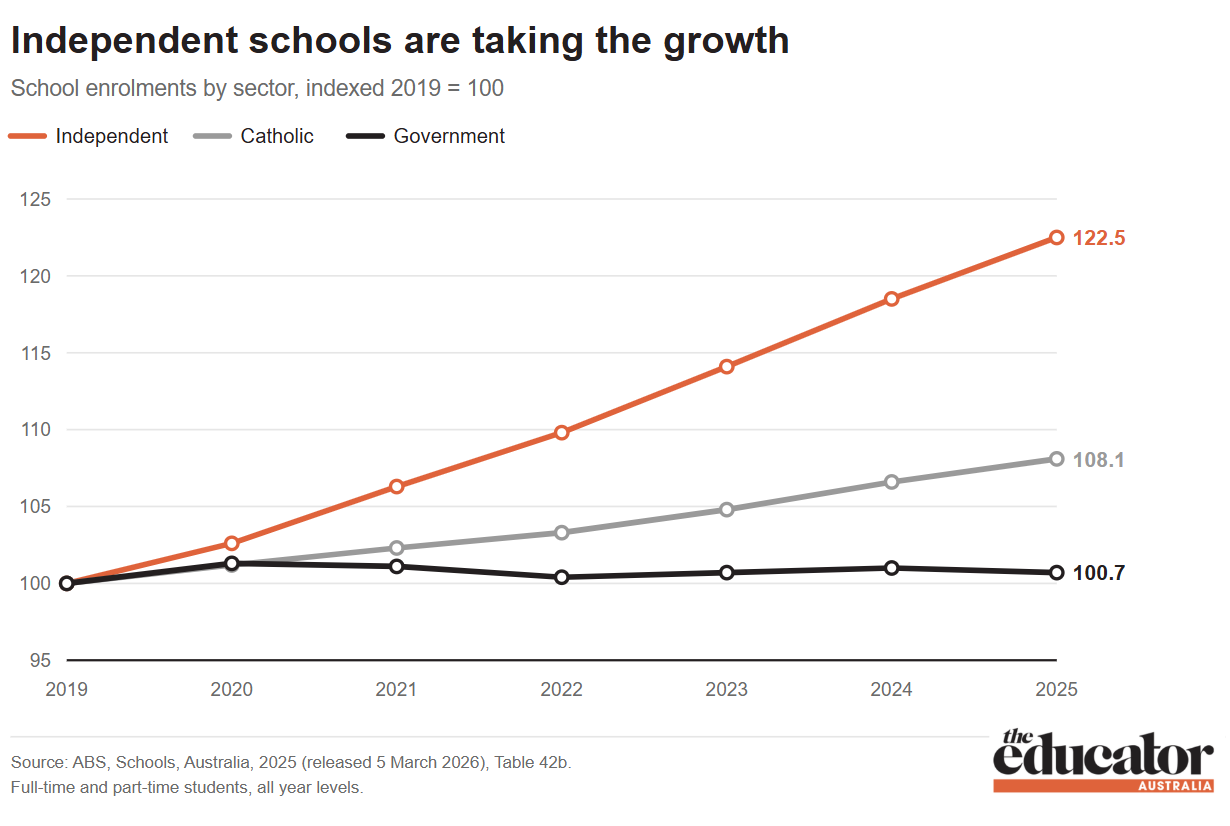
The children who are enrolling are also spreading differently across sectors. Since 2019, independent school enrolments have grown by 22.5 per cent and Catholic enrolments by 8.1 per cent, while government enrolments are up less than 1 per cent. This continues a shift toward the non-government sector that has been building for years.
The opposite of Rome
Australia has so far responded very differently from Italy. Between 2019 and 2025, enrolments from Foundation to Year 6 grew by less than 1 per cent, from 2,227,409 to 2,248,165. Over the same period, the full-time equivalent number of primary teachers rose 8.4 per cent, from about 150,300 to 162,800.
[Chart: 03-primary-enrolments-vs-teachers]
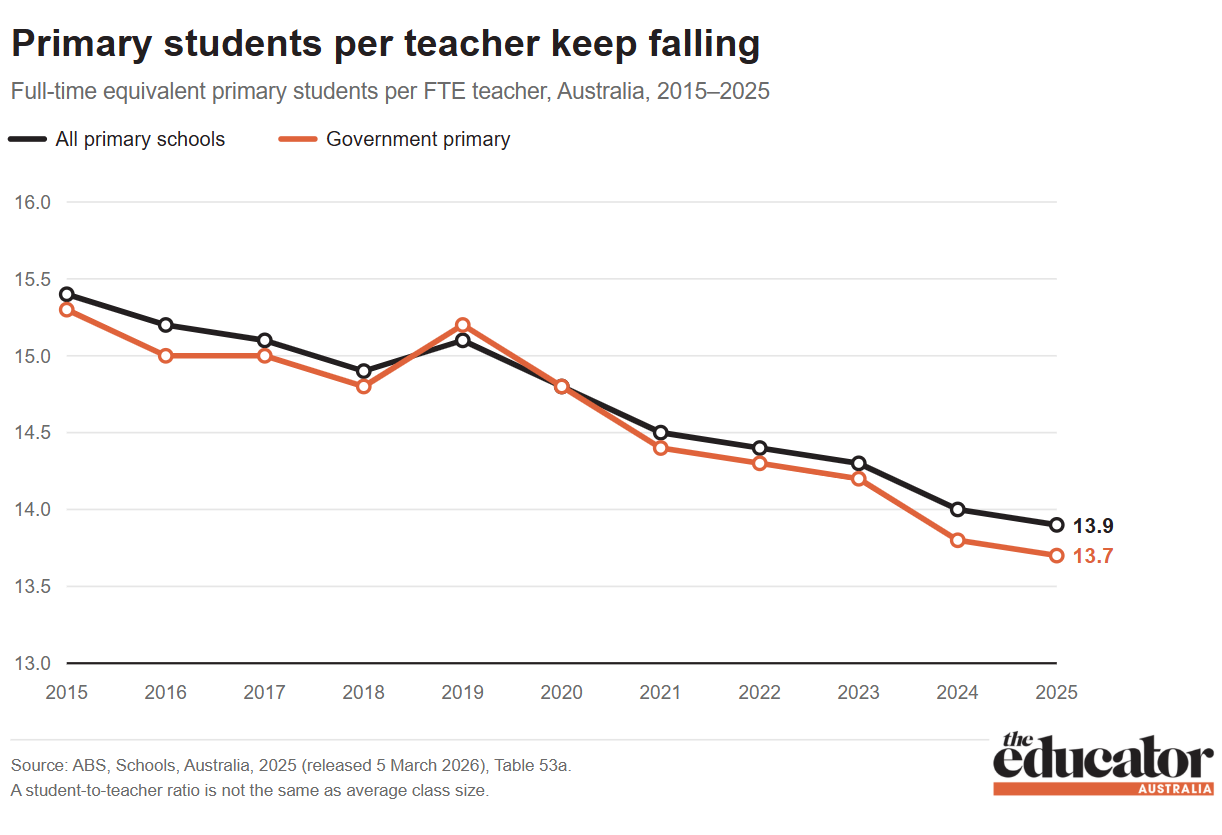
As a result, the number of primary students per teacher has fallen from 15.1 to 13.9 nationally since 2019, and from 15.2 to 13.7 in government primary schools. That ratio isn’t the same as class size, since it counts specialist and part-time teachers. Even so, it shows Australian systems have put the extra capacity back into staffing rather than taking it out as savings.
Whether that lasts is another question. Smaller Foundation cohorts are now moving through primary school and will reach secondary within a few years. Once that happens, every state treasury will be able to make the same argument Italy is making now.
Principals are likely to feel the pressure from both directions. Many are already stretched, as recent reporting on school leader burnout shows. Ministers are working through a new round of national school reforms prompted by weak international test results, and those reforms will be hard to deliver with fewer staff.
In Italy, the budget now goes to parliament, which is expected to vote on it before the end of the year.