



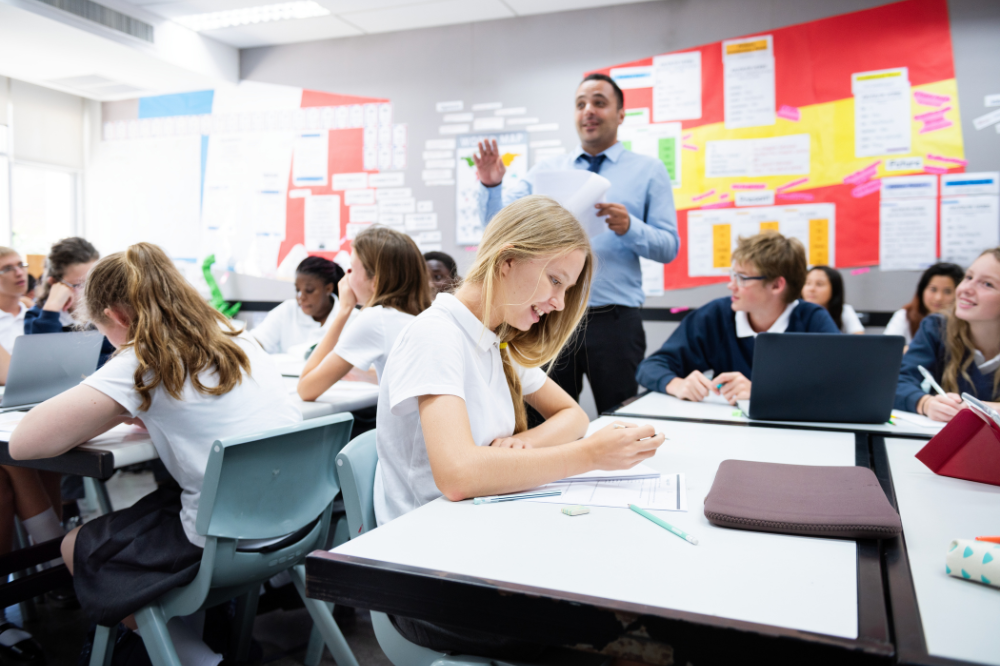
From academic pressure and bullying to mental health challenges, social media and uncertainty about the future, it’s clear that young people are dealing with a lot.
However, despite these immense pressures, the majority remain remarkably clear-eyed about what helps them thrive – both in and outside of school.
The second instalment of NAB’s 2026 Education Insights Report, titled ‘Life at School’, surveyed 400 secondary school students across Australia during 2025, revealing what they are worried about, what they value most, and where they believe schools can do better.
The survey found that overall enjoyment of school among Australian high school students dropped noticeably in 2025, after a brief uptick in 2024. This downward trend was widespread, affecting students from almost all backgrounds and year levels.
The data suggests that the enjoyment gap between boys and girls is widening, with boys reporting a higher average enjoyment score compared to girls. For the first time since 2023, a greater percentage of students classified their school enjoyment as ‘low’ (27%) rather than ‘high’ (26%).
Interestingly, there were exceptions to this overall decline, with Year 10 students and those identifying as LGBTQI+ reporting a slight increase in enjoyment. However, the survey’s authors cautioned that the overall enjoyment levels of these students remained below those of their non-LGBTQI+ peers.
“This highlights the persistent challenges faced by these students, who may still be experiencing higher rates of discrimination or lack of support, despite small gains in their reported enjoyment,” the report stated.
Schools matter more than ever
Dean Pearson, NAB’s Head of Behavioural Economics said grades, exams and future pathways remain front of mind for most young people.
“This reflects how much young people care about their futures and how motivated they are to do well,” Pearson said. “For schools, the opportunity is to help students hold onto ambition without being overwhelmed by it, by building confidence, promoting perspective, and making sure effort and growth are valued as much as outcomes.”
Pearson said schools play a crucial role in helping young people cope with the pressures they’re facing, pointing out that students consistently describe schools as places that can provide structure, encouragement, support and belonging.
“They value calm and caring teachers, stronger wellbeing support, practical life skills, fair discipline and more personalised learning. That is a positive message for school leaders,” he said.
“It shows that students see schools not just as places of academic pressure, but as places of protection, guidance and possibility. Schools remain one of the strongest day-to-day influences on how young people feel about themselves and their future.”
Suggestions for improvement
Students said the teachers who make the biggest difference are those who combine strong subject knowledge with empathy, enthusiasm and a willingness to adapt their teaching to individual needs. Beyond academic ability, students valued teachers who create inclusive classrooms where they feel respected, understood and supported.
Many students said they wanted educators to better recognise the challenges that can affect learning.
One student highlighted the difficulties associated with ADHD, while another noted that “there may be underlying factors like anxiety and different learning styles that affect how students approach their studies, and they aren’t always visible.”
Others called for greater emotional awareness from teachers, with one student writing: “When I say I’m okay, ask me again until I’m honest and say I’m not.”
Students also argued for more personalised approaches to learning, with one commenting that “everyone shouldn’t be handed the same exam as it doesn’t test everyone properly.” They called for improvements ranging from better wellbeing support and safer school environments to upgraded facilities, stronger action on bullying and hate crimes, more practical learning opportunities such as “a weekly real-life skills class”, and later start times so students are not “tired and grumpy and actually want to learn”.
Overall, students said they want schools that balance high expectations with flexibility, understanding and genuine care for their wellbeing, both inside and outside the classroom.
Students call for practical life skills, stronger wellbeing support
When asked what single change would improve their school, students overwhelmingly called for greater personal support, more practical learning and stronger social connection.
Suggestions ranged from improved mental health services and confidential support pathways to enhanced facilities and stricter enforcement of vaping rules. Many students argued schools should provide more personalised learning approaches that accommodate different strengths, weaknesses and learning styles.
Several respondents also wanted schools to teach practical life skills.
“Add a weekly ‘real-life skills’ class to teach useful things like managing money, basic cooking, fixing things and handling stress.”
Others called for later school start times, stronger year-level connections and greater participation in sport and extracurricular activities.
What students wish teachers understood
One of the strongest themes emerging from the report was students' desire to be understood as individuals rather than judged solely on academic performance.
Many students said teachers do not always see the anxiety, family challenges and emotional pressures that can affect learning.
“I wish my teachers knew sometimes when I'm quiet or don't finish my work, it's not that I don't care. I might be feeling overwhelmed, anxious or dealing with something outside of school.”
Others argued that a one-size-fits-all approach to assessment fails to recognise different abilities.
“It would be like asking an elephant and a monkey to climb a tree.”
Students under pressure, but hopeful
Pearson said the most encouraging finding out of the report for schools is that “challenges and hope can coexist.”
“Even while students report significant pressures, many also describe improvements in physical, emotional and mental wellbeing, and continue to express optimism about their future,” Pearson said. “That matters. It tells us that schools can play a key role.”
Pearson said that when schools create environments built on care, connection, relevance and trust, they are not just helping students cope - they are helping them build resilience for life.
“Taken together, the clearest message is that while today’s students are under pressure, but they are also hopeful, responsive to support and capable of thriving when schools continue to evolve as places of care, confidence and preparation for life.”