



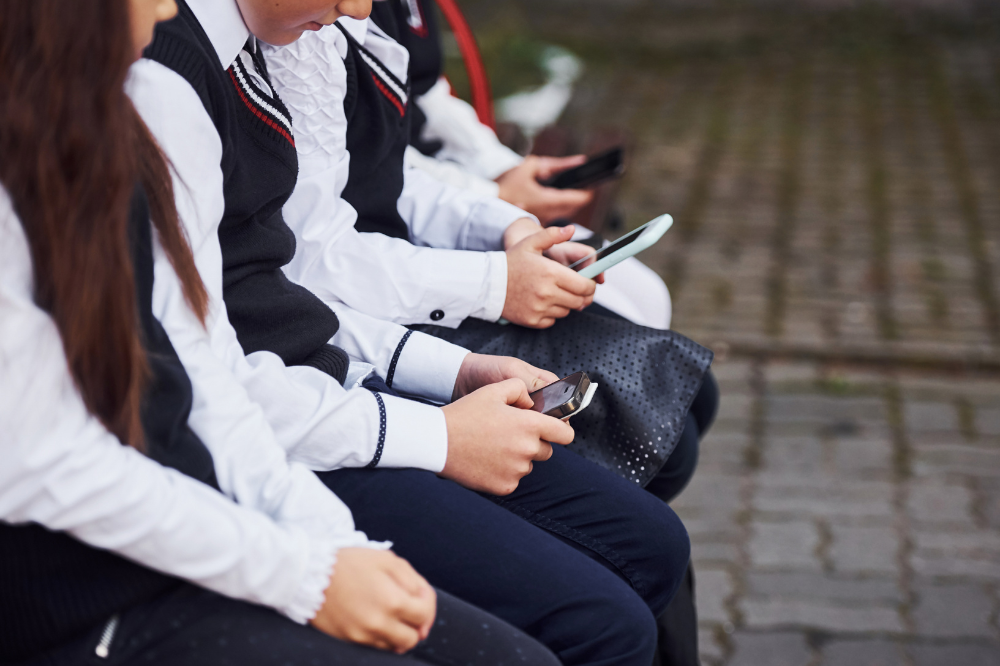
New research shows delaying smartphones across a school's entire cohort reduces mental health problems, giving leaders evidence as new guidance on smartphones in the UK looms.
The working paper, released by the Institute for Fiscal Studies (IFS), found that when a critical mass of parents at the same school agree to delay giving their children smartphones, mental health problems among students fall.
Economist Gregory F. Veramendi, an associate professor at Royal Holloway, University of London, examined 329 English primary schools where at least 20% of families had signed the Smartphone Free Childhood movement's "Parent Pact" by June 2026. He compared those schools with matched schools drawn from roughly 12,000 schools where fewer than 5% of families had signed, accounting for earlier mental-health levels, neighborhood affluence and school size.
Using a matched difference-in-differences design, Veramendi compared changes in children's mental-health needs in schools where a large share of parents signed with changes in similar schools where very few did. Where at least one-fifth of families signed, school-recorded social, emotional and mental health needs fell by around 8% relative to the counterfactual.
"My main finding is that children's recorded mental-health needs fall substantially where the pact is widely adopted," Veramendi wrote in the paper, published by the IFS in July 2026 and not yet peer-reviewed.
Distinguishing the policy from school phone bans
Veramendi drew a distinction between coordinated ownership delay and in-school phone restrictions, arguing the two address different problems. He said in-school bans alone showed no substantial mental health benefit, since they restrict access only during school hours.
"Coordinated ownership delay is a different policy," he said. "It changes the norm for when children first receive a smartphone, and it costs almost nothing to operate. The evidence here indicates that where communities adopt it intensively, children's mental-health need falls."
The distinction is timely for school administrators. Government guidance issued in January 2026 states that schools should be mobile phone-free environments by default, with any exceptions handled on a case-by-case basis, and schools have been expected to follow the guidance from September 1, 2026. Under Section 36 of the Children's Wellbeing and Schools Act 2026, the guidance now carries legal weight, a provision that took effect on June 29, 2026. Ofsted has said it will assess schools' phone policies during inspections.
Independent caution on causality
Not all researchers are convinced the findings prove cause and effect. Candice Odgers, professor of psychology and informatics at the University of California, Irvine, cautioned against overinterpreting the study in comments to The Times.
"I would not place this in the 'causal' evidence category," Odgers said. "It does not actually measure whether the students had lower smartphone use or exposure; the measure is parents' intent to give the child a phone as indicated by signing a pledge. It is a bold jump here to making this claim."
Broader research on youth smartphone use adds context to the debate. A King's College London review of 41 studies covering 41,871 young people estimated that 23% showed problematic smartphone use, including difficulty controlling their use or neglecting other activities. Researchers found consistent associations with depressed mood, anxiety, stress, poor sleep and weaker educational outcomes, while warning the evidence showed correlation rather than cause.
Movement scale
Smartphone Free Childhood launched its parent pact in 2024, encouraging families to jointly delay handing children a smartphone until age 14. More than 165,000 families have signed to date, according to the group.
For school leaders weighing implementation costs alongside the new statutory duty, Veramendi's paper frames coordinated delay as a low-cost complement – rather than a substitute – for mandated phone-free classrooms.