



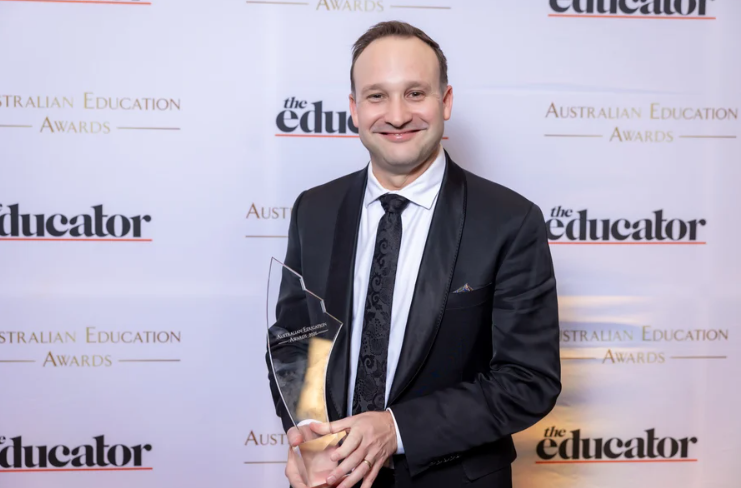
Some school leaders map out their path to the principal's office years in advance. Danny Crump wasn't one of them. Becoming a Principal, let alone Australia's best one, was never part of his plan, and the people who spotted his potential got there long before he did.
“I never had a career plan that said, ‘I want to be a Principal.’ I love teaching, I love working with young people and seeing them develop, and I was fortunate to have people around me who saw my own leadership potential, possibly before I saw it myself,” Crump told The Educator.
For Crump, what stood out most in the transition to school leadership at Stuartholme School in Toowong, Queensland was the shift from being responsible for his own work to creating the conditions for others to do their best work.
“I think that is incredibly challenging, but also very energising,” he said. “Principalship certainly carries differing weights of responsibility, some of which you’re never fully cognisant of until you’re in the chair.”
However, Crump said listening well, building trust and bringing people together around a shared purpose are at the heart of what Principals do.
“Ultimately, it is servant leadership that speaks most strongly to me.”
On Friday 7 August 2026, this unwavering commitment to his staff and students won Crump the Australian School Principal of the Year Award at the Australian Education Awards 2026.
Making room for others to grow
The philosophy that underpins Crump’s approach to school leadership is one built on trust, not answers.
“I think leadership is deeply relational, but it also needs a great deal of purpose. Trust matters, and leadership is about cultivating the conditions in which people, and indeed the organisation, can grow,” he explained.
“I don’t believe the Principal needs to have all the right answers. In fact, I think it is about enabling those you work with to bring different perspectives, to challenge your thinking, and also being prepared to ask the right questions yourself.”
Crump said this balance between autonomy and accountability is woven into the school's DNA.
“At Stuartholme, our Sacred Heart tradition speaks about educating to personal growth in an atmosphere of wise freedom,” he said. “This resonates strongly with me.”
Crump said the school places a great deal of value on individual agency, taking appropriate risks and encouraging students and staff to bring their gifts to the table, while remaining connected to a clear purpose and a sense of collective responsibility.”
“It is a privilege to work alongside others in leadership, to imagine what might be possible and to help people recognise how they can contribute to something bigger than themselves.”
The place where the title falls away
Despite the demanding nature of Principalship, Crump still takes time out to teach in the classroom, calling it his “happy place”.
“I thoroughly enjoy still being in the classroom. It is very much my happy place because, for that time, I can simply be Mr Crump rather than the Principal,” he said.
“It keeps me connected to the core business of the school and reminds me that the decisions being made in an office or around the Board table are all inherently connected to the young people we work with.”
Crump said teaching not only reminds him of the craft and skill involved in what teachers do daily, but allows him to see his students in a different way.
“I get to see their humour, their growth, their thinking and the things that matter to them,” he said. “Whilst I know not every Principal can maintain a teaching load, for me it is incredibly valuable. It keeps me grounded and reminds me why I do what I do.”
Conviction…with a soft edge
When asked what he believes makes a great Principal, Crump pointed to a balancing act few leaders ever master.
“I think a great Principal needs to hold true to a stable core while being prepared to disrupt at the edges,” he said. “Other important attributes are having a clear sense of direction, while remaining curious and open to other perspectives. A good leader listens outrageously loudly.”
Decisiveness matters too, but Crump is quick to attach a caveat.
“Be prepared to make difficult decisions, but also have the humility to acknowledge when you might have got something wrong,” Crump said. “There is also a constant balance between thinking strategically about the future and remaining attentive to the here and now.”
For Crump, though, none of this counts for much without the one quality that sits beneath it all.
“Above all, you need to care deeply about young people and believe in their capacity for success and growth,” he said. “Education is incredibly hopeful work. We are investing in a future we cannot fully know, and I think maintaining that sense of hope and possibility is one of the most important things a Principal can bring to a school community.”
What must remain human
Crump said one of the profession’s greatest challenges at present is also one of its greatest opportunities: determining what education needs to evolve and become in a world that continues to change rapidly.
“AI is, of course, an obvious part of this conversation, but I think schooling and education have never been more significant at a time when we need to understand more than ever the importance of being human,” he said.
“At the same time, Principals are navigating increasing complexity around student wellbeing, parent expectations, workforce sustainability, regulation and the financial pressures facing schools and families.”
Crump said the real risk is not the pressure itself, but what it crowds out.
“We need to be careful that we don’t become so consumed by managing that complexity that we lose our capacity to imagine what might be possible,” he said. “Again, I come back to the idea of maintaining a stable core while being prepared to disrupt at the edges.”
Whatever changes around us, education remains a profoundly human endeavour, said Crump.
“Our responsibility is to develop capable young people with character, courage, curiosity and compassion, and the confidence to contribute meaningfully to the world and shape it for the better.”