



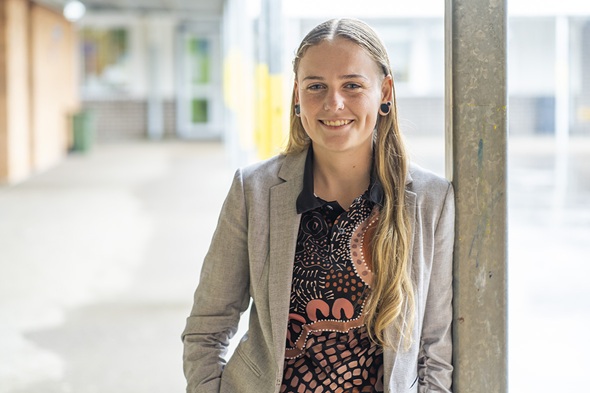
Jade Bassett is living proof that a teacher doesn’t have to be in the classroom for long to make a profound impact.
Bassett, who once described herself as a “disengaged student”, was crowned the FACTS Education Rising Star of 2026 on 7 August at the Australian Education Awards – an accolade that now accompanies several other major achievements in a career that is still blossoming.
From being shortlisted in the Top 50 Global Teacher Prize finalists to winning the 2025 Australian Schools Plus Teaching Fellowship and earning a spot among The Educator's Most Influential Educators for 2026, Bassett has an inspiration to other young educators who are looking to make their mark.
“Teaching was never something I saw as simply delivering content,” Bassett told The Educator. “I became a teacher because I wanted young people to experience the opportunities, confidence and sense of possibility that can come from having someone genuinely believe in what they are capable of.”
Bassett said that, as a science teacher, she quickly realised that some of the most powerful learning happens when students can see where what they are learning might take them beyond the classroom.
“That became particularly important to me in STEM, where many young women still don't necessarily see themselves represented in particular careers or industries,” she said.
“Over time, my role has evolved from teaching science and chemistry to creating opportunities that I wish every young person could access – connecting students with universities, industry, engineers, entrepreneurs and experiences where their ideas have genuine value.”
The difference between watching a future and living it
Bassett said the one thing that continues to drive her is seeing a student realise that their age, background or gender doesn't determine the size of what they can achieve.
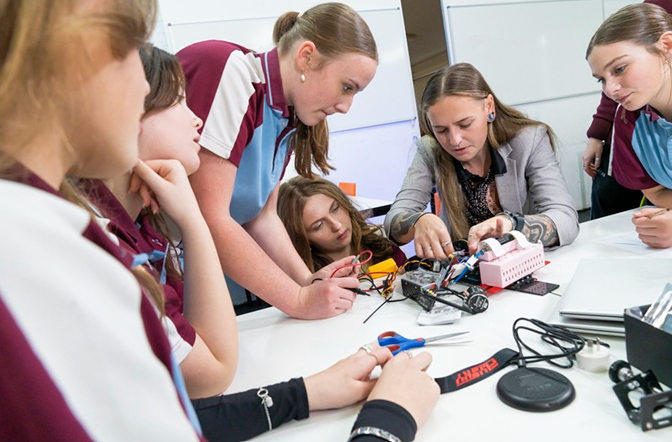
“My philosophy is that students shouldn't have to wait until they leave school to do something real,” she said. “I want students to experience STEM as something they actively participate in rather than something they simply learn about.”
Bassett said that means designing opportunities where students solve genuine problems, work alongside industry and universities, build and test ideas, enter competitions, develop businesses and present their thinking to people beyond their classroom.
“That philosophy underpins our Women in STEM program. Exposure is important, but participation is what builds confidence,” she said. “I don't just want students to meet an engineer; I want them to work like one.”
Bassett said the same goes when it comes to any young person who dreams of starting their own business.
“I don't just want them to hear from an entrepreneur; I want them to develop an idea, pitch it and discover that somebody might actually invest in it,” she said. “More broadly, I think education is at its most powerful when students stop asking, ‘When will I ever use this?’ because they're already using it.”
What changes when a 14-year-old is taken seriously
In 2023, Bassett founded the Women in STEM program at Rutherford Technology High School, where students were challenged to identify a genuine problem and develop a STEM-based business solution.
“One of our Year 8 students took that opportunity far beyond what anyone might ordinarily expect of a 14-year-old,” Bassett said.
“She developed her own company, refined the concept and ultimately pitched it in an environment where her idea was treated as exactly that – an idea with genuine commercial potential, rather than simply a school project.”
The result was an extraordinary $250,000 investment offer from a leading investor.
“For me, the most powerful part wasn't the dollar figure,” she said. “It was what happened when a young person was placed in a room where nobody asked her to ‘think like a Year 8 student’.”
Bassett said the girl was expected to “think like a founder”, and, in turn, she rose to that expectation.
“It completely challenges what we assume students are capable of when we give them access, trust and an authentic audience.”
Success isn't how far you go – it's who follows
For all the ground her program has broken, Bassett is candid about what she'd consider true success: a future where it no longer exists. She envisions a day when a young woman's rise to engineer, scientist or founder needs no special program to make it possible, and no explanation at all.
“The ultimate success, to me, would be reaching a point where a young woman becoming an engineer, scientist, founder or technology leader is so unremarkable that we no longer need programs specifically designed to convince girls that those spaces belong to them too,” she said.
“But I also hope today's students remember that there was a generation of women who held the door open and then expected them to hold it open for the person behind them.”
Bassett said that if students go on to build companies, lead classrooms, laboratories or industries, she hopes they carry that responsibility with them.
“Success shouldn't only be about how far you personally travel; it should also be about how many people have greater opportunities because you were there,” she said.
“If they eventually create opportunities for others that we couldn't even imagine for them today, I think we will have done our job.”