



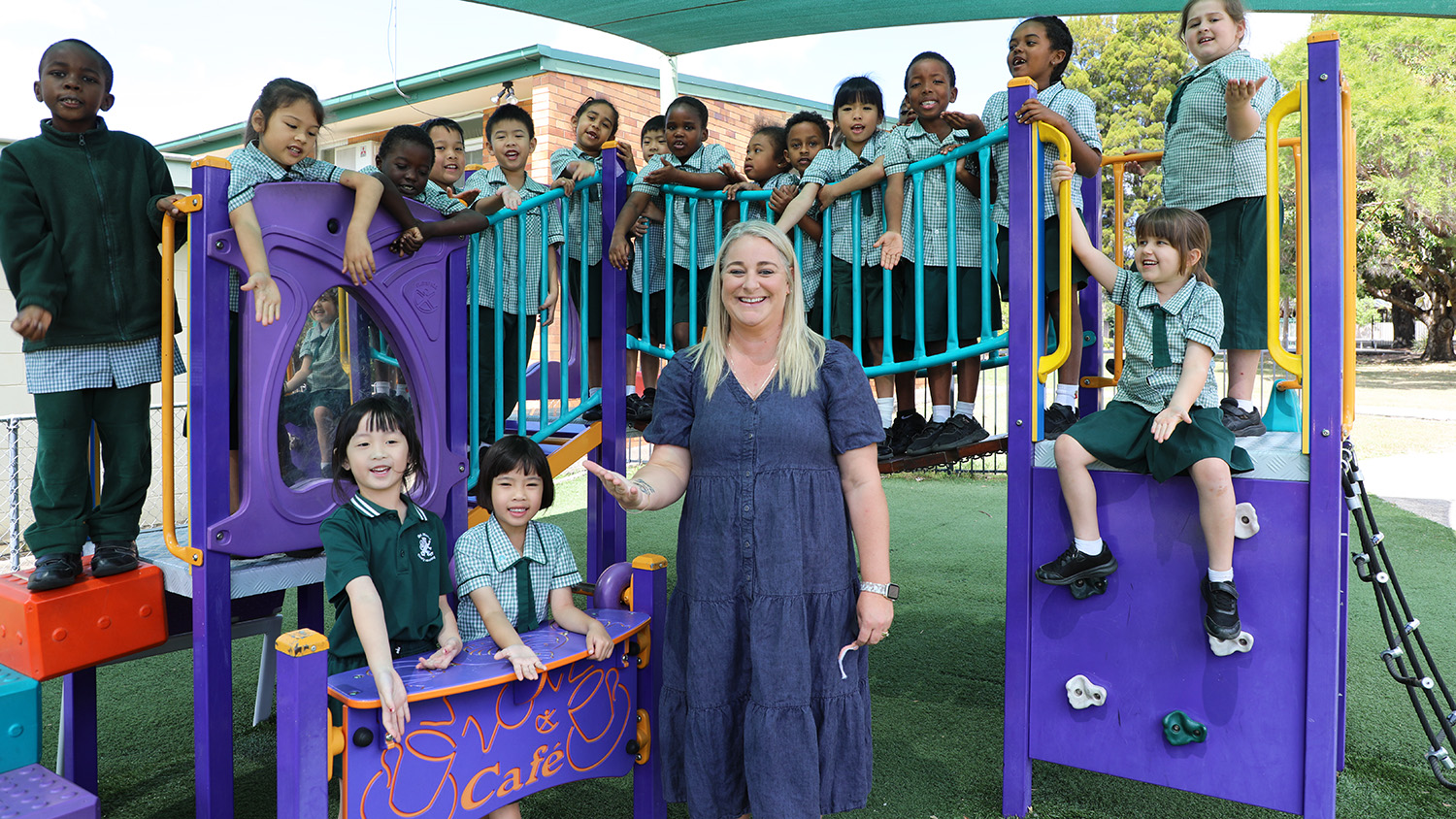
A Year 1 teacher at St Mark’s School, Inala, has won a Brisbane Catholic Education (BCE) award after turning a classroom communication strategy into a practice shared across her whole school.
Jessica Neilson-Scott received the NGS Super Award for Excellence in Learning and Teaching in Primary School for introducing Key Word Sign, BCE said. The awards night was held at Brisbane City Hall on 14 August. BCE received 633 nominations from 116 schools and its head office, and named 127 individuals and 22 teams as finalists.
Key Word Sign adds signs to spoken words by signing the key words in a message, according to a school guide from Down Syndrome Queensland. The guide said it is not a sign language but borrows signs from Auslan, Australia’s sign language.
A strategy that started with one student
Neilson-Scott introduced the approach to her class last year. She said she wanted to understand her students’ needs and ensure everyone could take part in learning.
“I knew there was one particular student who had so much to contribute, and I wanted to make sure there were no barriers, ensuring every opportunity to communicate his thoughts, participate in classroom activities, and build relationships with their classmates,” she said.
“When I discovered Key Word Sign, I saw it as a way to create more opportunities for communication, not only between this one student and I, but between the students in my class and their peers as well.”
Principal Allison Malouf said Neilson-Scott researched the approach with the school’s Student Support Team and the student’s family, and drew on her familiarity with Auslan. She also completed additional training.
“But rather than introducing it solely as a support strategy for one student, she made a deliberate decision to teach it to every child in her classroom,” Malouf said.
“Jessica’s impact didn’t stop at introducing Key Word Sign in her classroom alone,” she said.
“She now works closely with staff to build their confidence using Key Word Sign and supports them to embed it into their own classroom practice.
“Jessica regularly introduces new signs at school assemblies, giving all students the opportunity to learn and use Key Word Sign. This consistent exposure has helped create a shared language across the school, reinforcing our commitment to inclusion and belonging.
“Because of Jessica’s passion and leadership, Key Word Sign has become something the whole school community embraces. Students are using it in classrooms, in the playground and during whole-school events, creating more opportunities for connection, understanding, and participation for everyone.”
What educators can take from it
Down Syndrome Queensland said teachers it consulted had identified communication as a consistent barrier to students’ inclusion and learning. Its guide said Key Word Sign helps students understand teachers and peers, and does not hinder speech development.
Key Word Sign Australia, which runs training, describes the approach as designed for people with communication difficulties. It said teachers and aides also need to use it to model communication and create a signing environment. The group said research shows signing does not stop children from speaking where speech is possible.
A 2018 Macquarie University study of 196 pre-service early childhood teachers found Key Word Sign held potential for building the conditions for inclusion.
BCE’s account of St Mark’s does not include outcome data, so the evidence for whole-class use rests on the principal’s description. The school’s sequence is nonetheless clear: start in one class, train with specialist and family input, then spread through staff coaching and assemblies.
Educators weighing similar moves should check resources carefully. Key Word Sign Australia said some materials sold in Australia use American or British signs rather than Auslan.
“I became a teacher because I wanted to make a difference. I love teaching and seeing the difference I make to these students,” Neilson-Scott said.
“Whether it’s helping a child achieve a learning goal, build confidence or feel a sense of belonging, those moments are what make teaching so rewarding.
“Knowing something that started in my own classroom is now helping students across our entire school build friendships, participate more confidently, and feel included, is something I’m really proud of.”