




For Year 12 students weighing up their next move, the best graduate prospects may lie well beyond the big-city campuses, with new national ratings showing regional universities lead the country on pay and jobs.
The 2027 Good Universities Guide, released by Anyway on 17 November, compared all 41 Australian universities across eight categories of student experience and graduate outcomes.
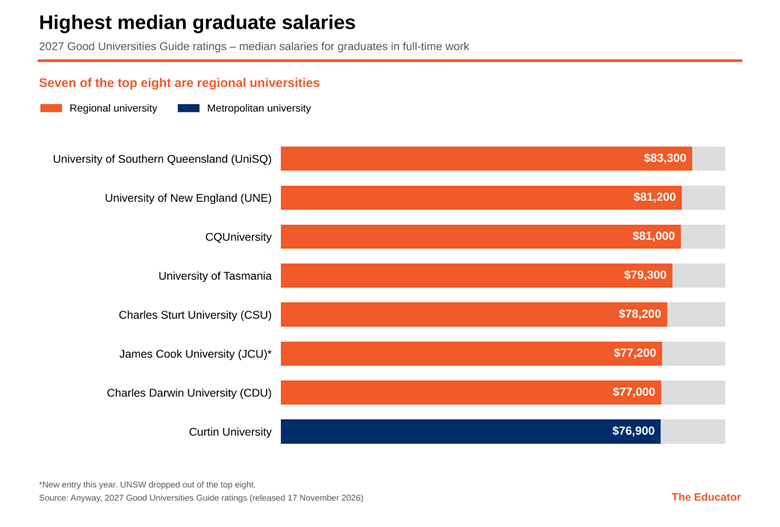
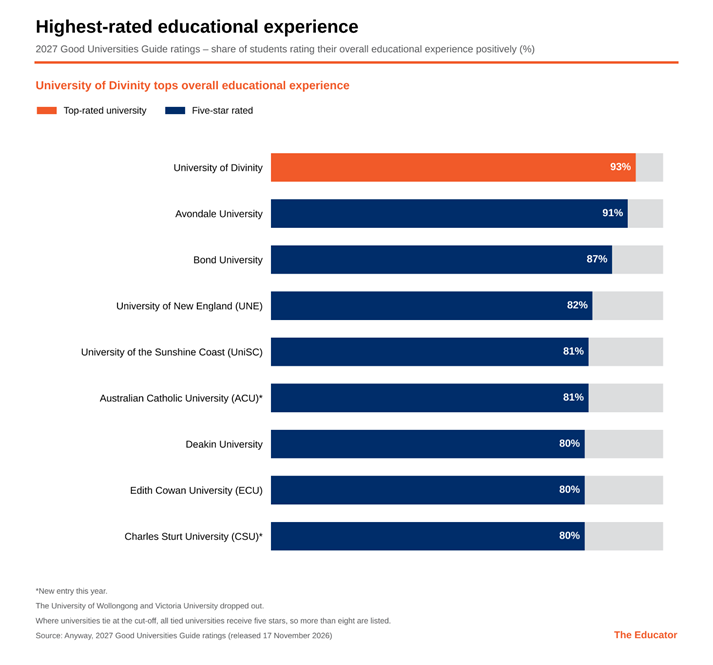
Seven of the eight universities with the highest graduate median salaries are regional, led by UniSQ ($83,300), UNE ($81,200) and CQUniversity ($81,000). Avondale University also climbed to first place for full-time employment, at 91%. Smaller institutions did well too, with Avondale and Bond University dominating the student experience ratings.
Why the big-city pull persists
Amanda Bardas, Head of Growth Strategy at Anyway (formerly Year 13), said the pull of big-city campuses often comes down to familiarity.
“Students tend to apply where their friends are going, or where the university names are most familiar,” Bardas told The Educator. “For many families who live in a capital city, a big metro university feels like the safe choice, and moving out of home is a significant cost and a big step straight out of high school.”
Bardas said advisers can help students compare universities on the specific courses they are interested in.
“A regional university won’t suit everyone, but it should be part of the conversation rather than ruled out by default,” she said, adding that with seven of the top eight universities for graduate salaries located in regional areas, the results likely reflect both the courses on offer and the work the institutions themselves are doing.
“Regional universities often have a strong focus on courses that support the local workforce, which lead into jobs with good starting salaries and strong demand,” Baras said. “But that doesn’t take away from what these universities are doing – many have built close links with local employers, designing courses around the jobs their communities need.”
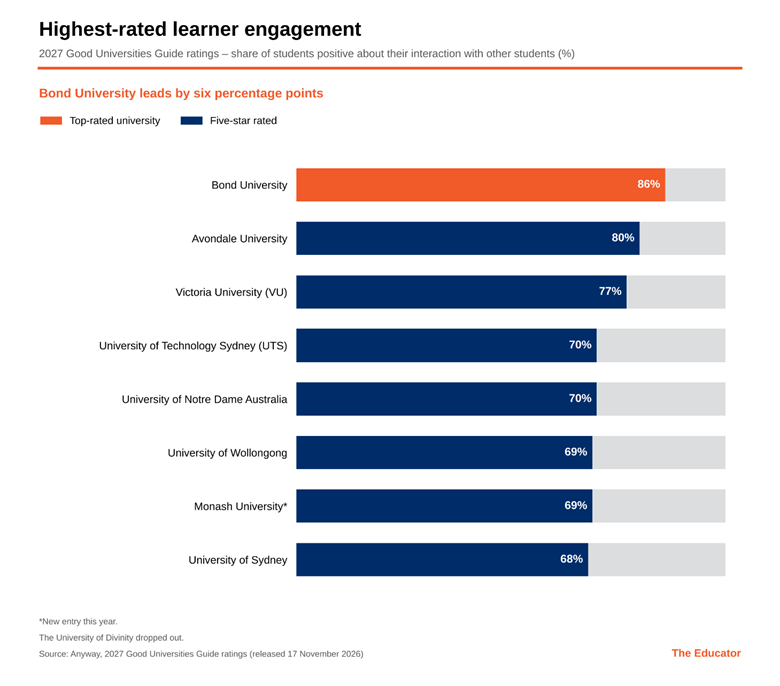
With learner engagement – a measure of how connected students feel to their peers – consistently the lowest-scoring area across the sector, Bardas said young people point to big changes in what student life looks like.
“They’re working part-time, commuting, living at home, completing some of their studies online – so they’re on campus less and have fewer chances to meet people,” she said. “Some also arrive on day one thinking it’ll be just like school.”
Bardas said schools can help by preparing students for what campus life is actually like before they leave.
“It’s different – but the best way to engage is to go to orientation, join a club or study group and treat building a network as part of the uni experience,” she said.
“Students who find their people in the first few weeks have an easier time settling in.”
Smaller universities stand out for student experience
Avondale University features in seven of the eight categories, Bond University in six, and the University of Divinity and the University of the Sunshine Coast (UniSC) in five each.
Larger universities appear less often in the institution-wide ratings, which reflect the experience across many different student cohorts. Their strengths show more clearly at field-of-study level, where Monash University, the University of Queensland and the University of Sydney each received more than 40 five-star ratings.
Adelaide University is rated as a single institution for the first time, following the merger of the University of Adelaide and the University of South Australia. Because the ratings draw on survey data from recent students and graduates, its results reflect the experience at both former institutions.
 While
Look past the overall score
While Monash, UQ and the University of Sydney each picked up more than 40 five-star ratings at field-of-study level, they appear less often in the institution-wide ratings.
Bardas said students weighing up a big university should lean on the field-of-study results.
“Institution-wide ratings average the experience across tens of thousands of students and dozens of faculties – a strong course can get lost in the overall number,” she said, adding that the institution-wide ratings are still useful for things that apply across the whole university, such as student support and learning resources.
“Our advice is to start with the course, look at how students in that field rate the teaching and what grads go on to earn, and then use the university-wide ratings to get a feel for the wider experience.”
The full ratings will be available on the Good Universities Guide website later this month.