



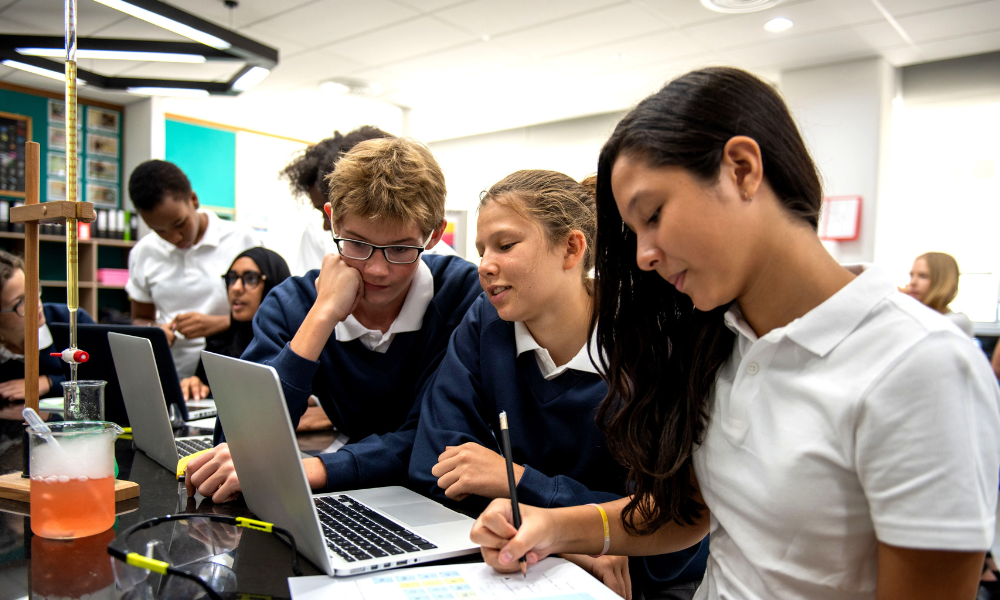
In 2008, Canberra launched the Digital Education Revolution, ultimately spending $2.4bn to put computers in front of students. Laptops were meant to transform learning. Now, the conversation is about what they’re getting in the way of.
A growing body of research has shown that, when used excessively, digital devices can adversely impact cognitive development, self-regulation, and behaviour. The arrival of AI in classrooms in recent years has only made this challenge more complex, with some experts warning that this technology may further degrade young peoples’ ability to think for themselves and learn.
So when the latest PISA results found that Australian high school students' results in maths and reading had hit their lowest point on record, education bureaucrats decided desperate times called for desperate measures.
Last week, education ministers agreed to introduce, trial or consider limits on screen use in schools and restrict student use of generative AI in primary schools and secondary school assessments, with each jurisdiction or sector to set timing and scope.
Ministers also agreed to return handwriting for Year 5 NAPLAN writing tests from 2028, subject to advice from the Australian Curriculum, Assessment and Reporting Authority (ACARA), which will also advise on doing the same for Years 7 and 9.
At the heart of these initiatives will be the Australian Schools Digital Detox Taskforce, announced by Federal Education Minister Jason Clare on 4 November, to ensure that “technology adoption and use in Australian schools must serve the purpose of advancing student learning and be supported by evidence.”
“Technology should be restricted in its use where it fails to advance student learning or causes harm,” the paper stated. “This is not about removing technology from schools. Students need digital skills, including the ability to use AI safely and responsibly, but technology must support learning rather than replace the thinking and effort through which young people build their knowledge and skills.”
As the Taskforce prepares to survey teachers, parents and students, Principals want to make sure teachers and school leaders are clearly heard before it reports to education ministers in 2027.
Principals must guide next steps
Andy Mison, President of the Australian Secondary Principals Association, said the Taskforce’s most useful role will be to give Principals “a consistent national approach” to devices and generative AI, which they have largely managed school by school “with little guidance.”
“Most would accept that some limits are warranted,” Mison told The Educator, adding that for secondary schools, limits should work as straightforward guidelines that schools apply to their context.
“A Year 7 student learning to manage a device for the first time and a Year 12 student preparing for an exam sat on screen need different settings.”
Mison said restricting generative AI in assessment will protect integrity.
“Students also need to learn when, how and why to use these tools, and to understand their limits and risks. That will take professional learning for teachers, with time to do it properly,” he said. “The Taskforce will make a meaningful difference if Principals and teachers are at the table from the beginning.”
Mison said Principals and teachers know where technology adds value, where blanket limits would add workload or widen inequity, and what support families need.
“Guidance designed with the profession is far more likely to work in classrooms.”
Debbie Hansen, Acting President of the Queensland Association of State School Principals, is serving in her current position until the end of the year before moving into Presidents role at the Australian Primary Principal's Association from January 2027.
Hansen agrees that Principals must be at the centre of the Taskforce’s work if its guidance is to be practical for all Australian schools.
“QASSP sees the establishment of the Taskforce as an opportunity to move beyond a simplistic debate about screen time and provide schools with clear, evidence-informed guidance about the purposeful use of technology in learning,” Hansen told The Educator. “However, it is imperative that Principals have a genuine voice in this work and are actively involved in co-designing the policies, resources and practical guidance that emerge from the Taskforce.”
Hansen said this is because Principals understand the realities of classrooms, the diversity of school communities and the challenges of translating policy into practice.
“Their experience must inform the process from the outset, rather than simply being consulted once decisions have been made,” she said. “I would expect the Taskforce provides practical resources, research and professional learning to support informed decisions about when technology enhances learning and when other approaches are more effective.”
Hansen said a thoughtfully implemented digital detox is not about removing technology, but restoring balance and intentionality.
“Children need opportunities to read, play, move, create and connect, while developing the digital literacy to use technology safely and responsibly in an increasingly digital world,” she said. “Ultimately, technology should serve learning, not dictate it, and principals and teachers must be trusted as partners in shaping how that happens.”
‘One-size-fits-all’ approach won't work
Welcoming the Taskforce, the Association of Heads of Independent Schools (AHISA) CEO, Dr Chris Duncan, said it was a timely response to growing concerns about students’ screen use, but that Principals must be given the flexibility to implement it in their own school contexts.
“AHISA is concerned with the mounting evidence that the overuse of screens by students within and beyond school is having a deleterious effect, not only learning and achievement, but also on student mental and physical health,” Dr Duncan told The Educator.
“A digital detox implies a much-welcome return to ‘tactile’ learning – feeling a pencil and turning a page – which contemporary brain science reveals is so fundamental to academic learning.”
Dr Duncan said that while applauding the government initiative, AHISA will “closely monitor” the implementation of the program.
“Our Association will resist a one-size-fits-all approach which is anathema to how our members lead their schools,” he said. “A carefully implemented program must allow Principals the latitude and judgement to leverage the program in ways sensitive to the context of their schools which serve distinctive communities.”
For other peak bodies, avoiding a one-size-fits-all approach also means avoiding a blanket ban on devices.
Andrew Dalgleish, President of the Australian Government Primary Principals’ Association, said an important starting point for the Taskforce will be clarity about what constitutes a “digital device”.
“[The Taskforce] must recognise the significant differences between personal devices, school-managed devices and technologies used specifically to support learning and accessibility,” Dalgleish told The Educator.
“Rather than a simple focus on reducing screen time, we would like to see a clear, evidence-informed framework that helps principals and teachers make intentional and purposeful decisions about when, why and how digital devices are used.”
Dalgleish said technology should be used where it “demonstrably adds value to learning”, while protecting opportunities for explicit teaching, reading, writing, creativity, physical activity and face-to-face interaction.
“Crucially, the Taskforce must draw on the practical experience of schools. AGPPA would welcome the opportunity to be represented on the Taskforce, ensuring the perspectives of government primary school Principals inform recommendations that are practical, evidence-based and responsive to diverse school contexts.”