



The world's most closely watched school report card has just been handed in, and the results are grim reading well beyond the countries that sat it. On 8 September, the OECD published PISA 2025, the triennial test of how well 15-year-olds in 91 countries can apply what they've learned in reading, maths and science to real-world problems. More than 760,000 students sat it. Average performance across OECD member countries has now sunk to the lowest levels ever recorded in all three subjects.
For readers running Australian schools, the temptation is to feel a little smug. We're not France. We're not Germany. Australian students remain above the OECD average across the board. But look past the ranking table and the same forces dragging down some of Europe's most admired systems, particularly around reading, equity and staffing, show up in our own results too.
Australia's report card – how did we do?
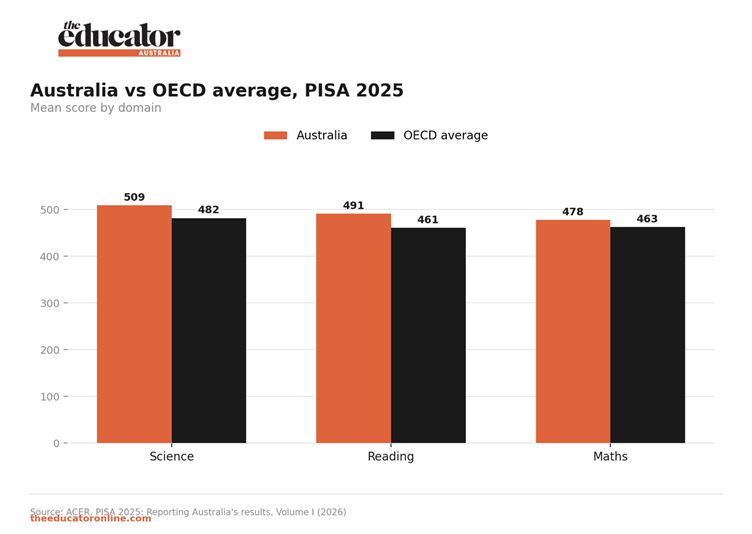
According to ACER's release of Australia's results, 14,658 Australian students across 766 schools sat PISA 2025, representing roughly 275,000 15-year-olds nationally. Australia scored 509 in science (OECD average: 482), 491 in reading (OECD average: 461) and 478 in maths (OECD average: 463). That's good enough for around 10th in the world for science and reading and around 16th in maths among the 91 participating systems.
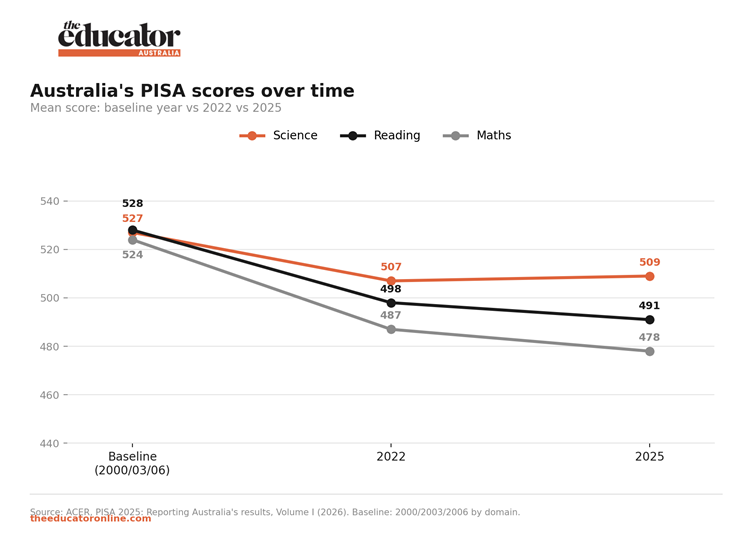
Reading and maths both fell to their lowest points on record. Reading is down 7 points since 2022 and 37 points since testing began in 2000. Maths has fared worse again: down 46 points since 2003 and 9 points since the last test, the steepest long-run decline of the three domains, and one that's dropped in every single cycle for over two decades.
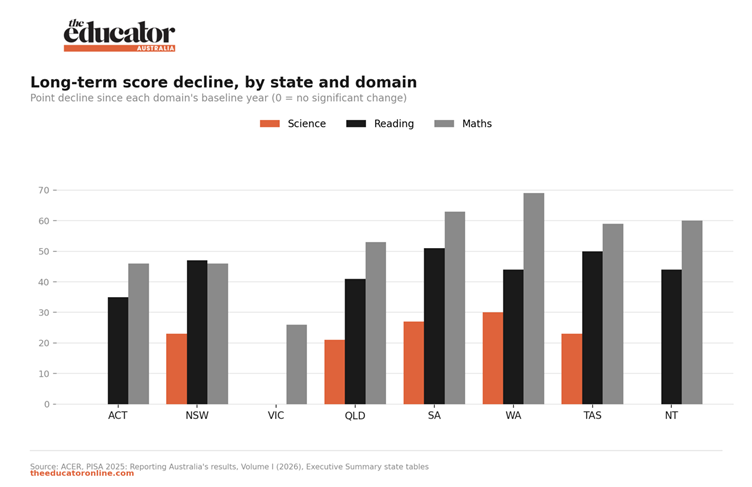
The national number also hides real variation underneath it. The ACT recorded the highest results in every domain (537 in science, 517 in reading, 502 in maths). Victoria, WA and NSW all scored above the OECD average across the board, while Queensland and South Australia sat above average in science and reading but closer to the OECD average in maths.
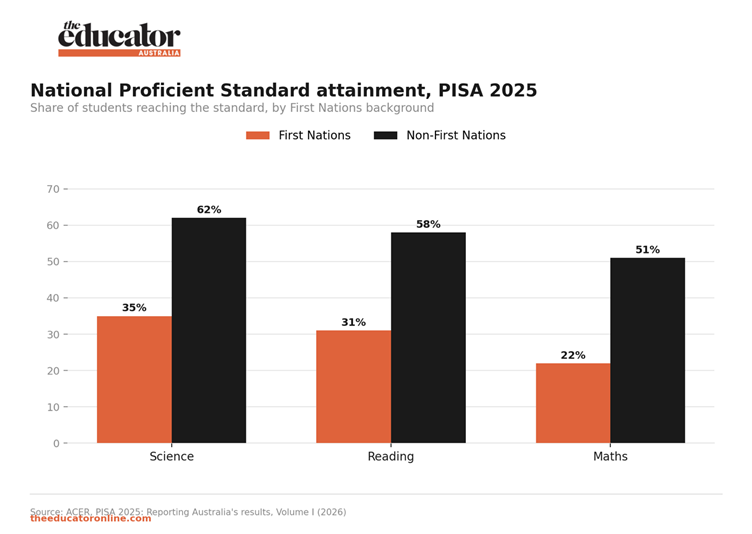
The gap for First Nations students remains large too: 72 points lower in science, 76 lower in reading and 74 lower in maths than non-Indigenous peers. Science was a bright spot here, improving 16 points for First Nations students since 2022.
Reaction split along predictable lines. ACER research director Dr Jonas Bertling said Australia could be "quite content" with the headline result while acknowledging the long-run reading and maths decline as a real concern.
Blaise Joseph of the Centre for Independent Studies called the trend "troubling," pointing to fewer high performers and more low performers than in previous cycles. Ballarat Clarendon College deputy principal Dr Greg Ashman, writing on his Substack, called Australia's maths trajectory "deeply worrying" and pinned some of the blame on curriculum design.
Federal Opposition education spokesman Julian Leeser put it more bluntly, telling reporters in Canberra that the school curriculum doesn't need "keyhole surgery" but "open heart surgery," starting with cutting the number of things schools are asked to teach.
Federal Education Minister Jason Clare used the results to defend the reforms rolling out under the National School Reform Agreement, pointing to England's jump of three places in reading, four in maths and seven in science as proof that reform can shift the numbers. His line that "the reading wars are over" nods to the phonics-based shift already under way in many Australian classrooms. But the England comparison cuts both ways. It's also a reminder that decline isn't inevitable, and that other systems are moving up while ours is largely standing still.
Europe's harder landing
If Australia's results are a flashing amber light, several of Europe's biggest school systems have gone straight to red. According to The Guardian, France and Germany each recorded their worst-ever PISA results, the Netherlands fell to an all-time low, and even Finland, long held up as the model system other countries tried to copy, saw scores drop again. England was the outlier, holding its ground while the rest of the continent's slide, which set in around 2018, continued. Across France, Germany, the Netherlands and Finland, the paper reported, the share of 15-year-olds lacking basic functional literacy and numeracy has climbed to nearly one in three.
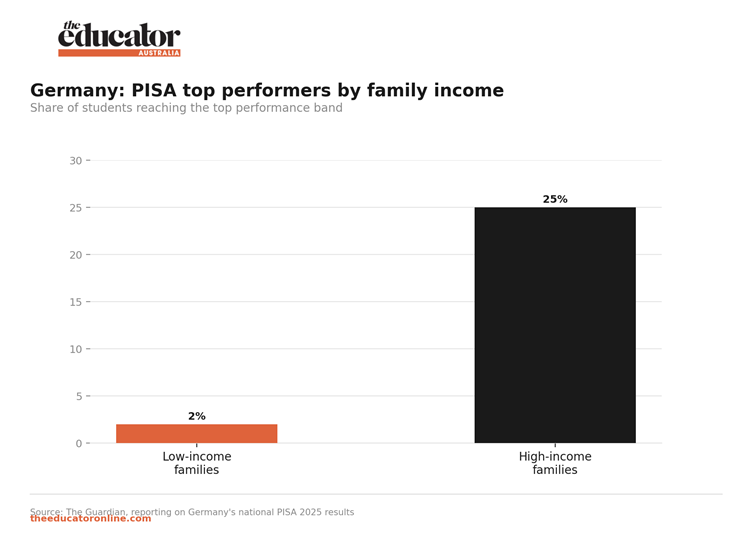
The detail is where it gets useful for a school-leader audience. In Germany, the link between a student's socioeconomic background and their results was roughly twice as strong as in Denmark or Norway: just 2% of students from low-income households reached the top performance bands, against 25% of those from wealthier families.
Germany's national PISA coordinator pointed to a growing number of teenagers leaving school without the basic literacy and numeracy needed for citizenship and employment. That should sound familiar to anyone who's read the Mitchell Institute's "Years Apart" research on Australia's own socioeconomic learning gaps, which found disadvantaged Australian students falling further behind their peers with every year of schooling, with the widest gap by Year 9.
In the Netherlands, close to two in five 15-year-olds, a record 39%, up from 33% in 2022, now lack the reading skills to judge whether a source is credible or work through a multi-page text. Researchers there found Dutch reading scores have fallen so far over the past decade that today's 15-year-olds are, on average, reading at the level 12-year-olds managed ten years ago. The Netherlands' teachers' union blamed cancelled classes, unqualified staff covering gaps, and workloads pushing experienced teachers out of the profession, a workforce story with obvious parallels to Australia's own staffing pressures.
France's result prompted a similarly sharp reaction, with far-right leader Marine Le Pen calling it a "catastrophe." Analysts pointed less to any single cause than to a decade of instability: eight different education ministers in ten years, teacher salaries below the OECD average, and a system where socioeconomic status heavily predicts outcomes.
One OECD education analyst argued the country's debate had become too fixated on how many hours students spend at their desks, rather than on giving teachers room to explore better teaching methods and stronger training. That's a critique Australian school leaders navigating their own curriculum and timetabling debates will recognise.
Even Finland, which hasn't overhauled its core curriculum in fifty years, posted lower reading and maths scores than in 2022. Its national PISA project manager said the results had prompted serious reflection on students' perseverance and effort, along with the uncomfortable admission that Finland isn't immune to the broader slide.
What this means for your school
None of the forces behind Europe's decline are unique to Europe. Each shows up somewhere in Australia's own data, and each is something a leadership team can actually act on now, ahead of ACER's more detailed Volume II release in December.
Reading is at a national record low, and OECD analysts have linked heavy phone and social media use to falling reading stamina. It's worth checking whether your phone policy and Tier 2 reading support are actually pulling in the same direction.
On equity, the Mitchell Institute's research shows Australia's socioeconomic learning gaps widen every year of schooling and peak in Year 9, the same pattern showing up in Germany's data. If your school hasn't recently disaggregated results by socioeconomic background, this is a reasonable moment to do it. Maths has declined in every PISA cycle since 2003, so with ACARA's early-years maths curriculum changes now rolling out, there's a real window to align classroom practice with the evidence base before the next cycle locks in another fall.
And on staffing, the Netherlands pinned part of its record-low reading result on classes covered by non-qualified staff. It's worth knowing how many of your own English and maths classes are currently taught out-of-field or by long-term casuals.