



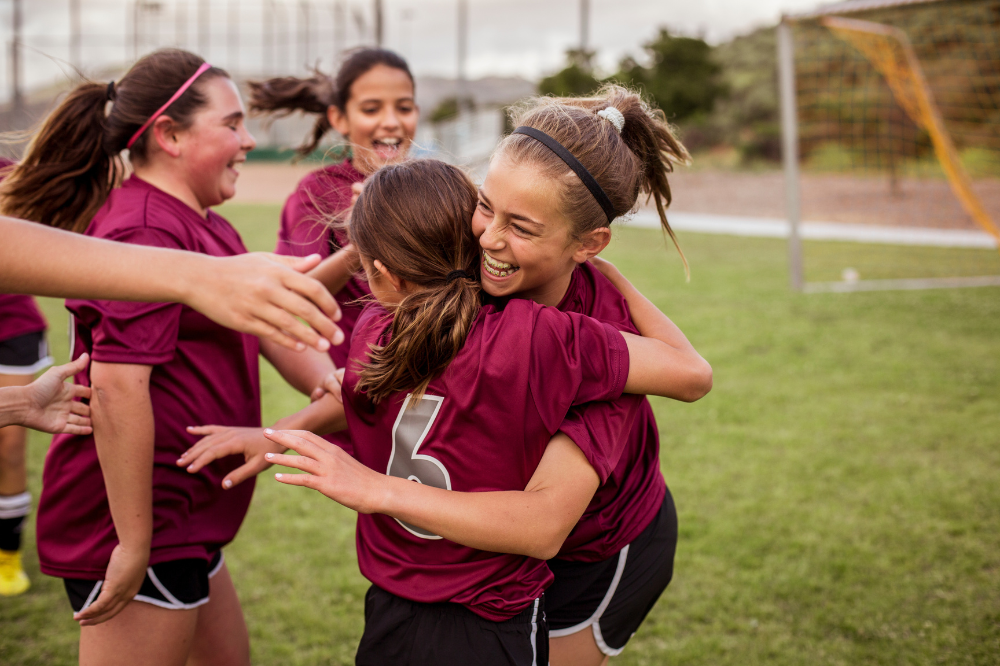
While it is widely recognised that sport can do wonders for confidence, mental health and overall wellbeing, many teenage girls are quietly walking away from it. Research from Flinders University shows that by age 15, around 60% of girls have dropped out of sport, compared to 42% of boys.
To address this, Cool.org teamed up with Dr Stacy Sims, a globally recognised exercise physiologist, nutrition scientist and author, to create a program aimed at helping Australian girls stay active and engaged in sport during the years they are most likely to drop out.
The ‘Bodies, Bias and Belonging’ program, designed for Years 5-10, includes more than 30 curriculum-aligned lessons focused on puberty, menstrual health, sports equity, and nutrition for girls.
Now, a $250,000 investment from social impact program MECCA M-POWER promises to expand the program, helping more Australian schools deliver high-quality lessons grounded in up-to-date, relevant, and Curriculum-aligned information.
The initiative builds on MECCA M-POWER’s broader commitment to girls’ sport and health, including backing the Trailblazers documentary, which has reached more than 100,000 students through classroom materials, supporting emerging female tennis players through the Australian Open, and launching the Momentum podcast by Missing Perspectives, celebrating women in sport.
With just 1% of global healthcare R&D funding – outside of oncology – directed to female-specific conditions, Bodies, Bias and Belonging responds to this significant gap that often results in a lack of understanding and support at the very moment girls need it most.
Breaking down long-standing barriers
Dr Sims is known for her pioneering research into female-specific sports nutrition and training, popularised by her mantra "women are not small men", and is also one of the recipients of the inaugural 2025 MECCA Prize.
“When we're looking at a lot of the barriers that girls are facing in sport, there tends to be a few different angles,” Dr Sims told The Educator. “When the sports environment is very male-centric, girls tend to shy away.”
Dr Sims said there's also the intimidation of strength training, of being strong in their sport – and the physical changes their bodies are going through, which can leave them feeling uncertain in their running stance or their sport stance.
“And then, of course, there's the menstrual cycle. A lot of people assume it's the period itself that pushes girls out of sport – but it really comes down to things like what uniform they're wearing, and whether they understand what's happening to their body,” she said.
“Because if they don't, the question becomes ‘what's wrong with me?’ instead of ‘this is happening to everyone.’ If we can normalise these experiences, the barriers start to drop.”
Dr Sims said the ‘Bodies, Bias and Belonging’ resources have been broken down to be easy to understand and easy to apply.
“We're really focused on nailing the basics – grounded in scientific evidence – so that anyone who engages with these courses comes away with a greater understanding of the physical, psychological and sociocultural factors that create these barriers for girls,” she said.
“If we can unpack those factors and bring the science to them, it empowers everyone – students, educators, parents – to take that step forward and truly understand what's going on.”
Dr Sims said real change depends on getting evidence-based support into the hands of educators.
“It doesn't matter how good your resources are - if they don't have a voice and a push behind them and we kept them to ourselves, there would be no impact,” she said.
“The investment and partnership with MECCA M-POWER gives us a much larger platform to get this information to everyone who needs it.”
‘An invaluable tool for educators’
Alexandra Pavlidis, Senior Health and Physical Education Teacher at Canterbury Girls' Secondary College, praised the resources as “an invaluable tool for educators” that supported young women in their learning journey.
“These resources will help us continue to deliver high-quality lessons grounded in up-to-date, relevant information aligned to the Victorian Curriculum,” Pavlidis said.
“The lessons empower students to understand everything from how nutrition fuels their body to exploring the factors influencing women’s participation in sport, helping build lifelong healthy habits.”
Pavlidis added that the resources are also highly adaptable across year levels, making them “a versatile addition to any HPE program.”
The resources were also brought to life at Canterbury Girls' Secondary College, in a Unit 1 Health and Human Development lesson focused on nutrition for young women, where student engagement was outstanding.
Canterbury Girls' Secondary College Students Alana, Theodora, and Chloe shared their enthusiasm for the program saying, “we all loved the Pick Your Plate game the most – we got to explore and compare the nutrients our bodies need while enjoying some friendly competition with each other for the medals!”
Students Genevieve and Sophie added, “being able to visually see how food fits into our daily intake makes it feel real, making it easier for us to apply what we learnt to real life.”
Helping girls build understanding and confidence
Jo Horgan, MECCA Co-Founder and CEO, said MECCA had long believed in the confidence that comes from truly understanding one’s body, strength, and potential.
“Every girl deserves to feel strong, capable and comfortable with who she is, and right now, too many girls are navigating puberty without the knowledge or support they need – and that’s simply not good enough,” Horgan said.
“Supporting this program is one way we can play a small role, helping girls build that understanding and confidence, so they stay in the game, trust their bodies, and back themselves every step of the way.”
Horgan said the program is designed to help girls better navigate the physical and emotional realities of adolescence.
“Bodies, Bias and Belonging gives young people simple, evidence-based tools to understand their changing bodies, how to move, how to fuel themselves, and how to build confidence through puberty – areas often missed in mainstream sport and health advice.”