



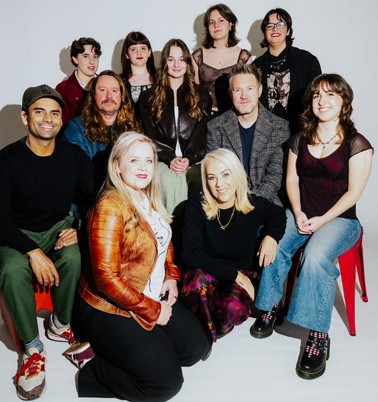
Photo credit: Michelle Grace Hunder
Front Row: Tushar Apte (Patron) Helen Marx (CEO The Mentor Academy and Board Member) Milly Petriella OAM (NUMAs Founder & CEO)
2nd row: John Waller (Music Teacher VIC), Eddie Perfect (Patron),
3rd row: The Fates (VIC) band members: Juno Russell-Petersen, Paddy Pearce, Ava Pearce, Esther Brown, Audrey McGuffie-Harris
Middle 2nd: Eve Beveridge (VIC)
In classrooms across Australia, a quiet paradox is playing out.
While decades of research show that quality music education lifts student wellbeing, engagement and academic outcomes, access to it is fading fast, with teacher training hours halving since 2009 and hundreds of thousands of children missing out altogether.
Recognising this, a new national initiative – Next Up Music Awards – is determined to change the tune.
Australia’s first ever contemporary music awards for youth aged 6-18 and music teachers throughout Australia are now opened for nominations, alongside applications for the national NUMAs Youth Intern Program for 20 youth aged 15-18 in roles across the music industry, creative and industry internships.
Launching on Thursday 28 January 2027, the inaugural NUMAs will be hosted by venue partner Carriageworks in Sydney. The awards will celebrate excellence across a diverse range of thirteen categories, including Artist of the Year, Song of the Year, Songwriter of the Year, Producer/Engineer of the Year, School of the Year and Music Teacher of the Year (Primary & Secondary).
Addressing a critical gap
“While music is technically part of the Australian Curriculum, in reality most students are still missing out on meaningful music education,” NUMA CEO & Founder Milly Petriella OAM tells The Educator.
“Three in four schools are missing out on a specialist music teacher, leaving 1.7 million children without quality music education[1].”
Petriella said the NUMAs were designed to tackle the problem from three angles.
“NUMAs responds to that gap by giving young artists, songwriters and producers a national platform to be seen and supported, recognising the teachers who make that work possible through the Music Teacher of the Year awards, and creating real pathways into the industry through the paid Youth Intern Program, on stage and behind the scenes.”
Star power with a deeper purpose
Australian icons Sia and Troye Sivan are among the first to join a distinguished group of Industry Patrons, alongside a long list of Australian music royalty supporting the initiative. They are joined by Mahalia Barnes as Artistic Director and DOBBY as First Nations Artistic Director, with Ruby Rodgers leading a national group of Youth Patrons who will help shape the program and ensure it reflects the way music is created, shared and celebrated by the next generation.
Petriella said the response from NUMAs Patrons shows that Australia has no shortage of talent, but the pathways to a career in music are still too informal, uneven and hard to navigate.
“Too often, young artists are left to work it out alone, depending on luck, location or who they happen to know,” she says.
“The fact that artists like Sia, Troye Sivan, Ruel, Marcia Hines and Kirk Pengilly have jumped on board shows a shared belief that young people need earlier, safer and more visible ways into music.”
Petriella said the program's secret weapon isn't the trophy or the recognition; it's the people and community gathered on their behalf to support them and provide real pathways that make a difference.
“Our Patrons help open doors, share knowledge and bring industry credibility, while our Youth Patrons keep the program grounded in what young creators actually need, even before they know they actually need it.”
The unseen hands behind every young artist
Petriella said behind every emerging talent stands someone whose contribution too often goes unseen.
“If we are serious about supporting young artists, we have to recognise the educators who help them get there,” she says. “Music teachers are often the first people to notice a student’s potential, give them confidence and create the space for them to write, perform, produce and collaborate, how often do we hear, “I want to thank my first music teacher who introduced me to music and changed the course of my life and career” on Grammy and ARIA stages”
At a time when many generalist teachers receive very limited arts-teaching training [2], specialist music teachers carry an enormous cultural and educational responsibility, says Petriella.
“Putting educators on the same stage as young artists says their work is not an extra, it is central to student engagement, wellbeing, creativity and future pathways,” she said. “With Music Australia presenting the Music Teacher of the Year awards, we hope it sends a clear message to school leaders and Education Departments that music teachers deserve proper recognition, support and investment.”
‘Back yourself!’
As the 15 September nominations deadline approaches, Petriella has a message for anyone hovering over the entry form, unsure whether they belong there.
“I would say: please do not wait until you feel ‘good enough and take up our challenge to Collaborate, Create, Nominate, Celebrate’,” she says.
“If you are recording songs in your bedroom, writing lyrics after school, producing beats, rehearsing with friends or helping music happen in your school or community, this platform was built for you.”
Petriella said self-doubt is the only real barrier to entry.
NUMAs is not looking for perfection, we’re looking for creativity, potential, commitment and voice. And to music teachers, I would say awards are not for ‘other people’,” she says.
“They are for the people doing the work every day, often quietly. Entering is free, and nominations close on 15 September. Back yourself!”
The NUMAS are open to students, teachers, schools and communities nationwide. To nominate, click here.
References
[1] 75% of schools lack a specialist music teacher, resulting in 1.7 million children missing a quality music education.
Robin Stevens, Trends in School Music Education Provision in Australia, The Music Council of Australia in collaboration with the Australian Society for Music Education and the Australian Music Association, 2003.
[2] Australian teachers receive an average of 15 to 20 hours of arts training during their three-year degree.
Hocking, H. (2009). National Audit of Music Discipline and Music Education Mandatory Content within Pre-Service Generalist Primary Teacher Education Courses: a report. Music Council of Australia.