



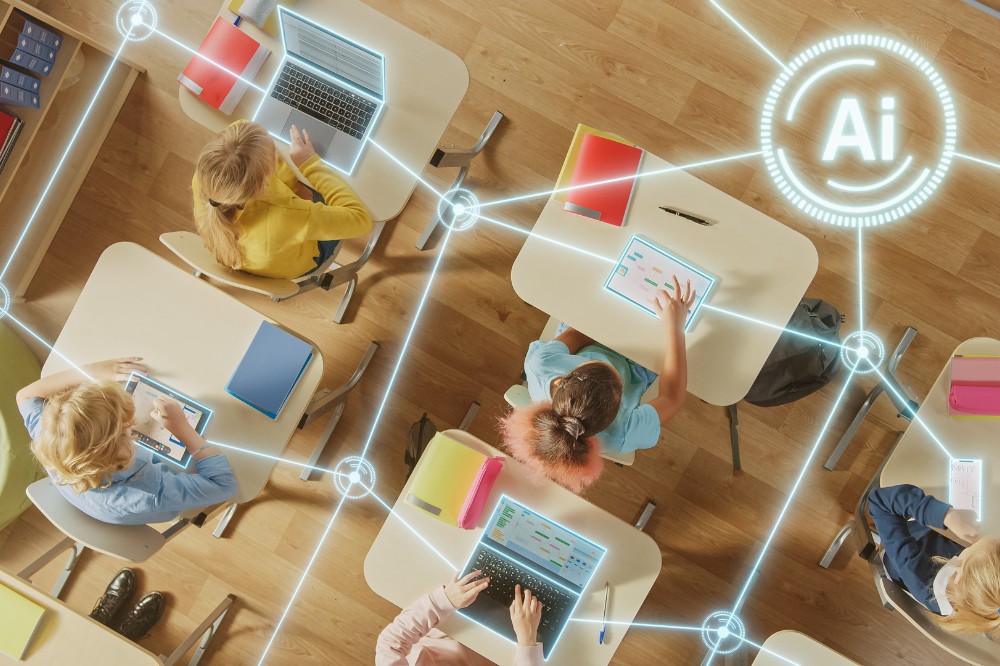
AI has moved into Australian schools faster than most school leaders predicted. According to Microsoft’s 2026 AI in Education report, a staggering 92% of students and education leaders, and 88% of educators, use this technology in their daily work.
Australian teachers are among the keenest users of AI, ranking fourth in the OECD’s TALIS survey.
However, most schools continue to fly blind when it comes to using AI.
In September, a study by Campion Education reported four in 10 schools had no formal policy on how students use generative AI. That leaves Principals with plenty to sort out.
A Microsoft spokesperson, whose company’s tools are already a fixture in thousands of Australian classrooms, said schools are facing several interconnected challenges as AI becomes more capable and more widespread.
“These challenges include building AI skills and confidence among educators and staff, protecting student privacy and security, rethinking teaching and assessment, making informed investments with limited resources, and ensuring technology expands opportunity rather than creating new divides,” a Microsoft spokesperson told The Educator.
“Perhaps the greatest leadership challenge is moving beyond isolated experimentation toward a shared institutional vision.”
The spokesperson pointed out that different teams often have different levels of AI readiness.
“Meaningful transformation requires alignment across leadership, teaching and learning, operations, and technology,” the spokesperson said. “Ultimately, education leaders must consider not only how AI can improve what schools do today, but also how education itself may need to evolve to prepare students for tomorrow.”
Before you leap, know where you stand
When asked how industry professionals become prepared for those challenges, Sean Tierney said the starting point is understanding where your institution is today and establishing a shared vision for where you want to go.
“Education leaders should assess AI readiness across their institution, including such areas as leadership and governance, teaching and learning, administration and operations, and technology, data, and security,” the spokesperson said. “This helps identify existing strengths, capability gaps, and areas requiring greater attention.”
From there, schools can take a deliberate approach, the spokesperson said.
“Engage educators and staff in shaping the strategy, establish responsible AI policies and security foundations, invest in AI literacy and professional development, and prioritise opportunities tied to meaningful educational and operational outcomes,” they said. “Rather than attempting to transform everything at once, institutions can begin with focused initiatives, learn from real-world experience, and expand approaches that demonstrate value.”
The spokesperson said Microsoft's Becoming a Future-Ready School framework introduces a practical five-stage journey: Explore, Prepare, Implement, Scale, and Transform.
“The framework provides education leaders with a way to navigate change while recognising that every institution will have its own priorities, resources, and starting point.”
An upcoming webinar hosted by Microsoft will help education leaders define what becoming future-ready means for their institution and how to translate the possibilities of AI into meaningful action.
Attendees will explore:
- How to evaluate institutional AI readiness: Discover a five-level maturity model to help identify strengths and opportunities across key institutional functions.
- A practical roadmap for AI transformation: Explore five stages, from understanding what is possible and preparing the foundations to implementing, scaling, and continually transforming.
- How to lead responsible transformation: Consider the importance of security, privacy, governance, educator empowerment, and preserving human judgment and agency.
- Where to begin and what to prioritize: Learn how to identify meaningful opportunities, engage stakeholders, and focus investments on outcomes that matter to students, educators, and school communities.
Participants will also be introduced to Microsoft's Becoming a Future-Ready School e-book, which provides additional considerations, examples, checklists, and resources to support their institution's journey.
Whose future are we preparing for?
The spokesperson said one of the most important questions education leaders should be asking today is: Are we preparing students for the world they're entering, or the world we grew up in?
“AI presents an opportunity to rethink not only how schools operate, but also what students need to learn, how they demonstrate understanding, and how educators can devote more time to the uniquely human aspects of education,” the spokesperson said. “But becoming future-ready isn't about putting AI first. It's about putting people first. Technology should strengthen human capabilities, not diminish them.”
The spokesperson said technology should help educators teach, support students in developing critical thinking and judgment, improve institutional effectiveness, and create opportunities that were previously difficult or impossible.
“There is no single path to becoming an AI-enabled school,” the spokesperson said. “The goal is to help education leaders understand where they are, envision what could be possible, and confidently take the next step.”
To register for the webinar, please click here.