



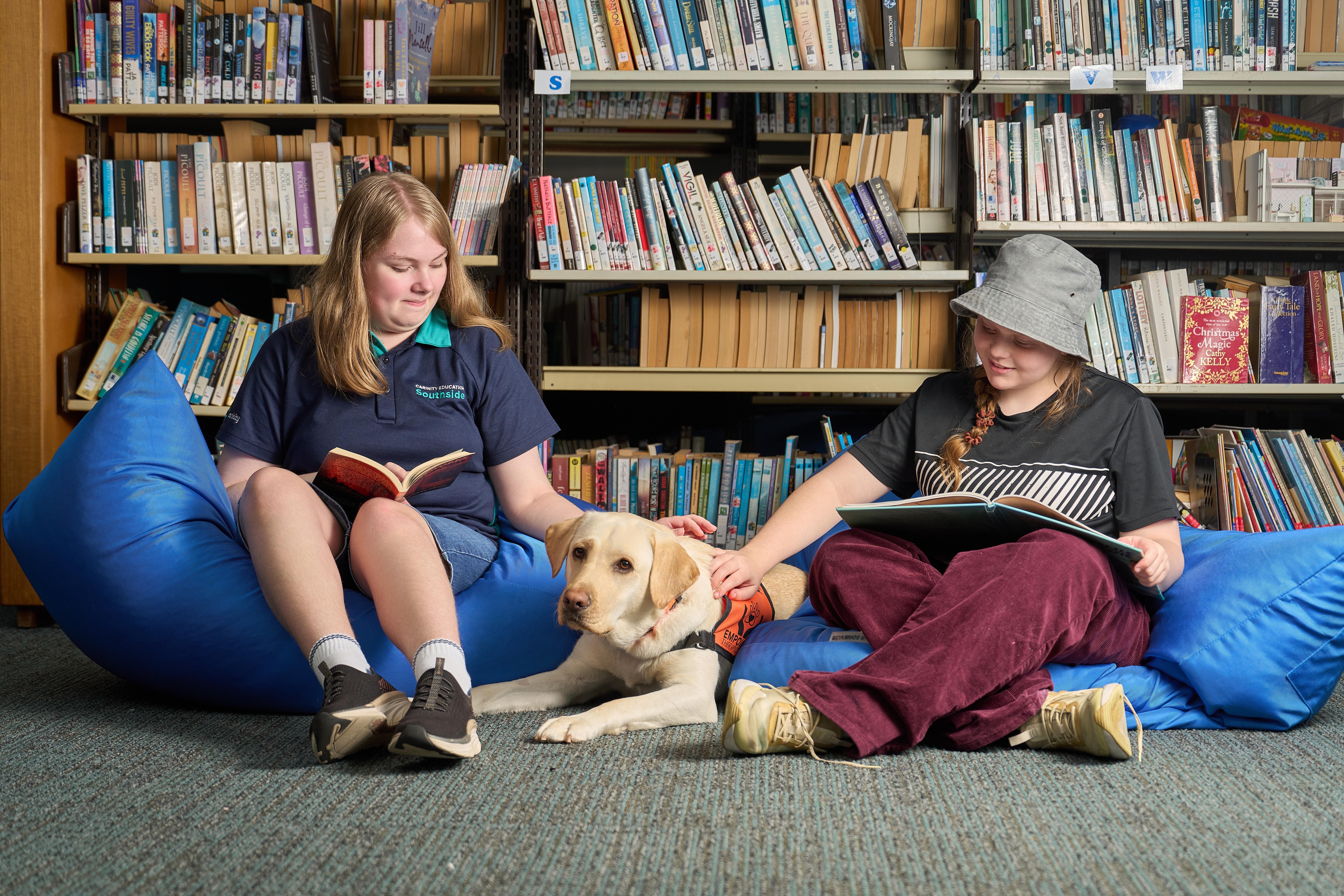
A Brisbane special assistance school has expanded its animal-assisted support program after a bequest funded the arrival of a second therapy dog. The addition builds on a growing body of practice showing how therapy dogs in schools can improve student wellbeing and emotional regulation in K–12 settings.
Now joining their first therapy dog, Tarmac, at Carinity Education Southside in Sunnybank, Queensland, is Sage (pictured above) — a 16-month-old Labrador funded by the bequest. The donation was left by a benefactor in her will, directed specifically toward improving student outcomes. The school caters to young women requiring flexible, non-traditional learning environments.
For principals weighing animal-assisted interventions, the Southside model demonstrates how a structured, dual-dog program integrates into everyday support staffing rather than operating as a separate initiative.
What does the research say about therapy dogs in schools?
The expansion reflects a widening body of evidence on animal-assisted interventions (AAIs) in educational settings. A 2025 PhD study from Monash University’s Faculty of Education found that therapy dogs in K–12 settings can support students’ social and learning engagement. The study also found benefits for emotional and behavioural wellbeing, alongside key safety and implementation guidelines for schools.
A 2024 study published in the journal Animals, conducted at the University of Queensland, Brisbane, found that animal-assisted education reduced anxiety and improved mood. It also recorded increased motivation and engagement among students.
For schools working with vulnerable cohorts, the evidence is particularly relevant. Research published in Animals suggests that consistent, structured contact with therapy animals can help children manage acute stress. This is evident at schools that have made therapy dog programs central to their student wellbeing strategy.
“The two dogs have helped to create a beautiful calmness over the school,” said Leann Faint, principal at Carinity Education Southside. Faint credited the animals with helping students de-escalate before returning to class. Both dogs greet students at the start and end of each day and visit classrooms throughout.
“Students are not as reactive and are able to request time with Sage and Tarmac if they need support in regulating,” Faint said.
Emotional regulation at the centre
Rather than functioning as a passive presence, the school’s therapy dogs are embedded in structured wellbeing support. Students experiencing heightened emotions are encouraged to spend brief time with one of the animals. This serves as a low-pressure reset that does not require verbal engagement before returning to class.
The school’s support team works alongside Sage throughout the day, giving students a direct point of contact when they need to regulate. Tarmac takes a complementary role, stationed in the first aid room for students arriving with signs of anxiety. For school leaders interested in practical strategies for prioritising mental health outcomes for students, this integration of animals into existing support structures is a model worth examining.
The Victorian Department of Education’s mental health support menu lists accredited therapy dog programs as approved interventions to improve student wellbeing, engagement, and social connection.
The listings stipulate that dogs work alongside qualified mental health professionals. This reinforces the position that therapy dogs in schools function best as part of a broader support framework.
Schools looking to scale mental health support further may also consider digital platforms that expand school-wide access to mental health services. This is a complementary option alongside animal-assisted approaches.
Empower Therapy Dogs supplied and trained Tarmac and has now provided Sage under the same program. As the evidence base for therapy dogs in schools strengthens, the Southside model offers a practical reference point for school leaders considering similar programs.