



For years, the case for getting phones out of classrooms has rested on gut instinct, principal surveys and before-and-after comparisons. Now one of the largest controlled experiments ever run on the question has been published.
The study, published in the journal Science, suggests that many Australian teachers have been right all along, at least up to a point.
A team from the Wharton School at the University of Pennsylvania, Jawaharlal Nehru University and the University of Copenhagen ran a semester-long trial across 10 tertiary institutions in Odisha, a state in eastern India. The trial involved 16,683 students, 742 teachers and more than 2,300 courses.
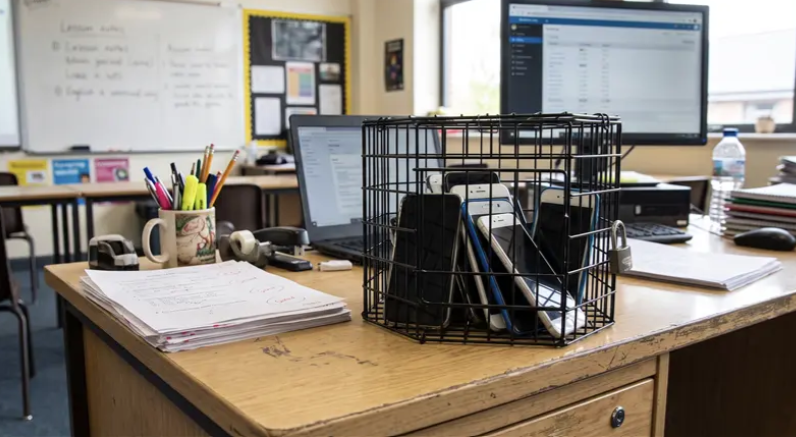
The method was simple. About 1,000 wooden deposit boxes, made from recycled materials, were installed in classrooms. Department-and-year cohorts were then randomly assigned. In the ban group, every student had to drop their phone into the box at the start of every lecture from February to May 2024. Students in the control group carried on as usual. Exceptions were allowed only for documented emergencies or caring responsibilities, and only if the student told the teacher beforehand.
Modest gains, aimed at the right students
By the end of semester, students in phone-free classes had grade point averages about 0.073 standard deviations higher than their peers, after accounting for prior results.
That may not sound like much. The authors point out, though, that large education trials typically produce effects of around 0.05 standard deviations. The gap between an average teacher and a very good one over a full year is roughly 0.20. So this is no silver bullet, but it is a respectable return for a policy that costs little more than a wooden box.
The detail that should interest school leaders most is who benefited. The gains were concentrated among students with below-median prior results and among first-year students. For high achievers, postgraduates and STEM students, the effect was close to zero. Grades in the ban group also became less spread out, which suggests the policy helped close gaps rather than widen them.
“Phone bans can cut achievement gaps,” lead author Alp Sungu told Knowledge at Wharton.
The ban did not change attendance, so the improvement seems to come from what happened inside the room rather than from more students turning up. The authors also addressed the obvious objection that teachers might simply have marked phone-free classes more generously. Between 60% and 80% of each course grade came from externally set exams, which were marked off-site by examiners who did not know students’ identities or which group they were in.

How much does a classroom phone ban lift grades?
Effect on student achievement, in standard deviations, compared with common education benchmarks
Source: Sungu, Choudhury & Bjerre-Nielsen, “Phones impede learning”, Science, 8 Oct 2026 (RCT of 16,683 tertiary students in Odisha, India). Benchmarks are approximate figures cited by the study authors from published meta-analyses.
Read next: The evidence is clear: Students learn better without mobile phones in class
Students came round to the idea
One common fear is that taking phones away breeds resentment. The trial found the opposite.
Among the 2,557 students surveyed, those who had experienced the ban became noticeably more supportive of restrictions. They were more likely to see restrictions as helpful and less likely to want a phone-free-for-all. Their self-reported wellbeing, motivation and sense of how much they were learning did not change. The main downside was a small rise in fear of missing out, mostly among male students.
Researchers also made unannounced spot checks through classroom windows. In phone-free rooms they saw fewer disruptions and less off-topic chatter. Teachers also used their own phones less, even though the ban didn’t apply to them.
There was one odd result. Observers rated students in the ban group as more distracted. The authors’ explanation is that once the main distraction is gone, attention drifts to smaller ones, like noise in the corridor, which are easier for an outsider to spot than a student quietly scrolling under the desk.
Read next: Neuroscientist: Fix foundations before fixing screentime
The Australian picture
Australia moved early on this issue. NSW extended its ban to public high schools from Term 4, 2023, and Queensland followed with a statewide ban covering phones and smartwatches.
A year after the NSW rollout, a Department of Education survey of almost 1,000 principals found 95% supported the ban, and 81% said learning had improved. “One year in it’s clear, this was the right decision,” Premier Chris Minns said at the time.
Those figures are perceptions, however, not controlled comparisons. The Indian trial is valuable because it shows cause and effect.
The international evidence is not all positive. In May, a National Bureau of Economic Research study of US schools using lockable Yondr pouches found that phone use on campus fell sharply. Average effects on test scores, however, were close to zero in the first three years. High schools saw modest gains, and student wellbeing dipped and discipline incidents rose in the first year before both recovered. Co-author Thomas Dee nonetheless urged policymakers not to abandon bans just because scores didn’t jump straight away.
Read next: Screen time surge driving rise in student behaviour problems – study
The authors are open about the study’s limits. Their participants were tertiary students averaging 19 years old, not schoolchildren. The trial tested lecture-only bans, not the bell-to-bell approach most Australian states use. It is also unclear whether the results would hold in wealthier countries, where students often carry a laptop or tablet as well as a phone.
The researchers suggest the effects could be even larger for younger students, given how strongly first-years responded. They acknowledge that this has not yet been tested.
That last caveat matters for Australian schools, because the debate here is already moving from phones to other screens. NSW will cap individual screen time in public schools from 2027, and Macquarie University-led research found that just 53% of NSW teachers agree digital devices help students learn.
Interestingly, students in the Indian trial also reported using other devices slightly less during phone-free lectures. That hints that one rule may shape wider habits, which is worth keeping in mind as schools rethink classroom tech in the age of limits.
For principals who have spent the past few years enforcing bans, the trial’s message is fairly reassuring. The policy is cheap, students warm to it once they’ve lived with it, and its benefits flow mainly to the kids who need them most. It won’t transform results on its own, but it seems to be a solid foundation.
Read next: Australia rethinks classroom screen time as scores slide