



As Australia's cities grow denser and land for new schools becomes harder to find, education leaders are being forced to rethink a long-held assumption: does a school really need a sprawling campus to thrive?
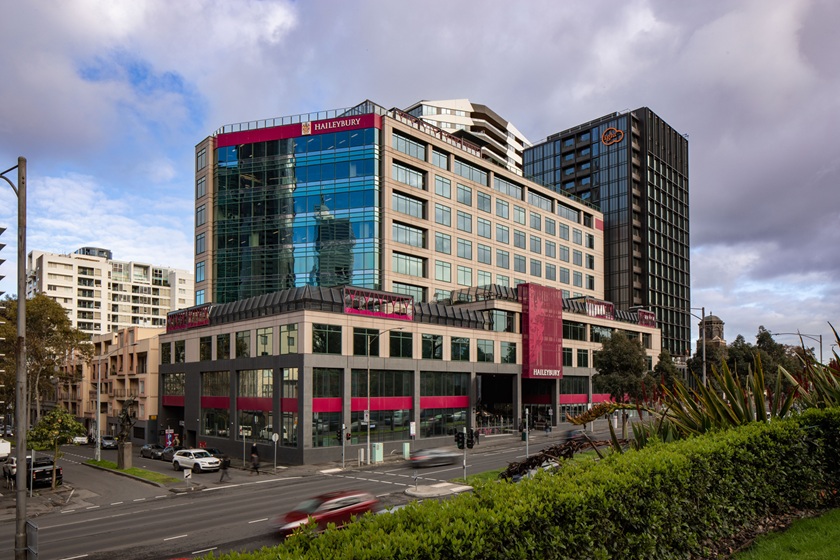
Ten years after opening Melbourne's first vertical school in the CBD, Haileybury City is offering a glimpse into what the future of urban education could look like.
With more multi-storey schools likely to emerge across Australia's major cities, educators are increasingly exploring how design, community partnerships and creative use of space can shape not only where students learn, but how they connect, belong and flourish.
Caroline Merrick has been Head of City at Haileybury since 2019. When asked if she has noticed students developing different habits, behaviours or ways of interacting with each other compared to what might be expected on a traditional campus, Merrick said the vertical campus had helped foster stronger connections between students of different ages.
“Being in the same campus and crossing paths as they move between levels, our City students work more closely across the different age groups,” Merrick told The Educator.
“Year 12 listen to Prep students read before school every week. Our Senior and Middle School students take an interest in what the younger students are learning, and the younger students are always inspired by our older [and very tall] students who proudly wear their uniforms full of badges and colours.”
Future-ready learning starts with culture
Merrick said schools often try to replicate what’s been done in the past, and that needs to change for the sake of learning and preparedness for the future.
“At City we don’t have bells – instead everyone keeps an eye on the clock, and students and staff work together to ensure everyone is on time because punctuality is part of our ‘Culture of Learning,’” Merrick said. “This helps students prepare for university and the workforce where time isn’t marked by a bell either.”
Merrick said thinking about students being ‘future ready’ requires challenging assumptions and empowering the school’s people to learn and lead.
“I think questioning the ‘why’ and being enterprising and entrepreneurial is a strength of Haileybury,” she said. “This is something every school could consider now and in the future.”
Merrick said the school looks for opportunities for its students to be part of the Melbourne community, particularly in the areas of culture and contribution.
“We support Melbourne City Mission and the Smith Family, we regularly have excursions to the NGV, Melbourne Museum, Chinatown, the Jewish Museum, Sea Life, the Immigration Museum, and Hamer Hall to hear the Melbourne Symphony Orchestra,” she said.
“The North Melbourne Rotary Club regularly attend our ANZAC and Remembrance Day assemblies in Flagstaff Gardens, which are open to the public. Connecting our students with the rich learning opportunities that are on our doorstep is intentional and rewarding for all.”
Connection by design, not by chance
Nathan Chisholm, Deputy Principal – Student Wellbeing at Haileybury, was the inaugural principal of Melbourne’s second vertical school, Prahran High School, which opened in Windsor in 2019. He said the research suggests vertical schools need to be intentionally designed around connection and belonging.
“In a vertical school, belonging doesn’t just happen through proximity, rather it should be intentionally designed. Schools are living ecosystems and are dynamic, relational and constantly evolving,” Chisholm told The Educator.
“The vertical school building itself doesn’t foster connection, but it is part of it, and we should design with this in mind.”
Chisholm said that from a design perspective, one of the more powerful choices is to create smaller, identifiable communities within the larger structure.
“These spaces can be all different shapes and sizes and they provide students a sense of home, familiarity and ownership in what may otherwise feel like an overly complex, multi-level environment,” he said.
“Transparency and visible sight-lines in buildings are important, too. Being able to see and be seen, as well as the settling beauty of natural light, also play a role in fostering connection.”
But architecture can only take you so far, Chisholm noted.
“In every school, the real work is cultural and in a vertical school, it’s even more important. Daily practices that prioritise relationships ultimately anchor belonging,” he said.
“In our vertical context, we invested deeply in relationships as our binding force, because in a vertical setting, connection is fundamental. We share space, students and staff and we genuinely leaned into that, with a commitment to ‘trust and responsibility.’”
Ultimately, said Chisholm, it is the “deliberate alignment” between pedagogy, people and place that ensures students feel known and connected.
“In recent years I’ve worked in partnership with colleagues from QLD and SA on a national research project led out of Queensland University of Technology,” he said.
“Working to better understand how students ‘thrive in vertical schools,’ our ground-breaking research will inform contemporary school and learning design into the future. It’s about designing for connection to enable young people to thrive. Our book will be published in 2027.”
Learning spaces that unlock new possibilities
In the most innovative vertical schools, the range and nature of the different learning spaces open enormous possibilities for interdisciplinary work, collaboration and enhanced student agency, said Chisholm.
“I often talk about the ‘pedagogy of place’ and it matters,” he said. “I look forward to seeing more adaptable environments that can be reconfigured easily, supporting direct instruction, virtual learning, collaborative inquiry, independent learning and creative production.”
Chisholm said that in a vertical context, where every square metre matters, this flexibility is both essential and innovative.
“Often, our vertical schools are a response to dense, urban environments. This will continue to be the case. This creates challenge but also immense opportunity, and vertical campuses, in urban environments, have access to so much in the community surrounding them,” he said.
“I’m excited to imagine even more genuine partnerships between school campuses, spirts fields, art galleries, business and technology hubs.”
The next challenge for vertical schools
When asked if there is a key lesson from leading international vertical schools that Australian education systems haven't fully embraced yet, Chisholm said Australia has built the structures, but the bigger opportunity lies in how schools use them.
“In Australia, we have made significant gains in building architecturally impressive vertical schools. But we can go further in our thinking as we make the cultural and pedagogical shift required to bring those spaces to life,” he said.
“We must still embrace evidence-based practices but also embrace the invitation vertical schools offer us to reimaging aspects of the whole school experience for our young people too.”
There is also perhaps a broader cultural lesson about embracing complexity rather than trying to simplify it, noted Chisholm.
“The most effective international models accept that layered, vertical schools are inherently dynamic, and they create cultures where learning by trying, adapting, and iterating is normalised,” he said.
“This requires investment in people, not just infrastructure. It requires trust, distributed leadership, and a willingness to be open to both ‘what works now’ and ‘what is next?’”