



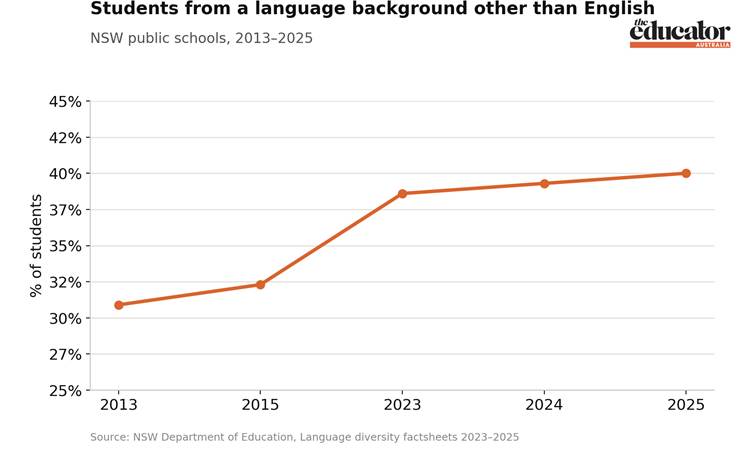
In NSW government schools, roughly forty percent of pupils come from a home where English isn't the only language spoken. That's the current enrolment data, not a hypothetical.
Now imagine a government legislating a hard ceiling on that number, class by class, school by school.
That's essentially what Italian Prime Minister Giorgia Meloni has announced over the weekend. It puts a stark version of a question every multicultural school system eventually has to answer: at what point does a diverse classroom stop being an asset and become, in a minister's own words, "neglect"?
What the Italian PM is proposing
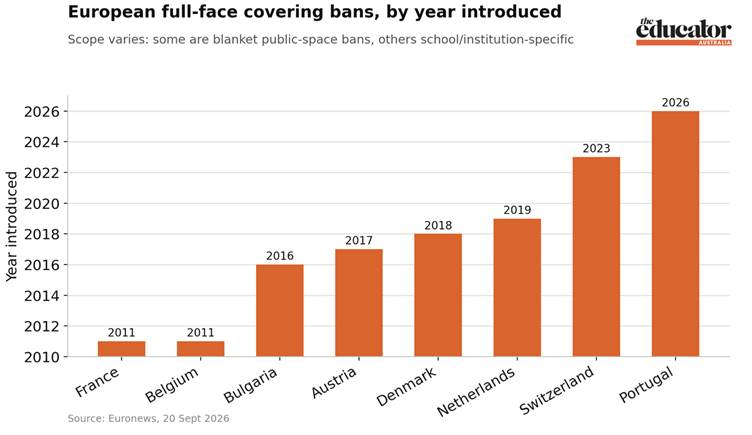
Speaking at a youth rally for her Brothers of Italy party, Meloni said her government will soon put a bill to Cabinet that does three things: sets a legal maximum on the number of foreign-born students allowed in any one class, requires parents of migrant children who are struggling to integrate to learn Italian, and bans full-face coverings specifically the burqa and niqab, not the hijab in schools, according to Reuters. "You must go to school with your face uncovered," she said.
Meloni didn't put a number on the class cap. Students who aren't Italian citizens make up 11.6% of the country's school population, according to research institute Fondazione ISMU. That compares with roughly 40% of NSW public school students who come from a language background other than English. The measures aren't identical (citizenship versus home language), but the gap shows how differently the same demographic reality can be read from one system to the next.
The person best placed to answer this has already tried it
Italy doesn't need to guess how a hard classroom works in practice. It's had an informal 30% quota on non-Italian pupils since a 2010 ministerial circular under then-education minister Mariastella Gelmini which was patchily enforced ever since, undermined by local demographics and a lack of spare classroom space in the neighbourhoods where migrant families actually settle.
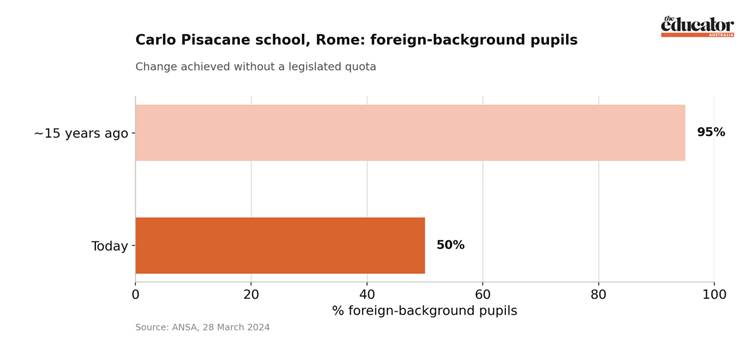
The Carlo Pisacane school in Rome's multi-ethnic Tor Pignattara district cut its ratio of foreign-background pupils from 95% to 50% over 15 years and is held up as an integration success story. Its head teacher, Rosanna Labalestra, has said a rigid cap of the kind some Italian politicians have floated would be "impossible to implement here," according to ANSA, since it would simply push families into other schools rather than integrate anyone.
It's the kind of gap between a policy number set in a minister's office and what's workable in an actual staffroom that any principal allocating classes in late January would recognise.
How other countries handle it
Italy's move sits inside a broader European debate about how, or whether, to manage the concentration of migrant-background students in individual schools:
- Denmark allows upper-secondary schools to cap enrolment of students of "non-Western origin" or from disadvantaged areas at up to 50%, and deliberately mixes classes by parental income.
- France can't legally do any of this. The Republic prohibits collecting statistics based on ethnicity or religion, so it manages concentration through "zoning," redrawing catchment boundaries to link disadvantaged and wealthier neighbourhoods.
- The Netherlands has had a narrower face-covering ban since 2019, covering schools, hospitals, government offices and public transport, rather than a blanket public ban.
- Austria already restricts full-face veils in public and will extend that from September 2026 to ban girls under 14 from wearing any Islamic head covering at school.
A 2019 Eurydice comparative report for the European Commission, mapping national approaches across 42 education systems, found most countries lean toward support measures such as language programs, staged curriculum access, and wellbeing services rather than hard enrolment caps. Italy's proposal sits at the harder end of that spectrum.
Legal pushback, even in Italy
Salvatore Curreri, a professor of constitutional law at the University of Enna, told the ANSA news agency that under Italy's constitution, "school is open to everyone," and warned that if the cap forced families to relocate their children far from home, it could undermine the integration it claims to protect. Green Europe MP Angelo Bonelli went further, accusing the government of chasing a far-right agenda instead of addressing what he called chronically low teacher pay.
How Australian schools handle the same problem (without a quota)
Australia has no equivalent cap and no serious push for one. The tools here are quieter and mostly funding- and staffing-based:
- Needs-based EAL/D staffing. NSW schools receive specialist English as an Additional Language or Dialect teacher allocations calculated from their own enrolment numbers, rather than a ceiling on how many such students they can take.
- Dedicated new-arrivals programs. Victoria's New Arrivals Program funds intensive English tuition and transition support for recently arrived migrant and refugee students, rather than limiting how many can enrol at once.
- Free interpreting, not language mandates. Rather than requiring parents to learn English as a condition of enrolment, the direction Meloni's bill takes with Italian, Australian schools can access free interpreting through the federal Translating and Interpreting Service.
- Enrolment zoning, not ethnic quotas. Where Australian schools do manage concentration, it's through geographic catchment zones tied to address, not caps calibrated to a student's background.
No Australian principals' body has responded specifically to Meloni's announcement it broke less than a day before publication, but the contrast in approach stands on its own.
Meloni's bill still has to clear Cabinet and then Italy's parliament. Curreri's constitutional warning, backed by a Rome principal's real-world experience of exactly this kind of quota, suggests it will face resistance even if it passes, a reminder of how far a government can go to legislate classroom composition, at a time when Australian schools are managing similar demographic shifts through entirely different, more localised tools.