




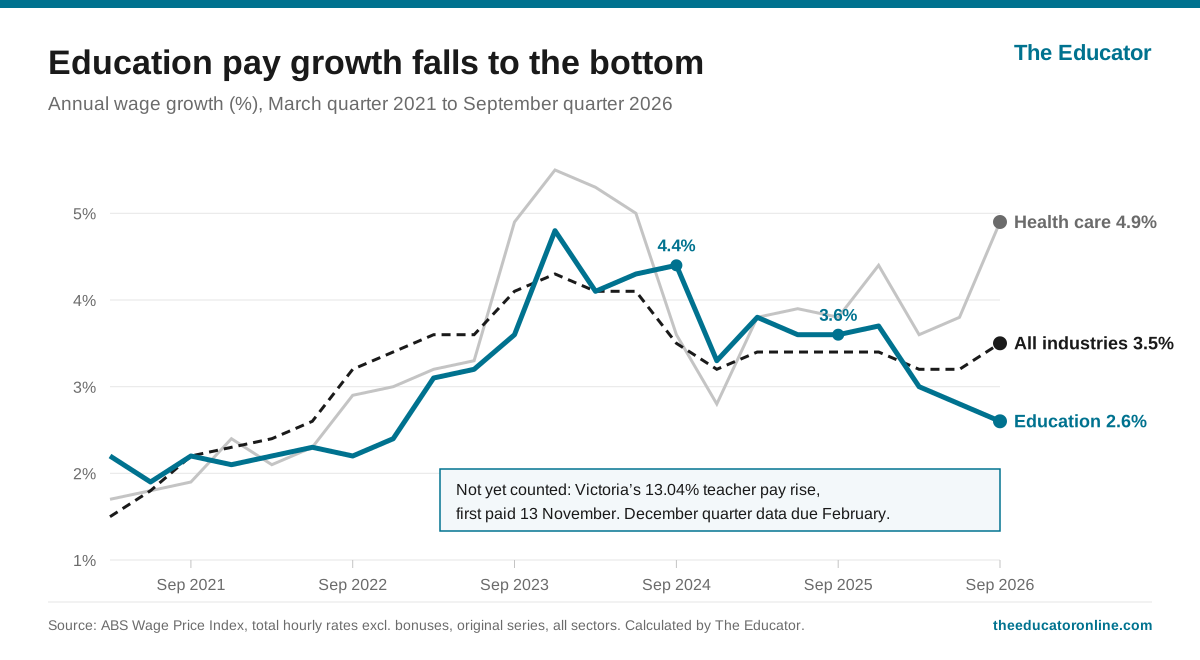
Pay in education grew more slowly than in any other part of the Australian economy over the past year, according to today’s figures from the Australian Bureau of Statistics.
Wages in education and training rose 2.6% in the year to the September quarter, the ABS Wage Price Index shows. That was the lowest result of the 18 industries the bureau tracks, and the sector's weakest annual growth since the December quarter of 2022, by The Educator's calculations from the ABS data.
Wages across the whole economy rose 3.5%. Consumer prices rose 3.9% over the same period on the ABS's quarterly measure, leaving education workers about 1.3 percentage points behind in real terms.
The slowdown has been steep. Education wage growth was about 4.4% two years ago and 3.6% a year ago.
Public sector education wages rose 2.5% over the year and private sector education wages 2.7%. In the September quarter alone, private education wages rose 1.0% and public education wages 0.7%.
Read next: Public school staff get big pay rise
Victoria's rise is still to come
The figures were collected before Victoria's new teacher pay deal took effect, so we’re not sure what effect that will have on figures yet.
Under Victoria's new agreement, public school teachers are receiving at least 13.04% this month, backdated to 10 August, with annual rises of 4% to 4.9% to follow through to 2029. The first increases were paid on 13 November.
The ABS measures pay for the last pay period ending on or before the third Friday of the middle month of each quarter, which for the September quarter fell in August. Backdated rises from state enterprise agreements are captured when they come into effect: in the June quarter of 2025, the ABS attributed a lift in public sector wages to exactly that, according to Westpac.
On that basis, the Victorian increase is likely to appear in the December quarter figures, due in February, and could lift education wage growth noticeably.
For now, Victoria's public sector wage growth across all industries was 2.9% over the year, equal lowest of any state or territory with the ACT.
"The outcome seen today has been won through the direct efforts of AEU members, who demanded pay and conditions that reflect the value and importance of their work in Victorian public schools," said Justin Mullaly, president of the Australian Education Union's Victorian branch, when the pay rise was announced.
Read next: Victorian teachers accept pay deal after 12-month dispute ends third strike threat
Falling behind health care
The gap between education and other public-facing professions has widened. Health care and social assistance wages rose 4.9% over the year, the fastest of any industry, boosted by state pay rises for nurses, midwives and other front-line workers.
"The main driver of public sector wage growth was pay rises for state government front-line workers covered by enterprise agreements. This included groups like nurses, midwives and police officers," said Rachael McCririck, the ABS head of prices statistics.
The ABS's education and training category covers schools, preschools, universities, TAFE and other adult education. Childcare centres are counted separately, under health care and social assistance.
Read next: Will more money stop teachers from leaving the profession?
What school leaders should watch
The Victorian deal changes the comparison between states. The Educator reported that experienced Victorian public school teachers now out-earn their NSW counterparts, and first-year teachers are level with them. Principals recruiting across state lines, particularly near the NSW-Victoria border, may see the effect first.
Independent and Catholic schools face their own pressure. Private sector education wages rose 2.7% over the year, below inflation, while government schools in Victoria are about to pay considerably more. Non-government schools that compete for the same teachers may need to respond at their next round of bargaining.
The December quarter figures will show how much of the gap the Victorian deal closes.
Read next: Why teacher pay has been dwindling for 30 years